




Which Engineering Plastics Are Best for Under-the-Hood Automotive Use?
Heat-stabilized, glass-fiber-reinforced polyamides are a strong starting point for many under-the-hood parts. PPA and PPS become stronger candidates as heat exposure, dimensional requirements, or fluid contact become more demanding. PEEK suits specialized components where sustained heat, chemical resistance, and mechanical performance justify its higher cost. The best choice comes from matching a specific compound to the component’s service conditions, rather than ranking resin families by their maximum temperature ratings.
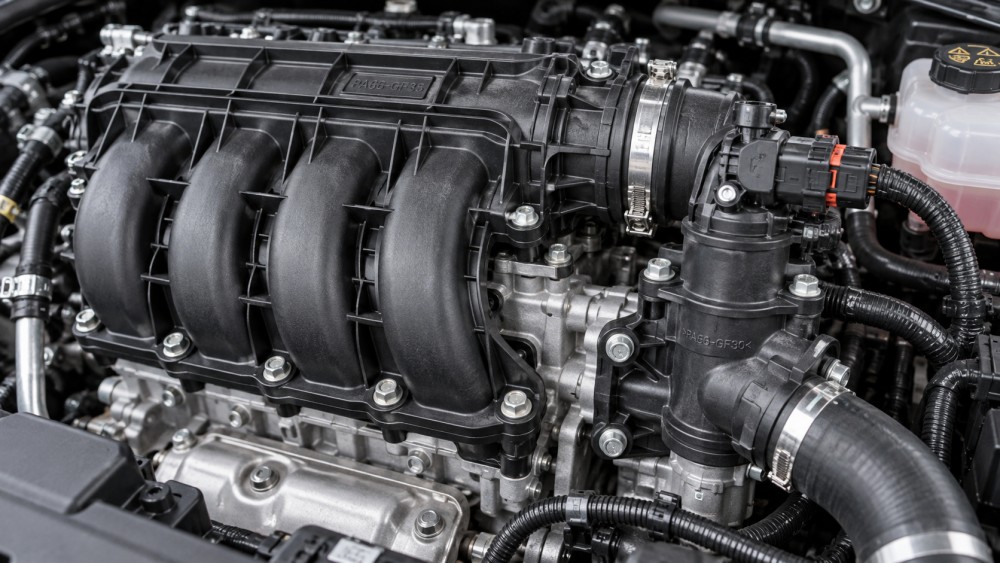
A coolant outlet, an intake manifold, and a connector near a turbocharger face different combinations of heat, pressure, vibration, and chemicals. Even within one assembly, the sealing surface may need dimensional stability while a mounting feature needs toughness. Those differences determine which material deserves consideration.
Which materials belong on the initial shortlist?
The following comparison identifies useful starting points. Each entry describes a material family; heat stabilizers, reinforcement, impact modifiers, and processing conditions determine the performance of the actual grade.
Location alone does not establish suitability. A shielded connector exposed mainly to hot air has a different duty cycle from a housing carrying pressurized coolant, even when both sit close to the engine.
When are PA6 and PA66 the best practical choice?
Reinforced PA6 and PA66 make sense when the application needs structural performance and moldable geometry without requiring a more expensive high-temperature polymer. Heat-stabilized grades are candidates for air-management parts, engine covers, mounting structures, and selected coolant components. PA66 generally offers a higher melting point than PA6, but that difference alone does not establish longer service life.
Heat stabilization and hydrolysis stabilization address different degradation mechanisms. A compound formulated to resist thermal oxidation in hot air is not automatically suitable for prolonged exposure to hot water-glycol coolant. A coolant component needs evidence for the relevant fluid formulation, exposure temperature, and mechanical load.
Polyamides absorb moisture. Conditioning changes dimensions, stiffness, and toughness, which affects sealing grooves, connector engagement, and assembly tolerances. A dry molded part can satisfy a dimensional inspection and later move outside the required fit after moisture absorption. Design calculations therefore need properties representative of the expected conditioning state.
Glass reinforcement reduces some dimensional changes and increases stiffness, but it does not remove moisture effects. For a bolted housing, creep beneath the fastener and stress around the boss deserve separate attention. Metal compression limiters can control assembly compression, although the surrounding plastic still has to survive temperature cycling and vibration.
What makes PPA worth considering over conventional polyamide?
Polyphthalamide, or PPA, covers several semi-aromatic polyamide chemistries. Many PPA compounds retain stiffness and strength at temperatures where conventional PA6 or PA66 compounds lose too much load-bearing capability. This makes PPA relevant to compact connectors, thin structural features, and housings with demanding sealing tolerances.
Its value becomes clearer when heat and mechanical loading occur together. A room-temperature tensile comparison can miss the reason for selecting PPA: a latch, flange, or fastening point must retain adequate stiffness while hot and after aging.
PPA still requires grade-level comparison. Water absorption and hydrolysis resistance differ among formulations. Lower moisture sensitivity than a conventional polyamide does not establish suitability for every coolant circuit. Processing also requires disciplined drying and appropriate mold temperatures. Poor moisture control during molding can reduce molecular weight, while unsuitable thermal conditions can affect crystallization and dimensions.
PPA earns its added cost when its retained properties solve an identified limitation. If a heat-stabilized PA66 grade already passes the component’s aging and load requirements, changing resin families may offer little practical benefit.
Is PPS the strongest choice for hot coolant and precision housings?
PPS is a leading candidate when low moisture uptake, chemical resistance, and dimensional consistency matter together. Reinforced PPS compounds are useful for pump structures, precision fluid housings, and electrical parts exposed to demanding thermal environments.
Its low moisture uptake simplifies some tolerance problems associated with polyamides. Sealing surfaces and locating features still require allowance for thermal expansion, molding shrinkage, and fiber orientation. Low water absorption does not guarantee a flat flange or uniform dimensions.
The main tradeoff is toughness. Highly reinforced PPS can be sensitive to sharp corners, installation damage, and concentrated loads. A housing that performs well under steady pressure could crack during hose installation or fastener tightening if the geometry concentrates stress.
Weld lines deserve particular attention. When melt fronts meet behind a hole or around an insert, the resulting region can be weaker than the surrounding material. Gate placement and mold filling influence whether that region lies across a pressure-loaded wall. A tensile value from a standard specimen does not represent this local weakness.
PPS also needs validation against the actual coolant chemistry and service cycle. Chemical resistance supports its selection, but long-term pressure retention still depends on the compound, molded structure, seals, and joint design.
When does PEEK justify its cost?
PEEK becomes relevant when a component must combine sustained heat exposure with demanding mechanical or chemical service. Examples include specialized bearing elements, thrust washers, and small components where failure or deformation would disrupt an assembly.
Wear performance requires more than selecting the PEEK resin family. Unfilled, glass-reinforced, carbon-reinforced, and lubricant-modified compounds behave differently. The mating surface, lubrication, contact pressure, sliding speed, and operating temperature determine which formulation is appropriate. Glass reinforcement can increase stiffness while creating an unsuitable wear interaction with a particular counterface.
PEEK requires processing equipment and tooling capable of its high melt and mold temperatures. Crystallinity, fiber orientation, and molding conditions affect dimensions and performance. Its cost is easiest to justify when a lower-cost material fails a defined requirement, or when the component’s small material volume makes reliability more significant than resin price.
Which temperature rating actually matters?
Melting point and heat-deflection temperature do not establish the allowable continuous operating temperature of a finished component. Melting point describes a transition in the polymer. Heat-deflection temperature measures deformation under a specified short-term test load. Neither directly predicts years of exposure to heat, fluids, vibration, and assembly stress.
A useful temperature specification separates sustained operation, repeated peaks, and brief exceptional events. It also identifies where temperature is measured. Engine-bay air temperature can differ substantially from the wall temperature of a part beside a hot metal surface or carrying heated fluid.
Heat soak after shutdown deserves attention because airflow and active cooling can decrease while nearby metal remains hot. A component may reach its most demanding thermal condition after the engine stops. Temperature cycling also creates repeated expansion differences between plastic, metal inserts, seals, and fasteners.
Long-term aging data should connect temperature and exposure duration to a relevant retained property, such as elongation, strength, or electrical performance. An allowable temperature based on one property cannot automatically support a different function. A housing can retain useful stiffness while losing the ductility needed to survive vibration.
How do fluids and reinforcement change the answer?
“Oil resistant” or “coolant resistant” is too broad for final selection. Engine oil, transmission fluid, fuel, cleaning agents, and water-glycol coolant present different chemical environments. Fluid additives and contamination can alter compatibility. Occasional splash exposure also differs from continuous internal contact under pressure.
Fluid testing should evaluate more than visible appearance. Mass change and swelling reveal uptake, but retained strength, elongation, dimensions, and seal integrity show whether the component still functions. A specimen can look intact after immersion while having lost substantial resistance to cracking.
Reinforcement increases stiffness and helps control creep, yet it introduces directional behavior. Fibers align with melt flow, so strength, shrinkage, and thermal expansion vary across a molded part. This matters around circular seal grooves and broad flanges, where uneven movement can create leakage.
Increasing glass content is therefore not an automatic durability improvement. Reduced ductility can make snap features or thin mounting tabs more vulnerable. The useful reinforcement level is the one that supports the required stiffness while preserving adequate toughness and molded-part integrity.
What evidence should support the final grade selection?
Validation needs to reproduce the interaction that could cause failure. Separate heat-aging and immersion results are useful screening tools, but they can miss damage produced by simultaneous temperature, fluid exposure, and stress. Pressure pulsation in a hot coolant housing is one example; vibration under sustained bolt preload is another.
A focused validation plan should include:
- Properties after representative aging. The fluid, temperature, duration, and conditioning state should match the intended service closely enough to support a meaningful comparison.
- Pressure retention and leakage testing on molded components, including thermal cycles and pressure pulses where those loads occur.
- Assembly-related loading: installation torque, hose forces, insert stresses, and vibration at mounting points. These loads often expose weaknesses that material coupons miss.
- Dimensional measurements after molding, conditioning, and aging, with particular attention to seal grooves, flange flatness, and connector fits.
Processing history belongs in that evidence. Insufficient drying can degrade susceptible polymers during molding; excessive residence time can damage heat-sensitive formulations. Gate location, weld lines, and fiber orientation can change component performance even when the resin grade remains identical.
A proposed substitute should therefore be compared using the actual formulation and relevant molded geometry. Matching the polymer name, glass content, and room-temperature tensile strength leaves important differences unresolved. The specification becomes useful when it connects the chosen grade to retained performance, controlled molding conditions, and the component’s demonstrated service limits.
Have questions about this sector analysis, or seeking best practices specific to your niche? Drop us a line below and let the senior consultants at APIM assist you.
We respect your privacy. Your information is strictly confidential.
Related News
- 00
0000-00
How does washing affect contamination in post-consumer recycled PP resins? - 00
0000-00
How does feedstock affect depolymerization equipment selection? - 00
0000-00
US Sets 213.44% Preliminary Antidumping Deposit on Chinese PTMEG - 00
0000-00
When should epoxy be used as a thermal interface material for semiconductors? - 00
0000-00
US Midterm Results Unlikely to Quickly Shift Recycled Plastics Market or Legislation