




Where Used Sheet Extrusion Lines Can Reduce Capital Risk in Expansion
Expansion Decisions Are Becoming More Conditional
A sheet producer may have a clear commercial reason to add capacity but still face an uncomfortable capital decision. Demand may be growing in one packaging format, a customer may be requesting shorter lead times, or an existing line may be operating close to its practical limit. Yet the projected volume can remain uncertain, resin costs may move sharply, and the cost of a new extrusion line can tie up funds long before the additional output is fully sold.
In that setting, a used plastic sheet extrusion line can reduce capital risk when it is treated as an operating asset to be verified, rather than as a low-price substitute for new equipment. The relevant question for a financial approver is not whether a second-hand line is cheaper at purchase. It is whether the line can produce saleable sheet at a predictable cost, with an acceptable installation timeline and a limited exposure to unplanned repair, quality loss, or obsolete controls.
Used equipment is most useful when an expansion project has a defined production need but does not justify the financial commitment, delivery lead time, or specification complexity of a new-build line. It is less suitable where the business case depends on a highly specialized product, tightly integrated automation, or performance guarantees that cannot be validated before purchase.
Where a Used Line Can Change the Capital Profile of an Expansion
Sheet extrusion capacity is often added for reasons that do not require a completely new process design. A converter may need more PP or PS sheet for thermoforming, a packaging producer may need an additional PE sheet stream, or a processor may want to separate a stable commodity product from a more variable development program. If the required material family, sheet width, thickness range, and output profile are already understood, a used line may offer a shorter route to capacity than a new system specified from the ground up.
The financial benefit comes from lowering the amount of capital committed before the commercial case has matured. A lower acquisition cost can preserve working capital for resin inventory, dies, tooling, utilities upgrades, installation, and customer qualification. Those costs are frequently underestimated when an equipment request is presented as a single machine purchase.
Used lines can be particularly relevant in the following situations:
- Capacity bridging: Existing demand has exceeded available production time, but the company is still deciding whether demand will remain durable enough to support a larger long-term investment.
- Replacement of a constrained legacy asset: A plant has a line with recurring downtime, poor energy performance, limited spare parts availability, or insufficient width for current orders. A sound used replacement may remove an operational bottleneck without forcing a full modernization program at once.
- Dedicated production for stable grades: A line can be assigned to repeatable products with known formulations and limited gauge variation, leaving a newer or more flexible line for higher-value work.
- Regional production expansion: A business opening or enlarging a site may need local supply capability before it has enough demand visibility to approve a fully customized installation.
- Recovery and reallocation of capacity: Some plants can use a used line to bring outsourced sheet production in-house, provided internal demand is sufficiently stable and the resulting fixed-cost base has been modelled realistically.
None of these situations makes used machinery automatically low risk. They merely create conditions where the gap between “sufficient capacity” and “maximum available specification” matters. Financial discipline begins with matching the line to the revenue model, rather than approving equipment because its purchase price appears attractive.
The Cost Comparison Must Extend Beyond the Purchase Order
The visible price of a used sheet extrusion line is only one part of the investment case. A new line may include engineering support, defined performance criteria, current controls, commissioning assistance, and an agreed scope of supply. A used line may require more effort to define what is included and what must be added. That does not remove its value; it changes the due-diligence burden.
For a finance team, the better comparison is the expected installed cost and the expected cost of producing acceptable sheet over the period in which the asset will be used. This includes the probability of additional spending, not just the most optimistic budget.
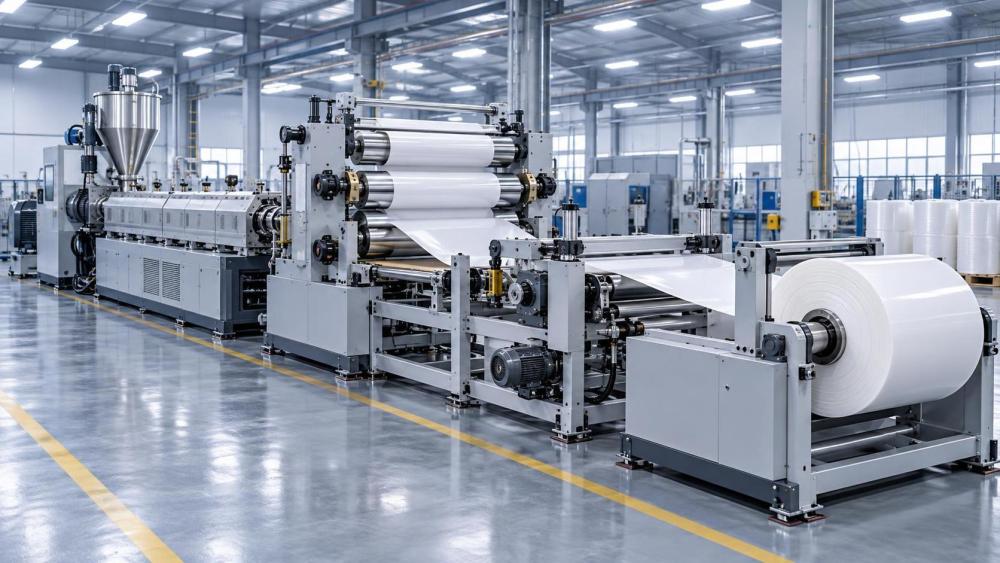
A project should also distinguish between a line that is operationally complete and a collection of major components. An extruder, roll stack, haul-off, winder, screen changer, dosing equipment, chillers, and controls may be commercially described as a line, while their actual integration status differs substantially. The financial model needs a clear scope list, including auxiliaries and any missing interface equipment.
Condition Matters More Than Age Alone
Age is a useful starting point, but it is not a reliable measure of remaining value. A well-maintained line with documented operation, available spares, and a conventional control architecture may be easier to return to production than a younger line that has suffered corrosion, unstable processing conditions, poor maintenance, or long idle storage.
Condition checks should focus on the components that determine uptime, melt quality, thickness control, and safety. For the extrusion section, buyers typically need information on screw and barrel condition, gearbox history, motor and drive status, heater zones, cooling arrangements, and the state of any melt pump or screen changer. Wear in these areas can affect output consistency and contamination control, while major repairs can materially change the capital case.
The downstream equipment requires equally close attention. Roll surfaces, bearing condition, temperature-control circuits, gap adjustment, and alignment influence sheet flatness, surface finish, and gauge stability. A roll stack that cannot maintain temperature uniformly may be unsuitable for applications where appearance, rigidity, thermoforming behaviour, or controlled thickness is important. Winders and haul-off systems need review for tension control, reel handling, shaft configuration, and compatibility with the buyer’s intended roll sizes.
Control systems deserve separate scrutiny. Obsolete drives, unavailable programmable controllers, undocumented wiring modifications, and damaged operator interfaces can turn a mechanically sound line into a difficult commissioning project. A control retrofit may be sensible, but it should be budgeted as a defined scope with downtime, engineering, and validation included. It should not be treated as a minor contingency.
Material and Product Fit Determine Whether the Asset Is Useful
A line that has processed PP, PE, ABS, or PS sheet may appear broadly flexible, but its practical fit depends on the product recipe and downstream requirement. Material behaviour varies with melt temperature, viscosity, moisture sensitivity, filler loading, regrind content, and the need for drying or dosing. A producer of basic opaque sheet may accept a different process window from a supplier making cosmetic-grade sheet, multilayer structures, or sheet intended for demanding thermoforming operations.
Financial approval should require a concise product-fit document. It does not need to predict every future order. It should establish the intended material family, target widths, typical thickness range, expected output range, colour-change frequency, acceptable percentage of regrind, and the quality characteristics that customers actually inspect. A line matched to the stated production window is more valuable than a nominally versatile line that requires extensive modification for each order.
This is also where equipment listings can assist preliminary screening. A reference such as Machinery Reborn is relevant when procurement teams are comparing the stated configuration of used PP, PE, ABS, or PS sheet extrusion equipment against their own material and product requirements. The listing should not replace technical verification, but it can help identify the major equipment elements and questions that need to appear in a request for information.
Supplier Checks Should Be Structured Around Evidence
Used-equipment transactions carry a higher information gap than a conventional new-machine purchase. The buyer often has incomplete access to operating records, and equipment may have been removed from service for reasons that are not immediately visible. A disciplined supplier review reduces uncertainty by converting general claims about condition into documents, inspection opportunities, and contractual clarity.
A useful review normally covers the machine identification details, build year where available, serial numbers, configuration, maintenance records, photographs of key sections, and information on whether the line is installed, powered, dismantled, or stored. If a live inspection is possible, it should examine the condition of electrical cabinets, motors, pipes, rollers, guarding, and accessible mechanical parts. If a production demonstration is offered, it should be evaluated against the buyer’s own requirements rather than against a generic statement that the machine “runs.”
When the line cannot be operated, the approval case should be more conservative. The allowance for refurbishment, missing items, and commissioning delays should rise accordingly. The contract documentation should define the included equipment, condition representation, packing responsibility, transfer point, available technical files, and any agreed inspection record. Ambiguity at this stage often becomes a cost dispute after shipment.
Questions that expose hidden scope
- Is the die included, and does its width and lip condition suit the intended sheet range?
- Are chill rolls, temperature controllers, dosing units, dryers, granulators, and edge-trim recovery equipment part of the package?
- Has the line been disconnected, and are cables, pipes, sensors, guards, and control cabinets identified for reassembly?
- Which manuals, electrical drawings, parameter backups, and spare-part lists are available?
- Can local technicians support the installed drives, motors, and automation hardware?
- Does the plant have the electrical capacity and utility infrastructure required for the line’s intended output?
How Financial Approvers Can Set a Practical Decision Gate
The strongest approval process does not require certainty about every technical issue. It requires explicit treatment of uncertainty. A used-line proposal is more credible when it shows a base case, a realistic installed-cost case, and a downside case that includes additional refurbishment or a delayed start-up. Management can then assess whether the capacity project remains worthwhile if the line needs work before reaching stable production.
Project sponsors should separate costs that are essential to operation from optional upgrades. Safety guarding, utility connection, basic controls restoration, and worn critical components usually belong in the required budget. Cosmetic refurbishment, convenience automation, or future-capacity modifications may be evaluated separately. This distinction prevents an apparently inexpensive line from accumulating unapproved scope after arrival.
Approval conditions can also be staged. A company may authorize inspection and technical assessment before committing to final purchase, then release installation funds only after the scope, site readiness, and product-fit assumptions have been confirmed. Such gates are especially useful when a project is intended to test a market, relieve a short-term capacity constraint, or replace a line whose failure risk is becoming difficult to manage.
Used sheet extrusion lines reduce capital risk most effectively when they support a narrow, well-defined expansion need: stable products, known materials, available utilities, and a realistic route to commissioning. They are less compelling when the project relies on exceptional output, intricate multilayer structures, demanding surface requirements, or unknown future product mixes. In those cases, the apparent saving at acquisition can be outweighed by adaptation and qualification costs. The sound decision is not driven by whether the equipment is new or used, but by whether its condition, configuration, and total installed cost fit the level of commercial certainty behind the expansion.
Have questions about this sector analysis, or seeking best practices specific to your niche? Drop us a line below and let the senior consultants at APIM assist you.
We respect your privacy. Your information is strictly confidential.
Related News
- 00
0000-00
Do polyolefin hot melt adhesives bond well to polyethylene? - 00
0000-00
Korean Study Finds PLA Barely Degrades in Landfill After 320 Days - 00
0000-00
How to assess batch consistency from a thermal potting compounds supplier - 00
0000-00
How much weight can carbon fiber reinforced plastics save in cars? - 00
0000-00
Switching from PS to ABS Sheet Extrusion: Equipment Checks