




When reinforced thermoplastics make sense for lightweighting in Africa
Reinforced thermoplastics make sense for lightweighting when a metal part carries more mass than its actual load path requires, when corrosion or electrical isolation complicates the metal design, and when injection molding can consolidate several functions into one component. The substitution case is strongest for housings, covers, brackets, air-management parts, fluid-system components, electrical enclosures, machine guards, agricultural equipment parts, and interior or semi-structural assemblies where stiffness, impact behavior, heat exposure, and fastening loads are understood together.
For reinforced thermoplastics Africa applications, the material choice should begin with the operating condition rather than a comparison of tensile strength values on a datasheet. A glass-fiber-reinforced polyamide, polypropylene, PBT, or polycarbonate blend can deliver substantial weight reduction against steel or cast metal, but each family responds differently to humidity, heat cycling, fuel or oil contact, ultraviolet exposure, and long-term loading. Replacing a metal component without reconsidering geometry, joint design, and molding direction often transfers a problem rather than solving it.
Where the lightweighting case is technically credible
A reinforced polymer is a good candidate when the part can use shape to create stiffness. Ribs, closed sections, gussets, curved walls, and locally thickened load zones allow a lower-density material to compensate for lower elastic modulus than steel or aluminum. This is especially useful where a metal part was previously stamped, welded, machined, or assembled from several pieces. An injection-molded component can integrate clips, cable routing, sealing grooves, locating features, bosses, and protective covers, reducing both mass and assembly interfaces.
Corrosion exposure can strengthen the case. Equipment used near coastal areas, in humid climates, around fertilizers, wash-down chemicals, or in dusty outdoor conditions may need coatings, paint repair, or isolation measures when made from metal. A correctly selected reinforced thermoplastic avoids red-rust concerns, although it is not automatically resistant to every chemical. Polyamide can be affected by moisture uptake and certain aggressive media; polypropylene has different limits under elevated heat and sustained mechanical load; polyesters need review where hydrolysis or high-temperature water exposure is present.
Electrical and thermal separation are also frequent reasons to replace metal. Reinforced polymers can combine structure with electrical insulation in battery-adjacent housings, cable-management systems, switchgear covers, pump components, and electronics supports. The same property becomes a limitation when the original metal component was intended to dissipate heat. In that situation, a thermally conductive compound, a metal insert, an enlarged cooling path, or a revised assembly may be required. Treating thermal conductivity as an afterthought can produce a part that passes bench loading but fails during repeated service cycles.
Weight reduction alone is not enough to justify a conversion. A simple flat metal plate that relies on its thin-wall stiffness may need a larger polymer section, more mold space, and a redesigned attachment method. If the revised part is too bulky for the available envelope, or if the load is concentrated at a narrow bolted joint, metal may remain the more rational material.
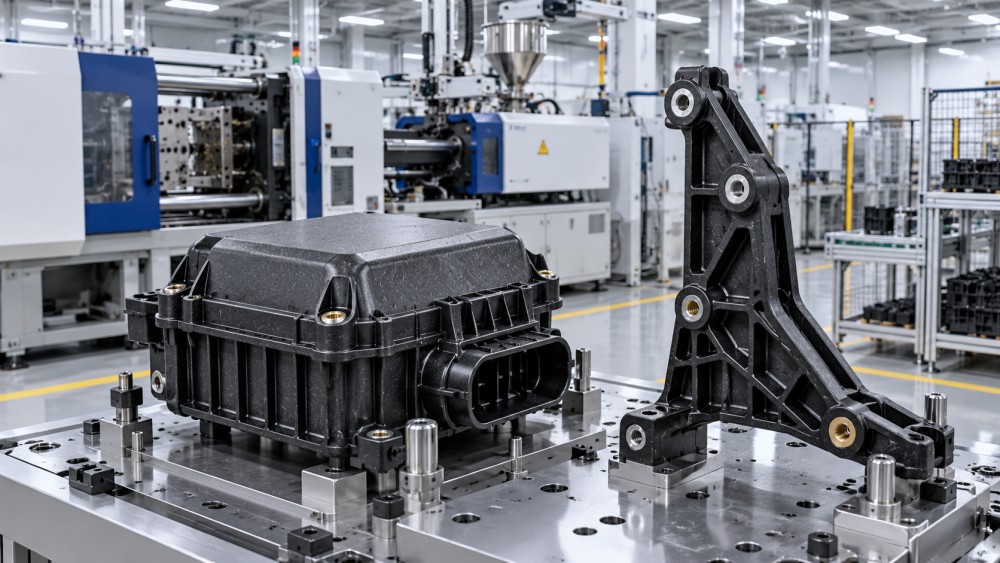
Reinforcement changes the material, not just the strength figure
Glass fiber is commonly selected where stiffness, dimensional stability, and load-bearing performance are needed. Yet fiber reinforcement introduces directional behavior. During molding, fibers tend to align with melt flow. Strength and stiffness are therefore higher in some directions than others, while weld lines, knit lines, and flow-front transitions can become weak regions. A bracket that performs well in a simple tensile specimen orientation may crack at a weld line around a hole or at a rib intersection in the actual part.
Mineral reinforcement can improve dimensional control, reduce shrinkage variation, and provide a more balanced response across directions. It is often useful for covers, housings, and parts where flatness matters more than maximum structural strength. Its density and mechanical profile differ from glass-fiber-filled grades, so it should not be treated as a direct substitute simply because both are described as reinforced. Hybrid formulations can balance warpage control with stiffness, but the resulting behavior still depends on the base resin and molding conditions.
Carbon-fiber compounds offer high stiffness at relatively low density, but they bring different concerns: electrical conductivity, surface appearance, abrasiveness, cost exposure, and processing control. Their value is usually confined to compact parts with severe stiffness requirements or where the section cannot be enlarged. For many industrial lightweighting projects, glass-fiber-reinforced engineering plastics provide a more workable balance of performance, moldability, and part economics.
Do not compare metals and polymers by tensile strength alone
The design question is usually deflection under load, not ultimate tensile strength. A reinforced thermoplastic can have impressive short-term strength and still deflect more than a metal part because its modulus is lower. That deflection may be acceptable in a cover, duct, enclosure, or non-precision support; it may be unacceptable where alignment, sealing compression, gear mesh, optical position, or belt tension must remain stable.
Creep deserves early attention because it can alter the result without visible fracture. Under constant force, polymer chains gradually rearrange, and reinforced grades only reduce rather than eliminate this tendency. Elevated temperature accelerates the effect. A mounting tab, clamp, or bolted flange may remain intact while losing the pressure needed for a seal or allowing unwanted movement. Long-duration loading should therefore be represented during evaluation, with the actual temperature range and assembled stress state.
Humidity also changes the interpretation of polyamide results. Moisture absorption can improve toughness but reduce stiffness and modify dimensions. A dry-as-molded specimen and a conditioned part do not behave identically. Where a polyamide component must hold a tight tolerance or retain clamping force, the expected moisture condition must be defined before dimensions, test results, and assembly settings are accepted.
Geometry determines whether reinforcement becomes an advantage
A metal-to-polymer conversion rarely succeeds as a one-for-one geometry copy. Metal can tolerate thin sections and sharp formed features that are unsuitable for molded reinforced resin. The polymer design needs controlled wall transitions, draft, smooth radii, reasonable rib thickness, and flow paths that place weld lines away from highly loaded regions. Thick, isolated sections should be avoided because they can create sinks, internal stress, uneven cooling, or poor surface quality.
Ribs are useful only when they support the load path. Adding many ribs without considering melt flow can increase warpage and create difficult mold filling. The fiber orientation caused by those flow paths may make a nominally symmetrical part behave asymmetrically after molding. A large flat cover, for example, can bow because orientation, cooling rate, and shrinkage differ between regions. Material grade selection and gate location must be considered together; neither is a final adjustment after the other has been fixed.
Fastening details need the same redesign discipline. Thread-forming screws in reinforced resin can work for serviceable covers, but repeated removal, high clamp loads, and high operating temperature require careful assessment. Metal inserts can improve durability, though the insert geometry and installation method influence local stress. Through-bolts with large bearing surfaces may distribute load better than a small washer against a molded boss. Isolation between a polymer part and a metal frame may also be required where differential thermal expansion could create stress or loosen a joint.
Processing quality is part of the material decision
Reinforced grades are sensitive to processing consistency. Moisture control is particularly important for hygroscopic engineering resins. Inadequate drying can reduce molecular weight during molding, weakening the finished part even when its appearance seems acceptable. Excessive residence time, unsuitable melt temperature, poor venting, and degraded regrind control can create variability that is mistaken for a design defect.
Fiber-filled compounds are abrasive. Gates, screws, barrels, nozzles, and mold surfaces experience greater wear than with unfilled resin. That does not invalidate the material choice, but tooling and maintenance assumptions should match the compound. Fine cosmetic textures near high-flow regions may degrade over production runs, and tight dimensions around gates or moving mold components may need closer monitoring.
Color changes, surface streaking, or gloss variation should not be dismissed as purely visual when they appear alongside changing fill pressure or warpage. They can signal inconsistent drying, dispersion, contamination, or a process window that is too narrow. Conversely, a cosmetic surface imperfection does not necessarily indicate a structural issue. The response should follow the observed mechanism rather than assuming every visible defect has the same cause.
A practical route to material-process fit
Start with the functional requirement of the finished assembly: load direction, permitted movement, service temperature, chemical contact, expected weathering, electrical requirements, and attachment method. Then identify which requirements are continuous and which occur only during unusual events such as impact, pressure spikes, transport vibration, or maintenance. This separates a true structural need from a short-term handling load.
Next, compare candidate material families at the relevant condition rather than at a single room-temperature state. Glass-fiber-reinforced polyamide may be appropriate for a heat-exposed structural part where toughness and strength are needed. Reinforced PBT can suit electrically sensitive housings with dimensional demands. Reinforced polypropylene can be attractive for chemically exposed, lower-temperature equipment components where moisture resistance and lower density matter. The final grade still depends on the exact environment, geometry, and molding route.
- Use the actual part geometry in simulation or physical trials, including ribs, holes, weld lines, inserts, and mounting interfaces.
- Review deformation after temperature exposure and sustained loading, not only immediately after molding.
- Evaluate the assembled joint: torque retention, gasket compression, clip engagement, and contact with adjacent metal parts often determine acceptance.
- Define a realistic moisture state for polyamide and other moisture-sensitive resins before dimensional or mechanical comparisons are made.
- Record molding conditions during trial production so that a favorable prototype result can be reproduced after the tool moves into regular use.
Material availability and batch consistency also affect the practical choice. A grade with exceptional laboratory properties has limited value if it requires a narrow processing window that the available molding operation cannot reliably maintain. Before release, the material specification should identify the approved resin family, reinforcement type, color or additive package where relevant, moisture-handling requirements, permitted regrind policy, and the critical dimensions linked to function.
Reinforced thermoplastics are most compelling where design freedom can be used to create stiffness, integrate functions, resist the relevant environment, and simplify assembly. They are less suitable where compact geometry, very high continuous temperature, extreme clamp loads, or stringent long-term dimensional stability leave no room to redesign the part. The sound choice comes from evaluating the material, molded geometry, processing route, and installed condition as one system.
Have questions about this sector analysis, or seeking best practices specific to your niche? Drop us a line below and let the senior consultants at APIM assist you.
We respect your privacy. Your information is strictly confidential.
Related News
- 00
0000-00
Do polyolefin hot melt adhesives bond well to polyethylene? - 00
0000-00
Korean Study Finds PLA Barely Degrades in Landfill After 320 Days - 00
0000-00
How to assess batch consistency from a thermal potting compounds supplier - 00
0000-00
How much weight can carbon fiber reinforced plastics save in cars? - 00
0000-00
Switching from PS to ABS Sheet Extrusion: Equipment Checks