




When does glass reinforced PBT make sense for thin-wall parts?
Thin-wall plastic parts often look simple on a drawing and difficult in real production. A connector shell, relay housing, clip body, sensor frame, or compact actuator piece may only have a small amount of material to carry load, hold alignment, survive heat, and still fill the mold cleanly. That is usually the point where material selection turns from a routine resin choice into a trade-off discussion.
Many teams run into the same question after a first round of part reviews or mold trials: should the part stay with unfilled PBT, move to another engineering plastic, or switch to glass reinforced PBT? The confusion is understandable. Reinforcement can improve stiffness and dimensional control, but it can also reduce flow, increase anisotropy, affect surface appearance, and create wear concerns in tooling and equipment. For thin-wall parts, those trade-offs show up quickly.
If you are evaluating a thin-wall application, the practical question is not whether reinforcement is “better” in general. It is whether the added glass gives enough value in the exact part geometry, operating environment, and molding window to justify the processing penalties. That decision usually becomes clearer when you stop looking at the resin grade first and start with the failure risks the part must avoid.
Where the material starts to make sense
In thin-wall designs, the base challenge is that there is less section thickness available to resist deformation. A part that looks acceptable in CAD can still bend too easily during assembly, creep under load, shift alignment after heat exposure, or warp enough to interfere with fit. Unfilled PBT already has useful electrical and processing characteristics, but once the wall becomes narrow and the tolerance stack becomes tight, its natural stiffness may not be enough.
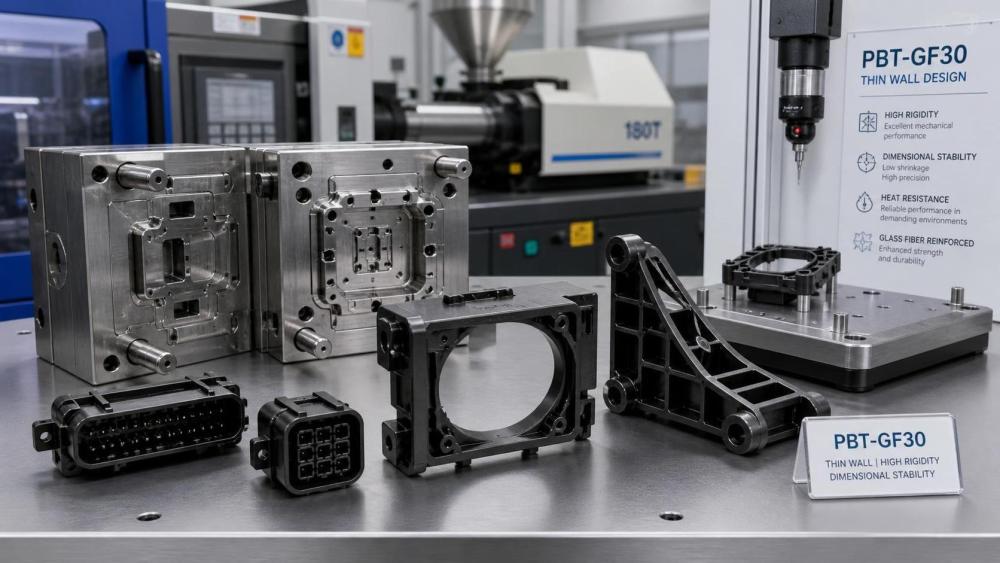
That is where glass reinforced PBT usually enters the conversation. It often makes sense when a thin-wall part must keep its shape under mechanical stress, maintain dimensions over temperature changes, and still offer the processing familiarity of a PBT-based system. This is common in electrical connector bodies, coil formers, switch components, motor-adjacent parts, compact industrial housings, and brackets with thin ribs or snap features that cannot simply be made thicker without affecting assembly space.
The key point is that reinforcement becomes more valuable as the design loses geometric freedom. If the engineer can add wall thickness, shorten unsupported spans, enlarge ribs, or change the load path, an unfilled or lower-filled resin may remain practical. If the design is already locked by packaging constraints, glass reinforcement becomes a more logical way to recover stiffness and dimensional stability without redesigning the entire component.
The first mistake people make in selection reviews
A common mistake is to focus only on fill performance during the early material screen. Thin walls naturally raise concerns about flow length, gate freeze, and short shots, so teams sometimes assume the easiest-flowing material must be the safest choice. That can be true for initial molding convenience, but it can also hide downstream problems.
A thin-wall part that fills beautifully and later distorts during fastening, loses alignment near warm electronics, or shows excessive deflection in service is not really the better material decision. In many cases, the short-term molding advantage of a softer, unreinforced resin is offset by a narrower performance margin after assembly.
This does not mean reinforced grades are automatically correct. It means the decision should include both moldability and retained function. For selection work, a thin-wall part should be judged by what happens after demolding, not only by what happens inside the cavity.
Questions that usually reveal the right direction
When deciding whether glass reinforcement is justified, a few practical questions are more useful than broad material comparisons.
Start with stiffness demand. Does the part need to resist flex during insertion, screw loading, latch engagement, or cable pull? Thin walls amplify these stresses because there is less section to distribute load. If the component must feel rigid in use or hold precise geometry against repeated handling, reinforcement may be doing real work rather than serving as a specification habit.
Then look at dimensional stability. Is the part expected to keep terminal position, contact spacing, mounting alignment, or sealing geometry? In compact electrical and precision industrial parts, a small amount of movement can create much bigger assembly issues. Glass reinforcement often becomes attractive when stable geometry matters more than cosmetic surface quality.
Heat exposure is another trigger. PBT is already used in many electrical environments, but thin walls reduce structural reserve. If the part sits near heat sources, sees repeated thermal cycles, or must hold shape during elevated service conditions, reinforcement may help prevent loss of rigidity that would be acceptable in a thicker section but not in a slim one.
Finally, ask whether the part is truly flow-limited or merely processing-sensitive. These are not the same. Some thin-wall parts can still be molded successfully with reinforced materials if the gate design, flow path, venting, melt temperature control, and fiber-aware mold layout are handled properly. Teams sometimes reject reinforced PBT too early because the first discussion is about viscosity rather than the whole molding system.
When the trade-offs start to outweigh the benefits
Not every thin-wall application is a good fit. There are situations where glass reinforced PBT creates more problems than it solves.
If the part has extremely long and narrow flow paths with little gate flexibility, reinforcement may push the process window too close to short-shot risk or high injection pressure. If visible surface quality is critical, glass-filled grades may also create appearance issues such as fiber read-through or less uniform finish compared with unfilled material. In decorative or consumer-facing components, that can matter as much as mechanical strength.
Another caution area is warpage behavior. Reinforcement improves stiffness, but fiber orientation can also create directional shrinkage effects. In a simple geometry this may be manageable; in an asymmetrical thin-wall part with uneven flow and rib structure, the result may be harder to predict. If the component relies on flatness, sealing contact, or very precise mating with another part, warpage risk needs to be evaluated with real attention rather than assumed away.
Tool wear should also stay in the discussion. For teams focused only on part performance, it is easy to overlook that reinforced compounds are tougher on screws, barrels, gates, and cavities over time. In high-volume production, that may not disqualify the material, but it changes the full cost picture and maintenance planning.
A more reliable way to compare options
Instead of treating the decision as “reinforced versus unfilled,” it helps to compare materials against the actual part risks. A thin-wall evaluation usually becomes clearer if you map the part against four practical categories: structural demand, thermal demand, dimensional sensitivity, and processing tolerance.
If structural and dimensional demands are high while processing tolerance is still reasonable, glass reinforcement often moves up the list. If processing tolerance is extremely narrow and the mechanical demand is modest, the value of reinforcement may drop. If thermal exposure is important but geometry is simple, a reinforced grade can be a strong candidate. If the part is highly cosmetic or has a very difficult flow pattern, another approach may be easier.
That “another approach” could include redesigning gate locations, changing wall transitions, reducing unsupported spans, adjusting rib strategy, or reviewing whether another engineering polymer family is more suitable. Thin-wall selection is rarely solved by resin choice alone. It is often solved by matching material behavior to mold design and part geometry at the same time.
Where evaluators should look before making the call
In practical review meetings, people often ask for one deciding property. There usually is not one. The better approach is to review the part in the order that failure is most likely to happen.
First, look at the assembly load case. If the part bends, cracks, or shifts during insertion or fastening, you already know stiffness is not optional. Second, review thermal exposure in actual use, not just room-temperature handling. Third, examine tolerance-critical areas such as terminal windows, latch interfaces, sealing edges, and mounting features. These zones often decide whether reinforcement is helpful. Fourth, talk to processing and tooling people early. Thin-wall parts made from reinforced materials are not unusual, but they do require realism about gate size, flow orientation, venting, mold temperature control, and wear management.
If information is being gathered from external industry sources, technical teams usually benefit most from structured material coverage rather than isolated data points. In a selection process, it helps to compare how reinforced compounds behave under mechanical stress, heat, and processing variation, and to place that against equipment capability and downstream assembly requirements. That kind of organized evaluation is often more useful than chasing a single brochure claim.
Signs that reinforced PBT is probably the right candidate
It is often a reasonable candidate when the part is thin yet must remain rigid in use, when dimensional drift would create functional problems, when service temperatures reduce confidence in an unfilled grade, and when the surface is secondary to structural reliability. It also becomes more persuasive when design changes are limited by packaging or interface constraints. In other words, when geometry cannot be made stronger by shape, the material has to do more of the work.
It is especially worth closer evaluation for electrical and industrial components where thin walls exist because space is limited, not because the loads are low. That distinction matters. Small parts are often assumed to be lightly stressed, but in reality they may face concentrated fastening force, repetitive thermal cycling, vibration, or precision alignment requirements. Those are exactly the conditions where reinforcement may justify its complications.
And signs that you should pause before specifying it
If the part fails mainly because it is difficult to fill, if cosmetic uniformity is a high priority, if flatness is extremely sensitive and the flow path is unbalanced, or if tooling durability is already a concern, then reinforced PBT should be reviewed carefully rather than selected by default. In some cases, a part is being pushed toward reinforcement to compensate for a mold or design issue that should be corrected directly.
That is an important distinction for evaluators. A reinforced resin can improve a sound design, but it is not a clean substitute for poor wall transitions, badly placed gates, or unrealistic tolerance expectations in a complex thin-wall geometry.
Bottom line for selection work
Glass reinforced PBT makes sense for thin-wall parts when the part needs more than just successful filling. It becomes valuable when stiffness, shape retention, thermal stability, and dimensional control matter enough that an unfilled material leaves too little margin. It makes less sense when the main challenge is extreme flow difficulty, high cosmetic demand, or geometry that is likely to warp because of orientation effects.
For most evaluators, the best decision comes from reviewing the part as a system: wall thickness, load path, thermal environment, tolerance sensitivity, gate design, and process capability together. Once that happens, the material choice is usually less ambiguous. Reinforcement is not the answer to every thin-wall problem, but in the right design envelope, it is often the reason a compact part remains functional instead of merely moldable.
Have questions about this sector analysis, or seeking best practices specific to your niche? Drop us a line below and let the senior consultants at APIM assist you.
We respect your privacy. Your information is strictly confidential.
Related News
- 00
0000-00
Do polyolefin hot melt adhesives bond well to polyethylene? - 00
0000-00
Korean Study Finds PLA Barely Degrades in Landfill After 320 Days - 00
0000-00
How to assess batch consistency from a thermal potting compounds supplier - 00
0000-00
How much weight can carbon fiber reinforced plastics save in cars? - 00
0000-00
Switching from PS to ABS Sheet Extrusion: Equipment Checks