




When do sustainable polymers for automotive meet crash-safety needs?
When Do Sustainable Polymers for Automotive Meet Crash-Safety Needs?
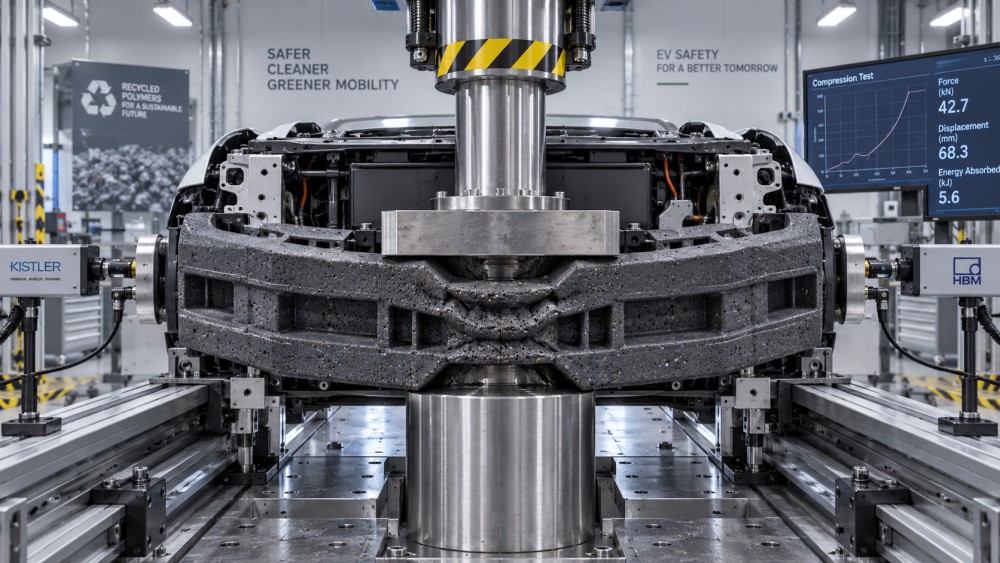
Sustainable polymers for automotive applications are moving beyond lightweighting and carbon-reduction claims into a tougher engineering question: can they protect occupants in a crash? For technical evaluators, the answer is rarely found in recycled-content percentage or a generic impact-strength value. It depends on where the part sits in the vehicle, how it deforms, which loads it sees, how it ages, and whether its behavior remains predictable across normal production variation.
A polymer may be suitable for an interior trim carrier, bumper fascia, underbody shield, energy absorber, seat structure component, battery enclosure element, or front-end module without being suitable for every safety-relevant application. Crash safety is a system outcome. Material selection therefore has to connect resin chemistry, compound formulation, part geometry, joining method, molding process, environmental exposure, and full-vehicle validation.
The practical question is not whether a sustainable material is “as strong as” its conventional counterpart. The more useful question is whether it delivers the required failure mode, energy management, dimensional stability, and manufacturing consistency for a specific component throughout its expected service life.
Crash performance is more than a single impact number
Material datasheets often present tensile strength, modulus, elongation at break, and notched impact resistance. These values are useful screening tools, but they do not independently predict vehicle crash behavior. A molded component can behave very differently from a laboratory specimen because fiber orientation, weld lines, gate location, wall-thickness transitions, local ribs, moisture condition, surface defects, and assembly interfaces all influence how a crack starts and propagates.
For crash-loaded plastic parts, engineers normally need to understand several linked behaviors:
- Energy absorption: whether the component can deform in a controlled way rather than fracture abruptly.
- Peak-load management: whether stiffness and collapse behavior help limit undesirable load transfer into adjacent structures.
- Failure mode: ductile yielding, progressive crushing, delamination, cracking, brittle breakage, or detachment can lead to very different system outcomes.
- Environmental robustness: performance must be considered after heat, humidity, UV exposure, fluid contact, thermal cycling, and low-temperature conditioning where relevant.
- Repeatability: a promising prototype material is not enough if recycled feedstock, moisture level, filler dispersion, or molding conditions create excessive batch-to-batch variation.
This is why sustainable polymers for automotive programs should be assessed as engineered compounds in a defined process window, not simply as base resins with a sustainability claim attached.
Where recycled and bio-based materials can be credible candidates
Recycled and bio-based feedstocks do not automatically make a polymer unsuitable for demanding automotive use. In many cases, carefully specified recycled polyolefins, recycled polyamides, recycled PET-based systems, or bio-attributed and bio-based engineering polymers can be formulated for applications with meaningful mechanical requirements. The issue is whether the available grade has a controlled property profile and a validation path appropriate to the component.
For relatively non-structural exterior and interior parts, sustainable-content compounds may be evaluated first where visual appearance, scratch resistance, odor, emissions, weathering, impact resistance, and dimensional stability can be verified at part level. For semi-structural components, such as certain front-end carriers, brackets, seat-related trim structures, underbody elements, or energy-absorbing features, the engineering burden becomes higher. The material must retain predictable deformation under relevant loading rates and temperatures, while also meeting assembly and durability requirements.
Highly safety-critical load paths require the most caution. A sustainable polymer may still be part of the solution, but substitution should not begin with a target percentage of recycled content. It should begin with the component’s load case, critical failure modes, allowable deformation, joining strategy, and vehicle-level safety requirements. In some designs, a hybrid approach may be more realistic: recycled-content polymer in non-critical zones, virgin or tightly controlled material in highly stressed zones, or a redesigned architecture that separates cosmetic, protective, and load-bearing functions.
The trade-offs hidden inside “sustainable” compounds
Recycled polymers can contain a more variable molecular-weight distribution, residual contaminants, pigments, incompatible polymer fractions, or prior thermal history. These factors may affect toughness, melt flow, odor, color, long-term aging, and weld-line strength. Mechanical recycling can be entirely appropriate, but the source stream, sorting quality, filtration, stabilization package, and compounding discipline matter greatly.
A compounder may use compatibilizers, impact modifiers, chain extenders, stabilizers, or reinforcement to tune performance. Each tool brings a trade-off. Glass fiber can increase stiffness and strength, but it can also reduce isotropic ductility and make local performance more dependent on fiber orientation. Mineral fillers can improve dimensional control and reduce cost, yet they may weaken impact behavior if formulation and geometry are not well balanced. Impact modification can improve low-temperature toughness, while potentially changing stiffness, flow behavior, paintability, or heat resistance.
Bio-based content requires equally careful interpretation. A polymer made partly from renewable feedstock is not necessarily biodegradable, and biodegradability is generally not a desirable selection criterion for a durable automotive component. What matters is the polymer’s actual mechanical, thermal, chemical, and aging profile, along with the evidence supporting the claimed feedstock origin and traceability.
Temperature and aging often decide the outcome
Crash testing is often associated with high loads and short time scales, but the material condition immediately before impact is just as important. A polyamide may be sensitive to moisture state. A polypropylene-based compound may become less ductile at low temperature. Heat exposure can change oxidative stability, while contact with automotive fluids, cleaning agents, or road contaminants may affect selected formulations. UV exposure can matter for exterior parts, especially when recycled feedstock has an unknown prior exposure history.
Technical teams should avoid accepting room-temperature impact data as a proxy for all service conditions. Conditioning plans should reflect the vehicle’s intended markets, component location, and foreseeable misuse or exposure. The right low-temperature threshold, heat-aging duration, humidity condition, or chemical exposure sequence must be defined by the applicable project requirements rather than copied from an unrelated material qualification.
This becomes especially important for electric vehicles. Components near battery systems may face a combination of thermal-management demands, electrical considerations, flame-retardancy requirements, vibration, and crash intrusion risks. A material that works for an interior energy absorber may not be appropriate for an enclosure-adjacent component, even when both are described as “impact resistant.”
From material data to a defensible selection decision
A sound selection process narrows uncertainty in stages. It does not wait until full-vehicle testing to discover that a compound is too brittle at a weld line or too variable after aging. The table below shows how technical evaluation can progress from initial screening to a more defensible program decision.
Process consistency is part of crash safety
The link between polymer processing and safety is often underestimated. Drying errors can degrade moisture-sensitive resins. Excessive residence time may damage the polymer or additive package. Poor mixing can leave uneven modifier or filler distribution. Insufficient melt filtration can introduce defects, while an unstable temperature profile can alter flow and fiber orientation in the mold.
For recycled-content compounds, consistent feedstock preparation and compounding are particularly important. Twin-screw compounding, dosing accuracy, degassing, filtration, and pellet handling all influence the material delivered to the molder. At the conversion stage, gate design, injection speed, packing, cooling, and mold temperature can alter the final part’s internal structure. A material approval that ignores these conditions is incomplete.
Procurement teams have a role here as well. A nominally equivalent grade from another source may differ in recycled-feedstock origin, stabilization approach, reinforcement morphology, melt-flow range, or color masterbatch. Cost-driven substitution without requalification can introduce a safety and quality risk, particularly where the component’s performance relies on controlled ductility rather than simple stiffness.
Questions that should be asked before approving the material
Technical evaluators should request more than a sustainability declaration and a standard datasheet. Useful discussions with material suppliers and compounders include the definition of recycled or bio-based content; feedstock origin and traceability; target specification ranges rather than only typical values; lot-release testing; molding recommendations; known sensitivity to moisture or thermal history; aging information; and any restrictions around regrind, paint, welding, bonding, or fastening.
It is also worth asking what changes trigger notification. If the supplier changes the recycling stream, additive package, production site, reinforcement source, or color system, the change may matter more than it would for a low-risk commodity application. Clear change control is often a better indicator of production readiness than an ambitious recycled-content claim.
A practical threshold for confidence
Sustainable polymers meet crash-safety needs when they have been matched to a defined automotive function, processed within a validated window, conditioned for relevant environments, and demonstrated to preserve the required part and system behavior. They do not meet the need simply because they match a conventional resin on one laboratory metric.
For teams comparing recycled, bio-based, and modified engineering plastics, the most productive next step is to create a component-specific evidence package: operating conditions, key failure modes, required test conditions, acceptable material variation, processing limits, and supply-chain documentation. Platforms such as Global Advanced Polymers & Industrial Materials Intelligence Network (APIM) help organize this broader view by connecting polymer performance, compounding quality, conversion processes, and application requirements. That structure makes it easier to distinguish a credible material transition from a sustainability claim that has not yet been engineered into a safe production decision.
Have questions about this sector analysis, or seeking best practices specific to your niche? Drop us a line below and let the senior consultants at APIM assist you.
We respect your privacy. Your information is strictly confidential.
Related News
- 00
0000-00
Do polyolefin hot melt adhesives bond well to polyethylene? - 00
0000-00
Korean Study Finds PLA Barely Degrades in Landfill After 320 Days - 00
0000-00
How to assess batch consistency from a thermal potting compounds supplier - 00
0000-00
How much weight can carbon fiber reinforced plastics save in cars? - 00
0000-00
Switching from PS to ABS Sheet Extrusion: Equipment Checks
Tag
- advanced polymers
- industrial materials
- engineering plastics
- recycled polymers
- polyamide
- PET
- polymer processing
- masterbatch
- sustainable polymers
- bio-based feedstocks
- mechanical recycling
- melt filtration
- compound formulation
- impact modifiers
- mineral fillers
- bio-based materials
- engineering polymers
- bio-based engineering polymers
- sustainable polymers for automotive
- color masterbatch