




When do high temperature thermoplastics for under hood parts fail on heat aging
In an engine compartment, “heat resistant” is never the same as “heat proof.” That distinction matters more than many teams admit during material screening. High temperature thermoplastics for under hood applications may survive short spikes, pass initial mechanical tests, and even process cleanly in molding, yet still fail months or years later through slow heat aging. For technical evaluators, the real question is not whether a polymer can tolerate heat on day one. It is when heat exposure begins to shift the material from acceptable performance into functional risk.
That shift is rarely dramatic at first. A bracket still looks fine, a connector housing still fits, a cover still meets dimensions. But tensile retention starts dropping, impact resistance falls away, creep increases, surfaces embrittle, and oxidation moves inward from exposed areas. By the time failure becomes visible in service, the aging process has usually been underway for a long time. Understanding when high temperature thermoplastics for under hood parts fail on heat aging means looking beyond catalog temperature ratings and focusing on degradation mechanisms, part design, loading conditions, and realistic validation methods.
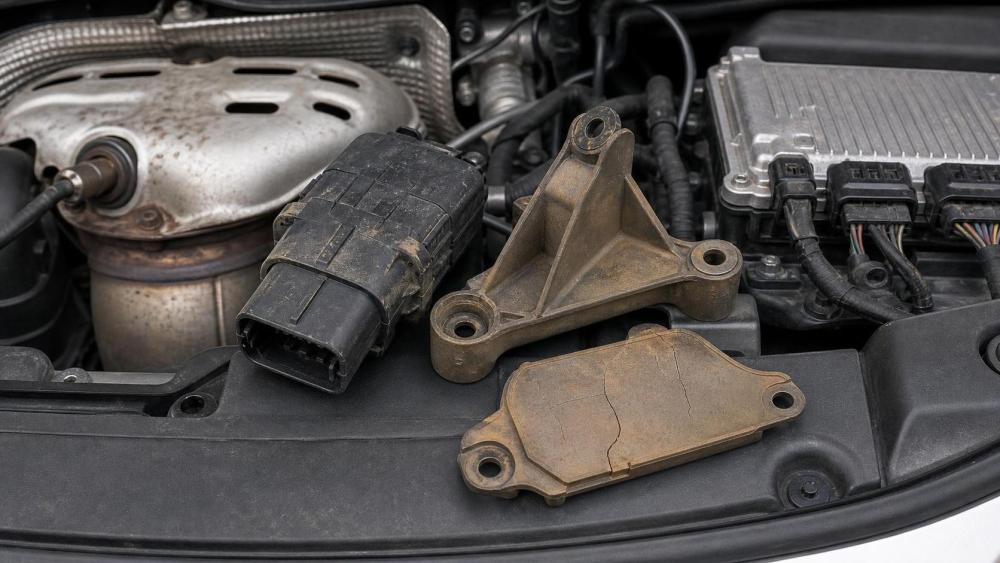
The under hood environment is especially unforgiving because heat is never acting alone. Components face thermal cycling, oils, coolants, road salts, vibration, clamping loads, moisture, and localized hot spots near turbochargers, exhaust routing, or electronic modules. A resin that performs well in dry oven aging may lose reliability much sooner when these factors combine.
Failure on heat aging usually begins before the part “breaks”
One of the most common evaluation mistakes is defining failure too narrowly. In practice, a thermoplastic under hood part has failed once it can no longer hold its intended function with acceptable safety margin. That can happen long before a visible crack appears.
For example, a glass-fiber reinforced polyamide used in a housing may still retain shape, yet its screw boss strength may have dropped enough that assembly torque creates microcracks. A PPS connector body may remain dimensionally stable, but latch flexibility may decline after prolonged thermal exposure. A PPA or PEEK part may not melt or distort, but oxidation at the surface can reduce fatigue resistance and make the component vulnerable under vibration.
So when do high temperature thermoplastics for under hood parts fail on heat aging? In engineering terms, they fail when one or more critical properties fall below the threshold required by the application. Those properties often include:
- Retention of tensile and flexural strength
- Impact resistance after aging
- Dimensional stability and warpage control
- Creep resistance under continuous load
- Electrical insulation performance
- Sealing integrity at interfaces
- Resistance to crack initiation and propagation
- Surface integrity after oxidation or additive depletion
In other words, failure is application-defined, not only material-defined.
Why heat aging affects some under hood polymers earlier than expected
Datasheets often highlight continuous use temperature, heat deflection temperature, or short-term thermal resistance. Those values are useful, but they do not tell the whole story. Heat aging is a time-and-temperature problem shaped by chemistry.
Most high temperature thermoplastics for under hood use degrade through one or more of the following pathways:
Thermo-oxidative degradation
Oxygen attacks polymer chains at elevated temperature, especially at exposed surfaces. Over time this can cause chain scission, embrittlement, discoloration, and reduced toughness. Materials that seem stable in bulk may still develop a brittle skin layer that later becomes the origin of cracks.
Hydrolysis and moisture-assisted aging
Polyamides, polyesters, and some other families can lose molecular weight under combined heat and moisture. Under hood service often includes humidity cycling, condensate, and fluid contact, so dry heat results may overestimate real-world life.
Additive depletion
Stabilizers, antioxidants, and processing aids are not permanent shields. If a formulation uses an insufficient stabilization package, the part may age acceptably at first and then deteriorate rapidly once protective additives are consumed.
Filler-matrix interface damage
In reinforced compounds, long-term heat exposure can weaken the bond between polymer and glass fiber or mineral filler. Mechanical property loss may then appear faster than expected, even if the base resin itself has not catastrophically degraded.
Crystallinity and morphology changes
Some semi-crystalline polymers continue to reorganize under heat, altering stiffness, shrinkage behavior, and dimensional fit. This is not always a chemical failure, but it can become a functional one.
These mechanisms help explain why two grades marketed within the same polymer family can age very differently. Compound design matters. Reinforcement level, flame retardants, colorants, recycled content, residual moisture control, and processing history all influence heat aging behavior.
Temperature alone does not define service life
Technical evaluators often ask for a simple answer such as, “Will this resin survive 150°C for 3,000 hours?” It is understandable. Procurement, design, and validation teams all want clean limits. But under hood durability is rarely governed by a single temperature number.
A better question is: what is the actual thermal exposure profile at the most critical section of the part?
Consider the difference between these scenarios:
- A clip exposed to 140°C continuously with little mechanical load
- A sensor housing exposed to 125°C average temperature but repeated cycling to 160°C
- A manifold-adjacent connector with local hot spots, vibration, and fluid splash
- A structural bracket carrying constant load near a battery or e-motor thermal source
All four may use “high temperature thermoplastics for under hood” service, but their aging timelines may differ sharply. Heat aging accelerates where stress concentrations, weld lines, thin walls, and chemical exposure overlap. A part can fail early not because the material grade was broadly wrong, but because the local service conditions were more severe than the qualification model assumed.
Practical signs that a heat-aged thermoplastic is approaching failure
Many parts give warning signs before end-of-life, but those signs are easy to miss if teams focus only on pass/fail testing. During evaluation, watch for changes that indicate the aging curve is turning downward:
- Noticeable color shift, especially yellowing, darkening, or chalking
- Surface gloss loss or brittle skin formation
- Reduced elongation at break after oven aging
- Drop in notched impact performance
- Increased brittleness around gates, weld lines, and corners
- Cracks near fasteners, clips, or snap-fit features
- Permanent deformation under load
- Loss of sealing compression or flange flatness
- Changes in connector retention force or latch behavior
Some of these are subtle. A part may still pass dimensional inspection while no longer having enough ductility for assembly abuse or field vibration. That is why aging evaluation should include retained properties that match the actual function of the component, not only generic resin testing.
Where technical assessments often go wrong
One recurring issue is reliance on resin-level data instead of part-level performance. Material suppliers may provide oven aging curves for molded test bars, but actual parts contain knit lines, variable wall thickness, anisotropy from glass fiber orientation, and local stress raisers. Those details can shift the true failure point significantly.
Another common problem is choosing test conditions that are too neat compared with service conditions. Dry heat aging in a controlled oven is useful for ranking materials, yet many under hood failures happen from combined aging: heat plus glycol, heat plus oil mist, heat plus humidity, heat plus cyclic strain. A material that looks strong in isolated thermal testing may become a weaker candidate when multi-factor exposure is introduced.
There is also the habit of overvaluing peak temperature and undervaluing duration. Repeated exposure at moderately high temperature for long periods can be more damaging than occasional short excursions to a higher temperature. This is particularly true where oxidation or creep governs performance.
How to judge when a material is no longer safe enough for the application
For technical evaluators, the decision point should come from a combination of retained performance, failure mode analysis, and application margin.
A useful approach is to define end-of-life around the most function-critical property. If the part must maintain clamp load, then creep retention and dimensional stability matter more than tensile strength alone. If it is a connector or latch feature, then ductility and fatigue retention may be the controlling factors. If it seals against fluid ingress, then compression set, flange stability, and crack resistance become central.
Instead of asking whether the polymer “survived” heat aging, ask:
- What property changed first?
- Was the change gradual or did it accelerate after a threshold?
- Did degradation begin at the surface, the fastener location, or the weld line?
- Is the failure chemical, mechanical, or design-driven?
- How much margin remains relative to worst-case service loads?
This framing leads to better decisions than a simple pass/fail judgment taken at one aging interval.
Material families do not age the same way
Even within high-temperature materials, failure timing depends heavily on resin type and formulation strategy. Polyphthalamide compounds may offer good heat resistance but still need careful moisture and hydrolysis evaluation. PPS generally performs well at elevated temperature and chemical exposure, though brittleness and design details still matter. PEEK can maintain excellent properties over time, but cost drives its use toward more severe applications where the duty cycle truly justifies it. High-heat nylons may look attractive on price-performance grounds, yet their long-term reliability under moisture and thermal cycling must be judged carefully in real service conditions.
Reinforcement also cuts both ways. Glass fiber can improve stiffness and heat deflection behavior, but if the application needs snap performance or vibration tolerance after aging, a very rigid formulation may become unforgiving. Mineral-filled systems may improve dimensional stability while lowering impact margin. Flame-retardant packages, pigments, and recycled fractions can also shift long-term aging behavior.
This is where structured technical intelligence becomes useful. Material decisions are rarely about one property in isolation. Evaluators need a view that links chemistry, compounding, processing, and application behavior.
Testing that reflects the under hood reality
A more credible heat aging program typically combines several layers:
- Baseline resin and molded part characterization
- Accelerated oven aging at realistic and elevated temperatures
- Property retention checks at staged intervals
- Thermal cycling rather than only static heat exposure
- Fluid exposure where relevant
- Load-bearing or assembled-part aging tests
- Microscopy or fracture analysis after failure
For many teams, the key improvement is not necessarily more tests, but smarter tests. If a part is mounted under preload in service, age it under preload. If it sees coolant and heat together, combine those conditions. If field failures often start at weld lines, sample those regions specifically. The closer the test setup comes to the actual application, the more meaningful the “when does it fail” answer becomes.
What technical evaluators should do before approving a grade
Before signing off on a material for an under hood part, it helps to slow down and challenge assumptions. Confirm the highest real part temperature, not just the ambient compartment temperature. Review local hot spots, assembly loads, fluid contact, and expected life hours. Ask whether the selected compound has enough stabilization for the full duty cycle, not only initial processing stability. Check whether molding conditions could have introduced hidden weakness through moisture issues, excessive residence time, or fiber damage.
Teams working across advanced polymers and industrial materials increasingly need this broader view. Platforms such as APIM are valuable in that context because they connect material families, modified compounds, processing variables, and application logic in one place. For evaluators comparing high temperature thermoplastics for under hood applications, that kind of structured context helps separate nominal heat resistance from durable field performance.
The short answer
High temperature thermoplastics for under hood parts fail on heat aging when prolonged thermal exposure reduces the specific properties the part depends on: strength, ductility, dimensional stability, creep resistance, electrical performance, or sealing integrity. The timing of that failure is controlled not only by temperature, but also by oxygen, moisture, chemicals, stress, formulation quality, and part design.
That is why two parts made from the same polymer family can age very differently, and why a datasheet temperature rating is only the beginning of the conversation. For technical evaluators, the most reliable answer comes from matching material chemistry and compounded design to real service conditions, then validating retained function at the part level. In under hood applications, heat aging is rarely a sudden event. It is a gradual loss of margin. The sooner you can see where that margin begins to disappear, the better your material decision will be.
Have questions about this sector analysis, or seeking best practices specific to your niche? Drop us a line below and let the senior consultants at APIM assist you.
We respect your privacy. Your information is strictly confidential.
Related News
- 00
0000-00
How does washing affect contamination in post-consumer recycled PP resins? - 00
0000-00
How does feedstock affect depolymerization equipment selection? - 00
0000-00
US Sets 213.44% Preliminary Antidumping Deposit on Chinese PTMEG - 00
0000-00
When should epoxy be used as a thermal interface material for semiconductors? - 00
0000-00
US Midterm Results Unlikely to Quickly Shift Recycled Plastics Market or Legislation