




When carbon fiber reinforced compounds justify their cost in lightweight parts
When Carbon Fiber Reinforced Compounds Justify Their Cost in Lightweight Parts
Carbon fiber reinforced compounds are easy to admire on a datasheet and easy to reject on a purchase order. The material price is usually higher than unfilled polymers, mineral-filled grades, and many glass-fiber reinforced alternatives. For a buyer looking only at price per kilogram, the decision can appear straightforward: carbon fiber costs more, so it should be reserved for exceptional products.
That view misses the point in many lightweight-part programs. Carbon fiber reinforced compounds for lightweight parts become commercially credible when the material changes the economics of the whole component or system. The relevant question is not whether a carbon-fiber grade is more expensive than a standard polyamide, PBT, PPS, or PEEK grade. It is whether lower mass, higher stiffness, better dimensional control, or part consolidation removes enough cost and risk elsewhere to justify the premium.
This distinction matters in automotive assemblies, industrial equipment, electronics housings, robotic systems, medical equipment, and precision mechanisms. In these applications, a part may be expected to carry load, maintain alignment, survive repeated thermal cycles, fit within a tight package, and remain suitable for high-volume molding. Material selection is therefore a business decision involving engineering, processing, procurement, quality, and supply continuity—not simply a resin-price comparison.
The Cost Premium Is Justified by a System-Level Gain
Carbon-fiber reinforcement is rarely the right answer for a component whose only job is to be lighter. If a non-critical cover can be made thinner with a conventional filled plastic, or if modest weight reduction has no effect on transport, energy use, handling, or product performance, the premium will be difficult to defend.
The stronger case appears when mass reduction unlocks another measurable benefit. A lighter moving arm in a robot or automated machine can reduce inertia and may allow faster, more controlled movement. A stiff, low-mass bracket can reduce vibration-related performance problems. In an electric vehicle, a lighter structural-adjacent component may help offset the mass of batteries or thermal-management equipment. In portable electronics or diagnostic equipment, a lighter housing may improve usability while retaining rigidity around sensitive internal assemblies.
There is also a practical packaging argument. Carbon fiber compounds can provide stiffness at relatively low density compared with metal options and often permit thinner walls than less rigid polymer choices. Where installation space is restricted, replacing a bulky reinforcement strategy with a thinner molded part can create room for wiring, insulation, cooling features, or other functional elements. That is frequently more valuable than the grams saved.
A useful procurement discipline is to define the value driver before comparing quotes. Is the project trying to reduce total part mass? Eliminate a metal insert? Hold a critical dimension after molding? Limit deflection under load? Reduce assembly operations? If the team cannot state the driver in operational terms, carbon fiber may be entering the design too early.
Where Carbon Fiber Has a Clearer Advantage Over Glass Fiber
Glass-fiber reinforced compounds remain the more economical choice for a large share of reinforced polymer parts. They are widely available, familiar to molders, and capable of providing substantial improvements in strength and stiffness. Carbon fiber should not be treated as an automatic upgrade.
The decision shifts when stiffness-to-weight becomes the governing requirement. Carbon fiber can be particularly attractive when a design has reached the limits of what a glass-filled grade can achieve without making the wall too thick, increasing part mass, or compromising another requirement. It is also considered when dimensional behavior needs tighter control, although actual warpage performance still depends heavily on fiber orientation, flow path, gate location, wall transitions, mold temperature, and part geometry.
Another differentiator is electrical behavior. Carbon fibers can make a compound electrically conductive or dissipative depending on formulation and loading. That can be useful for certain housings, fixtures, tooling elements, or components requiring electrostatic charge control. It can also be a reason to reject the material. A compound with conductive reinforcement may be unsuitable near electrical isolation zones unless the design and test requirements clearly allow it.
The table is a starting point, not a selection rule. Carbon fiber reinforcement changes a polymer’s behavior in several directions at once. It may improve stiffness and reduce thermal expansion, but it can also increase anisotropy, affect surface finish, alter weld-line behavior, and create different wear patterns in processing equipment. A viable material decision needs the full part context.
Part Consolidation Often Carries More Weight Than Resin Price
The most persuasive business cases are often not based on replacing one material with another in an identical drawing. They come from redesigning the part around the capabilities of the compound.
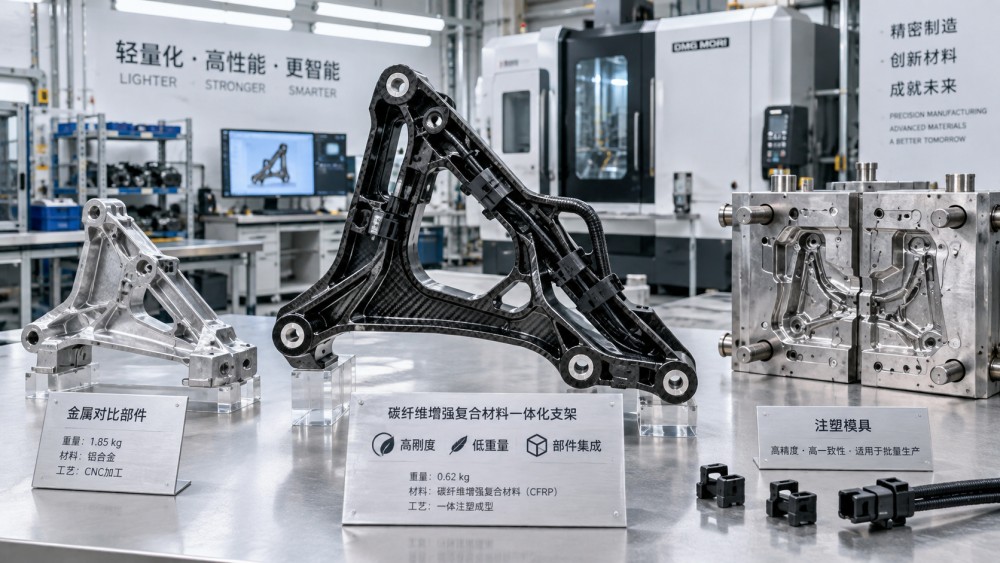
A stamped or machined metal component may require secondary drilling, corrosion protection, fasteners, separate clips, and an assembly step. A carefully designed injection-molded carbon-fiber reinforced component may incorporate ribs, mounting points, locating features, cable routing, or snap-fit geometry in one molding cycle. That does not mean every metal part can be replaced by an injection-molded polymer. It means the comparison must include manufacturing route and assembly architecture.
This is where teams sometimes make a costly mistake: they quote a carbon-fiber grade against the raw material cost of steel or aluminum, then conclude the polymer is uneconomic. The comparison should instead include blanking or machining, finishing, scrap, fasteners, inventory complexity, assembly labor, inspection, and the cost of a larger or heavier adjacent structure. Some of these items are difficult to quantify early in a program, but ignoring them produces a misleadingly simple decision.
Part consolidation has limits. Thick-to-thin transitions, long flow lengths, sharp corners, and high local stress around bosses can undermine an otherwise promising design. Reinforced compounds need geometry that respects flow direction and fiber orientation. A component that is elegant in CAD may still show unacceptable distortion or weak weld-line performance after molding. The material supplier, molder, and part designer should review these points before the tool design is frozen.
Processing Reality Can Decide the Project
For procurement teams, the grade name is only part of the risk profile. Carbon-fiber reinforced compounds require disciplined control from compounding through injection molding or extrusion. Fiber length retention, dispersion quality, moisture management where relevant, melt temperature, residence time, and feeding consistency can all influence the final part. Material performance stated under standard test conditions cannot be assumed to transfer directly to a complex production geometry.
A supplier’s compounding capability matters. In twin-screw compounding, feeding accuracy and screw configuration influence how fiber is incorporated and how the base resin and additives are dispersed. Excessive shear can reduce effective fiber length; poor dispersion can create property variation. Downstream, pellet quality and batch-to-batch consistency affect molding stability. These are not abstract process details when the part is load-bearing or dimensionally sensitive.
Molders should also assess wear. Reinforced compounds can be abrasive to screws, barrels, nozzles, gates, and tooling surfaces. The appropriate steel selection, surface treatment, maintenance plan, and spare-part strategy should be included in the manufacturing estimate. Leaving these costs outside the initial quote is a common way to make a material appear cheaper to process than it will be over the program life.
Surface appearance deserves an early discussion as well. Carbon-fiber compounds may not meet the same cosmetic expectations as unfilled or lightly filled polymers, particularly where fiber read-through, flow marks, or a dark conductive appearance are unacceptable. Painting, overmolding, texturing, or a separate cosmetic cover may solve the issue, but each option changes cost and process complexity.
Evaluate the Real Service Environment, Not Just Initial Strength
A lightweight part is not successful if it passes an initial static-load calculation but drifts out of tolerance after months of heat, humidity, vibration, fluid exposure, or cyclic loading. The base resin remains critical. Carbon fiber does not turn an unsuitable polymer into a durable one.
For example, a reinforced polyamide may need careful evaluation where humidity can influence mechanical and dimensional behavior. A high-temperature environment may point toward a different resin family, such as PPS, PEEK, or another engineering polymer selected for the actual exposure profile. Chemical contact, flame performance, electrical requirements, and cleaning agents can all narrow the material options before carbon fiber loading is even discussed.
Buyers should ask for technical information that matches the application: conditioning state for mechanical data, thermal performance relevant to the duty cycle, chemical compatibility guidance, shrinkage and warpage information where available, and evidence of lot consistency. If regulatory, safety, automotive, medical, or electrical approvals are required, those claims must be checked against the specific grade, color, thickness, process, and target market. A family-level statement is not enough.
A Better Procurement Framework for Carbon-Fiber Compounds
The most effective sourcing process treats the material as a controlled technical input rather than a commodity. Start with a functional specification: target mass, allowable deflection, load direction, operating temperatures, environmental exposures, electrical needs, cosmetic expectations, joining method, annual volume, and critical dimensions. Then ask suppliers to respond to the specification rather than simply offer their nearest carbon-fiber reinforced grade.
It is sensible to compare at least three routes where the project allows it: a glass-fiber reinforced alternative, a carbon-fiber reinforced alternative, and the existing metal or multi-part construction. The comparison should include part weight, piece cost, tooling implications, cycle-time expectations, assembly changes, quality-control burden, supply risk, and expected maintenance impact. A lower resin cost may still lose once secondary operations or system mass are included.
Supplier qualification should go beyond the sample plaque. Ask how the compound is controlled, what documentation accompanies production lots, whether formulation changes are managed through notice procedures, and how capacity and lead-time risks are handled. Carbon-fiber supply conditions, base-resin availability, and regional logistics can all affect continuity. Dual sourcing may be desirable, but it should not be assumed that two nominally similar grades are interchangeable without part validation.
This is the kind of decision where structured materials intelligence helps. APIM’s coverage of engineering polymers, modified compounds, compounding processes, extrusion technologies, and downstream applications is useful because it connects material properties with the operating details that determine commercial outcomes. A datasheet can begin a discussion; it cannot replace a cross-functional review of the finished part.
The Practical Threshold
Carbon fiber reinforced compounds justify their cost when they solve a problem that cheaper materials leave unresolved: too much mass in a moving system, insufficient stiffness in a constrained package, unstable geometry, an expensive metal assembly, or a performance requirement that depends on low weight and high rigidity at the same time.
They are a poor fit when the project has no clear value for weight reduction, when glass fiber already meets the specification, when the service environment is not understood, or when processing and tooling consequences have been excluded from the cost model. The sound purchase decision is not “carbon fiber versus low price.” It is whether the compound produces a better part and a more credible lifecycle cost after design, manufacturing, service, and supply-chain realities are all counted.
Have questions about this sector analysis, or seeking best practices specific to your niche? Drop us a line below and let the senior consultants at APIM assist you.
We respect your privacy. Your information is strictly confidential.
Related News
- 00
0000-00
Do polyolefin hot melt adhesives bond well to polyethylene? - 00
0000-00
Korean Study Finds PLA Barely Degrades in Landfill After 320 Days - 00
0000-00
How to assess batch consistency from a thermal potting compounds supplier - 00
0000-00
How much weight can carbon fiber reinforced plastics save in cars? - 00
0000-00
Switching from PS to ABS Sheet Extrusion: Equipment Checks