




When High Strength Lightweight Polymer Materials Cut Weight Without Losing Durability
Weight reduction is no longer a niche target. In many industrial programs, it shapes cost, energy use, transport efficiency, and product performance at the same time.
That is why high strength lightweight polymer materials are getting closer attention across automotive parts, electronics, industrial equipment, packaging, and precision components.
The real question is not whether polymers can be lighter than metal or glass. It is whether they can cut mass while still handling stress, heat, wear, chemicals, and long service cycles.
In practical terms, that decision affects tooling, assembly, certification, supply risk, and long-term product reliability. It also changes how teams evaluate value beyond raw material price.
Why lightweight strength matters now
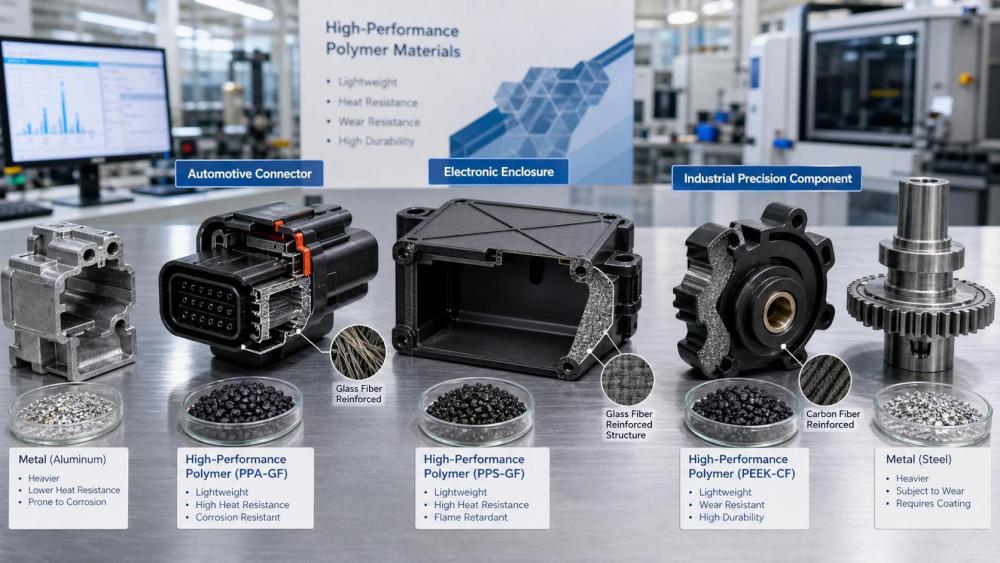
Across manufacturing, lighter structures can support lower fuel use, easier handling, reduced shipping loads, and more flexible product design.
But weight reduction alone creates little value if parts crack, deform, fatigue early, or become difficult to process consistently.
This is where high strength lightweight polymer materials stand out. They are engineered to balance mechanical performance with lower density, often replacing heavier traditional materials in targeted applications.
The shift is visible in reinforced polyamides, PEEK, PPS, PBT, PC blends, TPU systems, specialty films, and modified compounds built for demanding end uses.
What makes the topic more relevant today is the pressure coming from multiple directions at once: performance targets, sustainability goals, tighter packaging, and more complex assemblies.
What these materials really include
High strength lightweight polymer materials are not one single family. They include base resins, reinforced grades, specialty compounds, films, and bonded structures designed for specific loads and environments.
Some rely on inherently strong engineering plastics. Others gain performance from glass fiber, carbon fiber, mineral fillers, flame retardants, impact modifiers, or wear-resistant additives.
In many cases, the polymer is only part of the answer. Processing quality, moisture control, dispersion, fiber length retention, and cooling conditions strongly influence final durability.
This is why structured technical interpretation matters. Platforms such as APIM help connect material data with processing behavior, application logic, and supply chain realities.
A useful way to frame selection
Instead of asking which polymer is strongest, it is more useful to compare how each option performs under the exact conditions the part will face.
Where durability is won or lost
Durability is rarely defined by tensile strength alone. A lightweight polymer part can look strong on paper and still fail early in field conditions.
The weak points often come from combined stresses. Heat plus load, chemical exposure plus vibration, or thin-wall design plus poor molding control can change performance quickly.
For that reason, high strength lightweight polymer materials should be judged through the full operating envelope, not a single laboratory number.
- Creep resistance under continuous load
- Impact retention after aging
- Dimensional stability across temperature swings
- Chemical compatibility with oils, cleaners, fuels, or moisture
- Fatigue behavior in repeated motion or vibration
- Process consistency across batches and suppliers
In actual projects, durability also depends on part geometry. Ribs, gate location, wall transitions, and notch design can matter as much as resin choice.
How different industries use the same logic
The same lightweight principle appears in very different products, but the performance priorities change by application.
Automotive and mobility
Under-hood parts, connectors, housings, clips, interior structures, and battery-adjacent components often use high strength lightweight polymer materials to reduce mass and simplify assembly.
Here, heat aging, fluid resistance, flame performance, and dimensional stability usually matter more than headline strength values.
Electronics and electrical systems
Compact devices need thin walls, electrical insulation, stable tolerances, and sometimes thermal management. Flame-retardant PC, PBT, PPS, and conductive or thermally conductive compounds are common routes.
Packaging and film structures
In films and multilayer substrates, reducing material weight while holding barrier, puncture resistance, and sealing reliability is a different version of the same challenge.
A lighter structure only works when optical quality, oxygen barrier, moisture barrier, and line stability remain under control.
Industrial equipment and bonded assemblies
Some applications combine polymers with structural adhesives, seals, or composite layers. In these cases, the durability question extends beyond the substrate to bonding behavior and surface preparation.
Why process control matters as much as resin choice
A well-specified material can still underperform if compounding or conversion is unstable. That is especially true for reinforced and functional polymer systems.
Twin-screw extrusion settings, feeding accuracy, melt filtration, residence time, degassing, and pellet quality all affect how high strength lightweight polymer materials behave downstream.
During molding or extrusion, temperature profile, moisture content, shear history, and cooling rate influence warpage, shrinkage, surface quality, and retained strength.
This is one reason technical sourcing has become more data-driven. Material comparison now needs processing data, not just datasheets.
A practical evaluation path for better decisions
When reviewing high strength lightweight polymer materials, it helps to build a short decision frame before discussing grades with suppliers.
- Define the actual weight target, not a general preference for lighter parts.
- List the failure modes that matter most in service.
- Match required properties to the real environment, including heat, chemicals, and repeated loading.
- Check whether the part design supports the chosen polymer.
- Review process window, drying needs, tooling impact, and scrap sensitivity.
- Ask for batch consistency, test conditions, and certification evidence.
- Compare total system cost, including assembly, logistics, and service life.
Usually, the strongest case for substitution comes from combined value. Less weight, fewer parts, easier processing, and longer life often matter more than one dramatic property gain.
The growing role of sustainability in lightweight design
Weight reduction and sustainability increasingly overlap, but they are not automatically the same thing.
A lighter part may reduce transport or energy demand. Still, the full decision should also consider recycled content, traceability, process stability, repairability, and end-of-life options.
That creates new interest in recycled polymers, bio-based materials, mono-material packaging structures, and low-impact design strategies.
The trade-off is clear. Sustainable material choices must still meet durability expectations. If a part fails early, the environmental case weakens quickly.
What to assess next
The most useful next step is to narrow the discussion from broad material interest to a small set of application-specific questions.
Review which components are weight-sensitive, which loads are continuous or cyclic, and which processing limits could block a promising substitution.
Then compare candidate polymers through property retention, manufacturability, and supply stability rather than nominal strength alone.
APIM’s value in that process is its structured view across advanced polymers, modified compounds, films, adhesives, processing technologies, and supply chain signals.
That broader context helps turn high strength lightweight polymer materials from a material trend into a better-informed project decision.
Have questions about this sector analysis, or seeking best practices specific to your niche? Drop us a line below and let the senior consultants at APIM assist you.
We respect your privacy. Your information is strictly confidential.
Related News
- 00
0000-00
How does washing affect contamination in post-consumer recycled PP resins? - 00
0000-00
How does feedstock affect depolymerization equipment selection? - 00
0000-00
US Sets 213.44% Preliminary Antidumping Deposit on Chinese PTMEG - 00
0000-00
When should epoxy be used as a thermal interface material for semiconductors? - 00
0000-00
US Midterm Results Unlikely to Quickly Shift Recycled Plastics Market or Legislation
Tag
- advanced polymers
- engineering plastics
- twin-screw extrusion
- specialty films
- recycled polymers
- mono-material packaging
- PEEK
- PPS
- TPU
- PBT
- polymer materials
- thermally conductive compounds
- structural adhesives
- lightweight polymer materials
- melt filtration
- impact modifiers
- mineral fillers
- bio-based materials
- high strength lightweight polymer materials