




What to verify before choosing a glass reinforced thermoplastics supplier
Start with the application, not the grade name
A glass reinforced thermoplastics supplier should be evaluated against the part’s operating and processing requirements before price becomes the deciding factor. Two suppliers may offer a “30% glass-filled nylon” or “glass-reinforced PBT” with similar data-sheet values, yet their materials can behave differently in molding, dimensional control, surface appearance, moisture response, weld-line strength, or long-term heat exposure.
For procurement teams, the first question is therefore not whether a supplier can provide glass reinforced thermoplastics. It is whether the supplier can provide a material definition that matches the actual component and can reproduce that definition consistently over the life of the program.
This matters most where the compound replaces metal, supports a load-bearing feature, sits near heat sources, carries electrical functions, or must fit tightly with other parts. In those cases, a lower purchase price can be quickly outweighed by higher scrap rates, mold adjustments, assembly failures, field claims, or repeated qualification work.
Before requesting quotations, convert the component requirement into a short technical brief. It should identify the base resin family, expected service temperature, mechanical loading, chemical exposure, electrical or flame-retardancy needs, cosmetic expectations, processing method, annual demand, approved color, and relevant customer or regulatory requirements. Suppliers can then respond to the same specification rather than offering loosely comparable grades.
Verify what is actually inside the compound
“Glass reinforced” describes a broad category rather than a complete material specification. The base polymer may be polyamide, polypropylene, PBT, PET, PC, PPS, PEEK, or another resin. The glass level may vary substantially. Fiber length, fiber treatment, additive package, recycled content, impact modifier, flame-retardant system, pigment, and stabilizers can all alter performance.
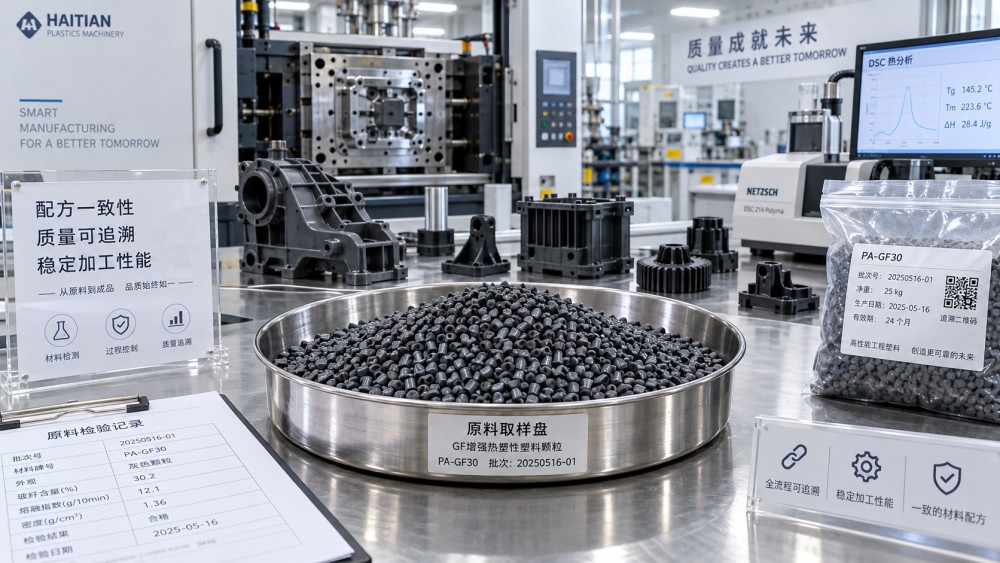
A supplier’s technical data sheet is a starting point, but it should not be treated as proof that every shipment will perform like the published typical values. Procurement should ask what controls are used to ensure that the delivered compound remains within agreed limits for the properties that matter to the application.
Useful questions include:
- What is the nominal glass-fiber content, and what production tolerance is applied?
- Is the fiber short glass, long glass, or another reinforcement format?
- Which resin source or resin specification supports the grade?
- Are mineral fillers, recycled streams, impact modifiers, flame retardants, lubricants, or processing aids included?
- What is the moisture specification at shipment, and what packaging protects the material before molding?
- Can the supplier provide lot-specific quality documentation for agreed properties?
- Will the formulation, fiber source, resin source, or manufacturing location be changed without formal customer approval?
Fiber content alone does not explain part performance. A compound with the same nominal glass percentage can differ in fiber dispersion, fiber breakage during compounding, and fiber length retained after molding. These factors influence stiffness and strength, but also anisotropic shrinkage, warpage, surface texture, tool wear, and weakness around weld lines.
Ask suppliers to describe their compounding route in practical terms. The objective is not to audit every screw element or process setting during the first conversation. The objective is to understand whether the supplier controls feeding, dispersion, melt filtration, drying, pellet handling, and quality release in a way that supports repeatable molding behavior. A supplier that can explain these controls clearly is usually easier to work with when a process issue emerges later.
Read performance data in the conditions that resemble use
Published tensile strength and flexural modulus often make glass-reinforced compounds look straightforward to compare. The difficulty is that these headline properties may have been measured under conditions that do not resemble the finished part’s service environment.
A nylon grade, for example, can show materially different behavior depending on its moisture condition. A reinforced polymer used under continuous heat may retain properties differently from one tested briefly at room temperature. A material exposed to oils, cleaning chemicals, coolant, humidity, ultraviolet light, or electrical stress must be evaluated for those exposures rather than only for its initial mechanical values.
For a supplier comparison, identify the few performance conditions that could cause a component to fail. These are often more useful than compiling every value in a data sheet. Depending on the part, the comparison may focus on:
- Strength, stiffness, and impact resistance at the expected operating temperature.
- Heat deflection, thermal aging, and retention of mechanical properties after heat exposure.
- Dimensional stability, creep, and fatigue under sustained or cyclic load.
- Resistance to the relevant chemical media and cleaning agents.
- Electrical properties, tracking resistance, dielectric behavior, or flame performance where applicable.
- Color stability, surface quality, and ultraviolet resistance for visible or outdoor components.
Testing conditions must travel with the numbers. A value without information on specimen direction, conditioning, temperature, thickness, testing standard, and sample preparation has limited value in a sourcing decision. Fiber-reinforced materials are direction-sensitive: a property measured along material flow can differ greatly from the transverse direction. For parts with ribs, bosses, clips, thin sections, or complex flow paths, this distinction can determine whether a grade is suitable.
Where the component is high-risk, request molded test plaques or trial material and define an agreed validation plan with engineering. The most useful trial is one run in the intended mold, on representative production equipment, using the expected cycle conditions. This reveals issues that data sheets cannot settle, including filling behavior, pressure demand, fiber orientation, gate sensitivity, shrinkage pattern, warpage, and surface defects.
Processing compatibility is a supplier qualification issue
A material can meet a laboratory specification and still create manufacturing problems. Glass reinforcement raises viscosity, increases abrasion, changes shrinkage, and can make flow behavior more sensitive to mold design and gate location. Some materials require tightly controlled drying. Others may need different barrel temperatures, mold temperatures, screw settings, back pressure, or residence-time limits than the incumbent grade.
Procurement should involve the molding or process engineering team early enough to assess these conditions. This is especially important when changing suppliers, changing the reinforcement level, moving between resin families, or replacing a virgin formulation with a compound containing recycled material.
Suppliers should be able to provide a processing window rather than a single ideal setting. That guidance should cover drying conditions, acceptable moisture level, melt temperature range, mold temperature, injection parameters, residence-time concerns, regrind policy, and any special recommendations for venting or gate design. It should also identify foreseeable risks, such as hydrolytic degradation from inadequate drying, excessive fiber breakage from aggressive screw conditions, or cosmetic limitations caused by exposed fibers.
For processors with sensitive tooling, include abrasive wear in the evaluation. Glass-filled compounds can shorten the service life of screws, barrels, gates, and mold surfaces, particularly at high reinforcement levels or high production volumes. A supplier does not need to eliminate that risk, but it should provide a realistic view of the compound’s abrasiveness and any tooling or processing recommendations.
Do not assume that a “drop-in replacement” claim removes the need for molding trials. A supplier may be able to match the nominal resin family and glass loading while still producing different flow, shrinkage, or orientation behavior. A drop-in claim is useful only when it is supported by part-level evidence under conditions similar to the buyer’s own production process.
Compare supplier capability beyond the first batch
The real procurement risk is often not the initial sample. It is the ability to receive the same material, in the right documentation and packaging, across repeated orders and possible changes in demand.
A credible glass reinforced thermoplastics supplier should be able to explain where compounding takes place, how batches are identified, what is tested before release, how retained samples are managed, and how deviations are handled. For regulated, safety-related, or customer-approved components, traceability needs to extend beyond a lot number on a bag. Buyers may need a clear link between the delivered lot, raw-material sources, production records, and quality release documentation.
Supplier change control deserves explicit attention. Resin substitutions, alternate glass-fiber sources, changes in additive suppliers, adjustments to recycled content, relocation of compounding, and modified pelletizing conditions can all affect a reinforced grade. These changes may be commercially reasonable for the supplier, but the buyer needs advance notification and a defined approval path before a material change reaches production.
Documentation should match the application. A basic commercial molded part may only require a robust specification and lot certificate. Electrical, automotive, medical, food-contact, or safety-relevant applications can require a deeper review of declarations, restricted-substance information, testing reports, material listings, and customer-specific approvals. Procurement should establish which documents are mandatory before placing an order, rather than discovering gaps after qualification.
Assess supply risk at the material-system level
Lead time alone does not capture supply resilience. Reinforced thermoplastic availability depends on the base polymer, glass fiber, additives, color masterbatch, compounding capacity, packaging, and transport. A supplier with local inventory may still depend on a single resin source or a distant compounding site. Conversely, a supplier with a longer standard lead time may have stronger formulation control and a clearer continuity plan.
Ask which inputs are single-sourced, whether approved alternatives exist, and what happens if the primary production site is constrained. These questions are particularly relevant for specialized high-temperature polymers, halogen-free flame-retardant systems, custom colors, and low-volume grades that are not produced continuously.
For programs where interruption is expensive, qualification of a second source should be considered before an emergency occurs. However, dual sourcing only reduces risk when both materials have been validated against the same part requirements. Keeping an alternate supplier on a commercial list without processing trials, documentation review, and change-control alignment creates a false sense of security.
Commercial terms should also reflect material reality. Minimum order quantities, production campaign size, shelf-life guidance, packaging format, inventory ownership, and forecast commitments may affect total cost more than a small difference in price per kilogram. A grade with a low quoted price but a large minimum order can generate excess stock, moisture-management concerns, and obsolescence risk. A custom formulation should have clear rules for forecast changes and end-of-program inventory.
Use technical support as part of the selection criteria
Technical support is often treated as a secondary service until a part starts warping or a molding line begins producing rejects. At that point, the supplier’s ability to interpret the issue can have direct commercial value.
Before approval, determine whether the supplier can support material selection, mold trials, processing troubleshooting, failure analysis, and formulation questions. The expected depth of support should fit the program. A standard noncritical component may need responsive documentation and application guidance. A complex structural or electrical part may justify direct access to a material engineer who understands fiber orientation, mold-flow considerations, conditioning, thermal aging, and relevant test methods.
Also establish who owns the decision when test results do not match expectations. Procurement, engineering, quality, and the supplier should agree on acceptance criteria before a production trial. Otherwise, a disagreement over whether a result is caused by material, molding conditions, tool design, or test setup can delay approval and obscure the corrective action.
Build the decision around the failure modes that matter
The best supplier is rarely the one with the longest generic data sheet or the lowest initial quotation. It is the one that can demonstrate control over the material features that drive the part’s likely failure modes, while also providing the traceability, supply continuity, and technical response needed for the program.
A practical selection process narrows the field quickly: define the application conditions, screen suppliers against non-negotiable material and compliance requirements, compare processing behavior through representative trials, then assess long-term quality and supply controls before commercial negotiation is finalized.
That sequence prevents procurement teams from treating glass reinforced thermoplastics as interchangeable commodities. For many components, they are engineered material systems whose formulation and processing history remain visible in the final part.
Have questions about this sector analysis, or seeking best practices specific to your niche? Drop us a line below and let the senior consultants at APIM assist you.
We respect your privacy. Your information is strictly confidential.
Related News
- 00
0000-00
How does washing affect contamination in post-consumer recycled PP resins? - 00
0000-00
How does feedstock affect depolymerization equipment selection? - 00
0000-00
US Sets 213.44% Preliminary Antidumping Deposit on Chinese PTMEG - 00
0000-00
When should epoxy be used as a thermal interface material for semiconductors? - 00
0000-00
US Midterm Results Unlikely to Quickly Shift Recycled Plastics Market or Legislation