




What to verify before choosing a carbon fiber reinforced compounds supplier
A carbon-fiber-reinforced compound can look qualified on a datasheet and still create avoidable cost in production. The usual failure point is not that carbon fiber was absent, but that the supplied material does not behave consistently enough in the intended molding, extrusion, or machining process. Fiber loading, retained fiber length, matrix resin quality, moisture condition, pellet morphology, additive package, and lot control can all affect the final part.
Price and nominal carbon-fiber percentage are therefore weak starting points for supplier selection. A lower-cost grade may require longer drying, produce greater mold wear, generate more scrap, show wider dimensional variation, or fail to maintain its properties after heat aging or chemical exposure. The relevant comparison is the cost and risk of producing conforming parts over time, not the price per kilogram on the quotation.
Verify the compound specification, not only the commercial grade name
“Carbon fiber reinforced” is a material category rather than a complete specification. Two compounds described as PA66-CF30, PPS-CF40, or PEEK-CF30 may differ materially in processability and end-use behavior. Before qualifying a source, the technical purchase specification should state what must remain controlled and what flexibility is acceptable.
The matrix resin needs to be identified clearly: for example, PA6, PA66, PPA, PPS, PEEK, PC, PBT, or PP. This is not a minor detail. The same fiber content in different polymer matrices produces different moisture sensitivity, chemical resistance, thermal capability, shrinkage behavior, weld-line performance, and recycling options. A supplier should disclose the base resin family and, where relevant, whether the formulation contains a blend, recycled content, impact modifier, lubricant, flame-retardant package, or other functional additive.
Carbon fiber itself also requires clarification. Critical questions include whether the fiber is virgin, recycled, continuous-fiber-derived chopped fiber, or a blend; the nominal fiber loading; the loading tolerance; and the method used to measure it. Fiber percentage expressed by weight does not directly describe part stiffness or conductivity, because the result is also influenced by fiber geometry, orientation, dispersion, and processing-induced breakage.
For molded components, retained fiber length after compounding and molding deserves particular attention. Excessive shear in compounding or injection molding can shorten fibers and reduce the reinforcement effect. Suppliers do not always publish fiber-length distribution in standard datasheets, but they should be able to explain the compounding approach, the expected processing window, and the basis for their performance claims. Where stiffness, warpage, or electrical behavior is critical, a sample-part trial is more meaningful than reliance on tensile-bar data alone.
A usable specification normally distinguishes between nominal values and release limits. A typical datasheet may show tensile strength, tensile modulus, flexural strength, impact resistance, heat deflection temperature, density, and melt-flow behavior. The purchase requirement should identify which of these are acceptance-critical for the application and whether values are required in dry-as-molded, conditioned, or heat-aged states. This distinction is especially important for polyamides, whose properties can shift substantially with moisture conditioning.
Ask how the numbers were produced
Test values cannot be compared safely without test conditions. Tensile and flexural properties may be reported using ISO or ASTM methods, but specimen thickness, conditioning, test direction, temperature, and strain rate affect the result. Carbon-fiber-filled compounds are anisotropic: flow-direction properties can differ significantly from transverse-direction properties. A high flow-direction modulus does not guarantee adequate strength across a weld line or around a hole in the finished part.
Request the full technical data sheet and test-method references rather than relying on a one-page marketing summary. For each key property, verify:
- the applicable test standard and specimen condition;
- whether the result is typical, minimum, maximum, or a controlled release target;
- the direction of measurement relative to material flow;
- the number of production lots represented, if that information is available;
- the sample preparation method, particularly for moisture-sensitive resins;
- the temperature and environmental exposure relevant to the actual part.
Heat deflection temperature alone should not be treated as a long-term service-temperature rating. It is a comparative test result under a specified load, not proof that a compound will retain functional properties after prolonged thermal exposure. The same caution applies to chemical-resistance statements. A general claim of resistance to oils, fuels, cleaners, or electrolytes is insufficient when the part will face a specific fluid concentration, temperature, stress level, and exposure duration.
Electrical properties also need application-specific verification. Carbon fiber can make a compound electrically conductive or dissipative, but the outcome depends on fiber loading, orientation, dispersion, part thickness, and test method. A supplier’s volume-resistivity figure may not predict the performance of a molded enclosure, connector housing, or static-control component. If the requirement involves ESD control, shielding, grounding, or insulation separation, test finished geometries under the relevant customer or product standard.
Processing stability is a supplier qualification issue
A grade that meets mechanical targets but runs poorly can be more expensive than a higher-priced alternative. Carbon-fiber compounds may require tighter control of drying, barrel temperature, back pressure, screw speed, residence time, gate design, and mold temperature than unfilled resins. The supplier should provide a processing guide with recommended drying conditions, moisture limits where applicable, melt-temperature range, mold-temperature range, and guidance on residence-time control.
Material handling deserves equal attention. Hygroscopic compounds may arrive within specification but absorb moisture after opening if packaging and warehouse practice are inadequate. Confirm bag construction, liner type, pack size, resealing options, pallet protection, shelf-life policy, and storage conditions. Ask whether every shipment includes a certificate of analysis and whether the certificate identifies the actual production lot, not merely a generic grade specification.
For injection molding, the material supplier should be able to discuss likely gate abrasion, screw and barrel wear, venting needs, and the effect of high fiber loading on flow and weld lines. Carbon fiber is abrasive. Tool-steel selection, surface treatment, and maintenance intervals may have a measurable influence on the total cost of the project. These are not necessarily reasons to reject a compound, but they should be priced into the part economics before approving a material.
Run a controlled conversion trial when replacing an existing grade or introducing a new supplier. The trial should use production-representative equipment, tooling, drying practice, and cycle conditions. Track not only laboratory properties but also cycle time, pressure profile, part weight, appearance, warpage, reject causes, mold deposits, and post-processing behavior. A compound can show equivalent tensile properties while producing different shrinkage or orientation patterns in a complex part.
Separate fiber content from compound consistency
Nominal carbon-fiber loading is often used as a shortcut for quality, yet loading alone does not establish consistency. A reliable supplier controls incoming resin, fiber feed, dosing accuracy, dispersion, melt temperature, filtration where appropriate, pelletizing, cooling, and packaging. Variability at any stage can alter flow behavior, color, surface quality, mechanical properties, and downstream molding stability.
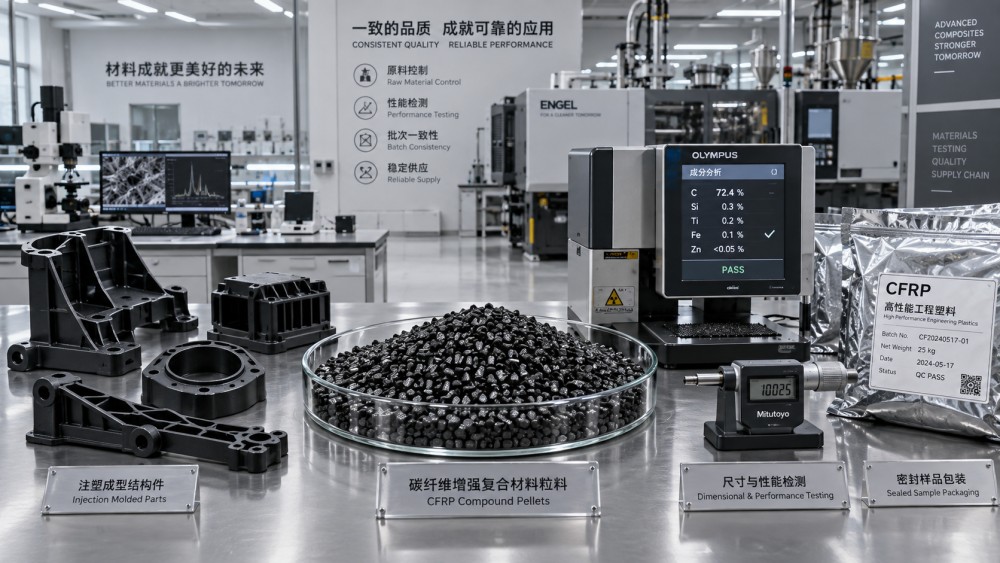
Ask for the supplier’s lot-release controls and for the variables checked on each batch. The exact control plan will vary by resin family and application, but relevant items can include moisture, density, melt-flow or rheological behavior, ash or fiber-content verification, color, pellet quality, and selected mechanical tests. The important point is not that every property is tested on every lot; it is that the supplier can demonstrate a defined release system, traceability, and a documented response when a result falls outside control limits.
The method used to verify reinforcement content should be understood rather than assumed. Conventional ash testing is not automatically straightforward for carbon-fiber-filled systems because carbon fiber and polymer decomposition behavior must be distinguished carefully. Suppliers should identify the analytical method used and show that it is appropriate for the formulation. If fiber content is a contractual requirement, agree in advance on the test method, sampling plan, tolerance, and procedure for resolving disputed results.
Color consistency may appear secondary, but it can indicate formulation or processing variation in visible parts. More importantly, black carbon-fiber compounds can conceal contamination, burned pellets, or dispersion problems that would be easier to detect in natural materials. Incoming inspection should include pellet appearance and packaging condition, but it should not substitute for supplier process control.
Documentation must match the application and destination market
Documentation requests should be tied to the product’s regulatory and customer requirements. Generic compliance statements have limited value when they do not identify the grade, revision, substance scope, and period of validity. For electrical and electronic applications, declarations related to RoHS or REACH may be relevant depending on the product and market. For flame-retardant grades, confirm the precise test classification, specimen thickness, color, processing condition, and whether a recognized certification file applies to the exact formulation.
Where a UL recognition is required, verify the current UL Yellow Card or relevant certification record rather than accepting a broad statement that the material is “UL compliant.” A material family may include grades with different colors, thickness ratings, reinforcing levels, or flammability classifications. The molded part and final product can also be subject to requirements beyond the resin’s material recognition.
Automotive supply chains may require a quality-management system such as IATF 16949 at certain tiers, along with customer-specific approval documents, change-notification rules, and production-part validation. These expectations should not be imposed automatically on an industrial application that does not need them, but they should be assessed early where the end customer requires formal PPAP, IMDS reporting, restricted-substance declarations, or traceability to raw-material lots.
Certificates matter most when they are linked to a controlled document system. Check revision control, expiry policy, authorized signatory or digital validation, and whether the supplier informs customers when the formulation, manufacturing site, fiber source, additive package, or test method changes. An undocumented formulation change can be more disruptive than an announced price increase.
Evaluate supply continuity beyond quoted lead time
Carbon-fiber-reinforced compounds depend on several upstream inputs: the base polymer, carbon fiber, additives, packaging, and compounding capacity. A supplier may have adequate current inventory while remaining exposed to a single fiber source, one compounding plant, constrained production slots, or long international transit routes. The right question is not simply “What is the lead time?” but “What conditions can change it, and how will the supplier respond?”
Clarify manufacturing location, normal production cadence, minimum order quantity, standard pack size, safety-stock arrangements, forecast expectations, and allocation policy during shortages. A supplier that compounds only after receiving an order may be suitable for low-volume specialty parts but unsuitable for a program with tight production continuity requirements. Conversely, a large minimum order may create unnecessary working-capital exposure if the grade has limited shelf life or is unique to one project.
Supply resilience also includes technical continuity. Determine whether the supplier has a second qualified manufacturing line or site, whether critical raw materials have approved alternatives, and whether substitutions require customer approval. “Equivalent raw material” should not be accepted without clarity on the change-control process. In carbon-fiber compounds, a change in fiber grade, sizing compatibility, or base-resin source can affect both processing and end-use performance.
Compare cost on a converted-part basis
The quoted material price should be converted into a realistic part-cost view. Include material yield, regrind policy, drying energy, cycle-time effect, scrap rate during startup, tool wear, machine wear, quality-testing burden, freight, duties where applicable, inventory carrying cost, and the cost of qualification. A lower-density or higher-modulus alternative may reduce part mass or enable wall-thickness changes, but those benefits only count after tooling, validation, and functional requirements have been assessed.
Regrind requires particular caution. Some carbon-fiber compounds can tolerate controlled internal regrind under defined conditions, while others may suffer further fiber shortening, moisture exposure, thermal-history effects, or property variation. The acceptable percentage should come from validated part performance and supplier guidance, not from a general assumption that thermoplastics are freely recyclable in-process.
Request a transparent commercial basis: currency, Incoterms, price-validity period, surcharge mechanism if any, freight responsibility, payment terms, and the treatment of off-spec material. For cross-border supply, confirm who bears the cost and administrative responsibility for export documentation, customs classification, restricted-substance declarations, and product-origin records where needed. These details can alter the effective landed cost more than a small difference in resin price.
Qualification should end with an enforceable control plan
A supplier approval is stronger when technical and commercial expectations are converted into documents that can be used after the first shipment. The approved grade should be identified by exact code and revision. Acceptance properties, sampling expectations, certificate requirements, packaging, labeling, lot traceability, storage conditions, and approved manufacturing locations should be recorded. So should the notification period and approval process for changes to formulation, raw materials, production equipment, test methods, or site.
For critical parts, retain reference samples from approved lots and define escalation actions for deviations: containment, root-cause analysis, replacement material, retesting, and communication timing. This is particularly valuable when the compound is used in safety-related, electrical, high-temperature, or high-load components, where a material deviation may not become visible until after assembly or service exposure.
The strongest carbon fiber reinforced compounds supplier is not necessarily the one with the highest published property values or the lowest opening quotation. It is the source that can repeatedly supply the specified formulation, explain how performance is controlled, support production-representative validation, document compliance accurately, and manage changes without creating hidden risk in the finished part.
Have questions about this sector analysis, or seeking best practices specific to your niche? Drop us a line below and let the senior consultants at APIM assist you.
We respect your privacy. Your information is strictly confidential.
Related News
- 00
0000-00
Do polyolefin hot melt adhesives bond well to polyethylene? - 00
0000-00
Korean Study Finds PLA Barely Degrades in Landfill After 320 Days - 00
0000-00
How to assess batch consistency from a thermal potting compounds supplier - 00
0000-00
How much weight can carbon fiber reinforced plastics save in cars? - 00
0000-00
Switching from PS to ABS Sheet Extrusion: Equipment Checks