




What is driving growth in the mechanical recycling plastics market?
The growth of the mechanical recycling plastics market is being driven less by a single breakthrough than by a change in the economics and obligations surrounding plastic use. Recycled resin is no longer evaluated only as a lower-cost substitute for virgin polymer. For many packaging, consumer goods, automotive, construction, and industrial supply chains, it has become a material linked to regulatory compliance, customer specifications, waste-management strategy, and access to downstream markets.
That shift does not mean every plastic stream is suitable for mechanical recycling or that recycled content can be introduced without trade-offs. Market expansion depends on a more demanding equation: sufficient feedstock must be collected, sorted, and cleaned; recyclers must produce consistent material; converters must maintain process stability; and finished products must meet applicable safety, performance, and traceability requirements. Growth occurs where those conditions can be aligned at industrial scale.
Regulation is turning recycled content into a procurement requirement
Public policy is one of the strongest forces behind demand for mechanically recycled plastics. Extended producer responsibility (EPR) systems, landfill restrictions, separate-collection requirements, packaging rules, and recycled-content obligations change the commercial position of recovered material. They create a direct cost for placing difficult-to-recycle packaging on the market and, in some cases, establish a reason to secure recycled polymer before it becomes scarce.
In Europe, packaging policy has become particularly consequential because it connects packaging design, recyclability, recycled content, collection systems, and producer responsibility. The EU Packaging and Packaging Waste Regulation (PPWR) places greater emphasis on packaging that can be recycled at scale and includes recycled-content requirements for certain plastic packaging categories over time. Its importance for the mechanical recycling plastics market is not confined to one regulation: it encourages brand owners, packaging converters, resin suppliers, and recyclers to work from a common set of material and design constraints.
Similar demand signals appear through recycled-content legislation and procurement policies in individual jurisdictions elsewhere. Their details differ substantially. Some focus on beverage containers, others on rigid packaging or public purchasing. For market research, the critical distinction is not simply whether a rule exists, but which polymer, product category, calculation method, and compliance evidence it covers. A nominal recycled-content target can have limited effect if the relevant material is exempt, if mass-balance accounting is allowed under specific conditions, or if food-contact restrictions prevent a recycled stream from entering the intended application.
Regulation also changes risk management. A converter that can document recycled content, material origin, and chain of custody may be in a stronger position when supplying multinational brand programs or regulated product categories. This is why certification systems and traceability records have gained commercial relevance alongside pellet quality. The material must be usable, but it must also be demonstrably what the buyer claims it is.
Brand commitments create demand beyond legal minimums
Consumer-facing companies have made packaging sustainability commitments for reasons that extend beyond formal legal duties: retailer requirements, investor scrutiny, public reporting, and pressure to reduce reliance on virgin fossil-based plastics all play a role. These commitments pull demand through the value chain, especially for recycled PET (rPET), recycled polyethylene (rPE), and recycled polypropylene (rPP).
The resulting demand is often strongest where recycled material can be incorporated with manageable technical risk. Clear PET bottles, opaque HDPE containers, household-product packaging, transport packaging, crates, bins, pipes, agricultural products, and some durable goods can offer practical entry points, though each has different quality and regulatory thresholds. For example, a recycled resin suitable for a dark-colored non-food container may not be appropriate for a clear bottle, a thin film, or a product exposed to demanding mechanical loads.
This distinction matters because “recycled content” is not a uniform purchasing category. Buyers may require post-consumer recycled (PCR) content, post-industrial recycled material, a specified color range, odor limits, food-contact authorization, low gel content, controlled melt flow, or support for a particular molding or extrusion process. The mechanical recycling plastics market therefore grows most reliably where demand specifications are precise enough to guide investment but realistic enough to be supplied from available waste streams.
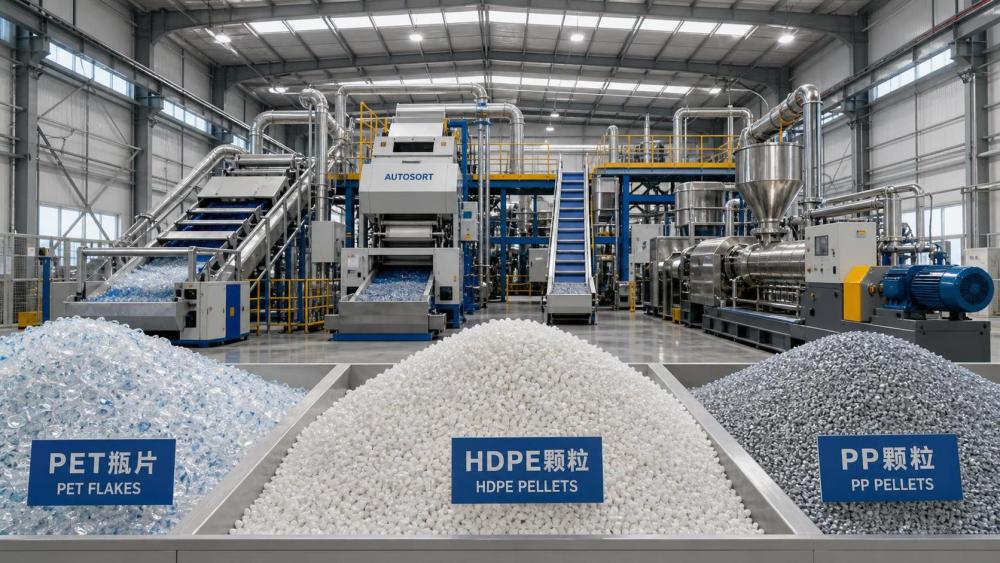
Mechanical recycling remains the practical route for many high-volume polymers
Mechanical recycling generally involves collecting, sorting, washing, size reduction, separation, drying, melt filtration, extrusion, pelletizing, and, where required, deodorization or further decontamination. It does not convert polymers back into basic chemical feedstocks. Its commercial attraction lies in its relative maturity and its ability to process substantial volumes of suitable material with established equipment.
For relatively clean, well-separated streams, the route can retain considerable material value. PET bottles, HDPE containers, PP rigid packaging, PE films, and selected industrial scrap streams are common examples. The output may be used directly, blended with virgin resin, compounded with additives, or directed to applications that tolerate wider property variation.
Mechanical recycling is particularly competitive when collection and sorting systems can generate a consistent feedstock. A recycler handling a narrow, well-characterized stream can manage contamination and process conditions more effectively than one receiving a mixed stream containing multiple polymers, labels, adhesives, pigments, fillers, paper, metal, food residues, and moisture. This is one reason why the market is closely tied to waste-system quality, not only recycling plant capacity.
The route also fits the practical needs of many converters. Recycled pellets can be introduced into existing injection molding, blow molding, sheet extrusion, pipe extrusion, fiber, or film operations if material behavior is sufficiently controlled. The processing window may need adjustment, and formulations may require stabilizers, chain extenders, compatibilizers, odor-control measures, or blending with virgin resin. Yet the ability to use recycled feedstock within familiar conversion processes makes mechanical recycling commercially relevant even where closed-loop recycling is not feasible.
Better sorting and process control are widening the usable feedstock base
Technology is a growth driver because it improves the probability that waste can be turned into a predictable polymer feedstock. Near-infrared sorting, optical color sorting, density separation, washing systems, hot washing, sink-float separation, metal detection, flake sorting, and advanced melt filtration all address different parts of the contamination problem. Their value depends on the incoming stream and the intended end use.
Sorting is often the decisive stage. A recycling line cannot fully compensate for a feedstock containing incompatible polymers or excessive non-plastic contamination. Small amounts of PVC in a PET stream, for example, can create serious processing and quality problems. Polyolefin streams present a different challenge: polyethylene and polypropylene may be useful in some blended applications but require better separation when a buyer needs tightly controlled mechanical properties.
Improvements in sorting do not eliminate the need for packaging design changes. Black pigments, multilayer structures, incompatible labels, full-body sleeves, metallized layers, barrier coatings, and difficult adhesives can reduce sortability or complicate washing and reprocessing. The connection between design and recycling economics is becoming clearer: a package may be technically recyclable in principle while remaining difficult to recover at sufficient quality through the collection and sorting systems available in a given market.
Process control inside the recycling plant is equally important. Moisture can degrade hydrolysis-sensitive polymers such as PET during melt processing. Residual inks, adhesives, and organic contamination can cause odor, discoloration, volatile emissions, or black specks. Repeated heat history may reduce molecular weight or alter melt-flow behavior. Quality-focused operations respond through feedstock specifications, washing discipline, drying, filtration, vacuum degassing, additive selection, laboratory testing, and lot-level controls. These steps add cost, but they also determine whether recycled resin can move from low-value applications into more demanding ones.
Virgin resin volatility makes secondary supply strategically relevant
Mechanical recycling is not insulated from virgin polymer markets. When virgin resin prices fall sharply, recycled material can lose its simple price advantage, particularly in applications with limited recycled-content obligations. When virgin supply is tight or affected by energy, logistics, or regional disruptions, qualified recycled resin can become more strategically valuable.
However, the relationship is not a straightforward discount calculation. Buyers may accept a recycled resin at a price close to, or above, virgin material where it supports a contractual recycled-content target, a product claim, or a compliance obligation. Conversely, a low-cost recycled pellet may have little practical value if color variation, odor, contamination, inconsistent melt flow, or weak documentation creates production losses downstream.
This makes supply agreements more important than spot purchasing for critical applications. A meaningful assessment of supply security should examine collection access, sorting arrangements, yield losses, capacity utilization, quality systems, transport distance, and the degree to which a recycler depends on one waste source. Recycled polymer availability is shaped by material recovery rates and feedstock competition, not merely by installed extrusion capacity.
Demand is diversifying, but application ceilings remain real
Packaging remains central because it generates large volumes of recoverable plastics and is subject to visible sustainability pressure. Yet other sectors are also relevant. Automotive suppliers use recycled polymers where specifications permit, particularly in non-appearance and selected interior or under-the-hood components. Construction applications can absorb recycled PVC, PE, PP, and other polymers in products such as pipes, profiles, membranes, and insulation-related components, depending on standards and formulation needs. Consumer durables, furniture, logistics products, electronics housings, and industrial products can also create demand for recycled compounds.
These markets do not require the same material quality. A pallet, drainage product, injection-molded utility item, and cosmetic bottle impose different requirements for impact resistance, stiffness, surface finish, odor, color, chemical resistance, dimensional stability, and regulatory documentation. Growth in the mechanical recycling plastics market should therefore not be interpreted as a universal move toward closed-loop use. In many cases, material is cascaded into a different product category. That can still displace virgin resin and extend polymer utility, but it should not be confused with a permanent loop.
Food-contact applications illustrate the limits clearly. Recycled plastic used in food packaging must satisfy stringent safety requirements, and the suitability of a process depends on polymer type, collection system, decontamination performance, intended use, and the rules of the market where the packaging is sold. Food-grade rPET has become an important reference point because bottle collection streams can be relatively well defined and decontamination technologies have developed around them. The same logic cannot automatically be transferred to mixed polyolefin waste.
The market is moving from “recycled” to “specified recycled”
The most important commercial change is the shift from broad recycled-content claims toward detailed material specifications. Buyers are asking whether a resin is PCR or post-industrial, mono-polymer or mixed, natural or colored, odor-controlled or standard grade, food-contact suitable or non-food only, and supported by auditable traceability. They also need to know how the resin behaves on their equipment.
This favors recyclers and compounders that can control variability rather than merely process volume. Compounding can play a major role by blending recycled resin with virgin polymer, reinforcing fibers, impact modifiers, stabilizers, compatibilizers, mineral fillers, or color systems. Such formulations may enable recycled content in applications that cannot tolerate an unmodified recyclate. But every formulation introduces another question: does the additive package improve performance without reducing future recyclability or complicating end-of-life sorting?
There is no single quality hierarchy across all recycled plastics. A highly consistent black rPP compound may be valuable for an automotive part, while a clear rPET flake with controlled contamination may be valuable for bottle-to-bottle recycling. The relevant measure is fitness for a defined application, not an abstract label of “high quality.”
What will determine whether current momentum becomes durable growth
Mechanical recycling has a clear role in reducing dependence on virgin resin for streams that can be collected, sorted, and processed effectively. Its market growth is supported by policy, corporate demand, established processing routes, and improving waste-handling technology. But durable expansion will depend on resolving the mismatch between ambitious recycled-content targets and the physical quality of available feedstock.
The most useful indicators are not headline capacity announcements alone. Feedstock capture rates, contamination levels, sorting yields, approved end uses, long-term offtake arrangements, traceability systems, and converter acceptance provide a more realistic view of market development. Where collection design, packaging design, recycling technology, and end-market specifications reinforce one another, mechanical recycling can supply a dependable industrial material. Where they do not, additional capacity may produce pellets that remain confined to low-value or unstable outlets.
Have questions about this sector analysis, or seeking best practices specific to your niche? Drop us a line below and let the senior consultants at APIM assist you.
We respect your privacy. Your information is strictly confidential.
Related News
- 00
0000-00
How does washing affect contamination in post-consumer recycled PP resins? - 00
0000-00
How does feedstock affect depolymerization equipment selection? - 00
0000-00
US Sets 213.44% Preliminary Antidumping Deposit on Chinese PTMEG - 00
0000-00
When should epoxy be used as a thermal interface material for semiconductors? - 00
0000-00
US Midterm Results Unlikely to Quickly Shift Recycled Plastics Market or Legislation