




What is driving demand for recycled automotive polymers?
Demand for recycled automotive polymers is being driven less by a single sustainability objective than by a convergence of design, regulatory, supply-chain, and cost pressures. Vehicle manufacturers need credible ways to reduce the environmental impact of materials without compromising safety, appearance, manufacturing efficiency, or warranty performance. Recycled polymers can address part of that challenge, but only when their quality, composition, and availability are controlled closely enough for automotive use.
The important commercial shift is that recycled content is no longer evaluated only as a procurement attribute or a corporate reporting metric. It is increasingly becoming a material-development requirement that affects component design, supplier qualification, tooling conditions, traceability systems, and end-of-life strategy. This is why demand is strongest where recycled material can be incorporated into established polymer applications with manageable performance risk, rather than where it merely offers the highest nominal recycled-content percentage.
Regulation is changing the value of recovered automotive materials
Policy pressure is a central driver, particularly in Europe, where circularity in vehicles has moved from a broad environmental ambition toward more specific material expectations. The European Union’s proposed Regulation on circularity requirements for vehicle design and on management of end-of-life vehicles would, if adopted in its proposed form, establish recycled-content requirements for plastics in new vehicles and include a dedicated role for material recovered from end-of-life vehicles. The legislative process and final obligations remain subject to change, but the direction is commercially significant: automotive plastics are increasingly being viewed as a recoverable feedstock rather than a one-way manufacturing input.
This matters because vehicle recycling has traditionally generated mixed and contaminated polymer streams that are difficult to return to high-value applications. Bumpers, instrument panels, wheel-arch liners, underbody shields, interior trim, electrical housings, foams, coatings, adhesives, and metal inserts can enter dismantling and shredding systems together. The resulting material may contain incompatible polymer families, pigments, fillers, elastomers, paint residues, or legacy additives. A regulation that gives greater value to closed-loop recycling creates a reason to invest in better dismantling, sorting, decontamination, compounding, and verification.
The regulatory effect extends beyond the automotive manufacturer. Tier suppliers, compounders, recyclers, dismantlers, and material traders need clearer evidence of material origin and recycled-content calculation. A recycler that can provide a stable polypropylene stream with documented automotive origin is in a different commercial position from one offering a broadly specified post-consumer mixed polyolefin. Both may be recycled material, but their value in a vehicle program is not comparable.
OEM climate commitments are turning material choices into supply-chain questions
Automakers’ decarbonization and circularity commitments are another major source of demand. For a vehicle manufacturer, reducing the footprint associated with purchased materials can be relevant to lifecycle assessments, supplier engagement programs, product declarations, and public sustainability commitments. Plastics deserve attention because they are used across a large number of parts and because virgin polymer production is energy- and feedstock-intensive.
Yet the commercial requirement is not simply to buy recycled resin. Automotive programs are governed by multi-year qualification cycles, defined specifications, production-part approval procedures, color and appearance requirements, and warranty exposure. A recycled polymer grade must be available in sufficient volume, exhibit consistent lot-to-lot behavior, and continue to meet processing and functional requirements after formulation, molding, painting, welding, or assembly.
This turns demand into a request for managed supply rather than an open-ended request for recyclate. Procurement teams increasingly need answers to questions such as:
- What is the feedstock source, and is it post-industrial, post-consumer, or recovered from end-of-life vehicles?
- How is polymer identity verified before and after sorting?
- Which contaminants are screened, and at what point in the process?
- Can the supplier maintain the same formulation and recycled-content range through the program life?
- What documentation supports recycled-content claims and chain-of-custody requirements?
- How will a supply disruption in recovered feedstock affect qualification and delivery?
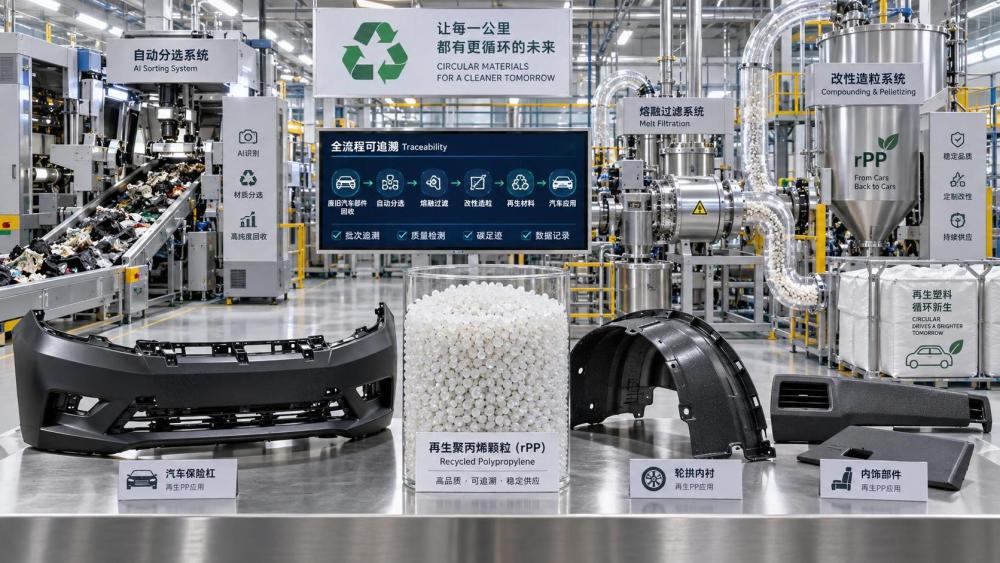
The need for these answers explains why automotive-grade recycled polymers are often supplied as compounded materials rather than as minimally processed recycled pellets. Compounding can correct variability through blending, filtration, stabilization, odor reduction, reinforcement, impact modification, and controlled use of virgin polymer where permitted by the specification. The objective is not to disguise recycled content; it is to make recycled feedstock function predictably in a demanding industrial system.
Lightweighting and electrification create new openings, but not universal substitution
Automotive polymers have long supported weight reduction, corrosion resistance, part integration, styling freedom, and cost-efficient production. These same advantages make them relevant in battery-electric vehicles, where vehicle mass, packaging space, electrical insulation, thermal behavior, and acoustic performance remain important design considerations. Recycled-content compounds can enter this landscape when they preserve the properties required by the part.
The opportunity is most practical in applications where mechanical and cosmetic demands are known, material history can be managed, and design margins exist. Examples may include underbody components, wheel-arch liners, non-visible structural covers, luggage-area trims, seat-related parts, air-management ducts, splash shields, selected interior substrates, and certain exterior or semi-structural components. Polypropylene compounds are particularly important because polypropylene is widely used in automotive interiors, exteriors, and under-the-hood applications, while recycled PP streams can be upgraded with mineral fillers, elastomers, stabilizers, and compatibilizers.
Other polymer families also matter. Recycled PET can be relevant for fibers, nonwovens, insulation elements, and some engineered compounds. Recycled polyamide may offer value where recovery and contaminant control are sufficiently robust, although moisture sensitivity, molecular-weight management, and reinforcement compatibility require careful assessment. Recycled ABS, PC/ABS, and other styrenic materials can be viable in selected interior and electrical applications, but appearance, odor, volatile emissions, flame-retardant content, and impact performance may narrow the usable range.
Electrification does not automatically expand recycled content in every plastic component. High-voltage electrical systems, battery enclosures, thermal-management hardware, and safety-critical structures can impose stringent requirements for flame retardancy, dielectric behavior, heat aging, hydrolysis resistance, dimensional stability, and long-term reliability. In these applications, the barrier is not a lack of sustainability interest; it is the burden of proving that recycled feedstock does not introduce unacceptable variation or unknown substances.
Economics are becoming more nuanced than “recycled costs less”
Recycled polymers are often associated with lower material cost, but automotive sourcing decisions cannot rely on that assumption. The price relationship between virgin and recycled material changes with crude-oil markets, regional collection systems, available scrap volumes, sorting yields, energy costs, transport distances, and demand from other industries. High-quality, traceable automotive recyclate can command a premium when supply is limited or when a vehicle program requires narrowly specified material.
The more useful economic question is whether the total system cost is defensible. A lower-priced recycled resin can lose its advantage if it causes higher scrap rates, longer molding cycles, greater color variation, additional drying requirements, more frequent machine cleaning, or requalification work. Conversely, a higher-priced recycled compound can have strategic value if it reduces compliance exposure, supports a customer material target, stabilizes a local supply loop, or allows a supplier to retain a program that requires documented recycled content.
There is also a growing distinction between recycled content that is physically present in a part and environmental claims based on mass-balance allocation. Chemical recycling may produce feedstocks that can be processed into polymers with properties similar to virgin materials, potentially broadening applications where mechanical recyclate is unsuitable. However, mass-balance models, allocation methods, certification schemes, and customer acceptance need to be understood precisely. A claim based on certified allocation is not equivalent to a part made from physically segregated recycled polymer, and commercial documents should not blur that distinction.
Quality consistency is the real bottleneck
The decisive issue in recycled automotive polymers is not whether a material can meet a datasheet once. It is whether it can meet the agreed specification repeatedly across production lots and over the lifetime of a vehicle platform. Recycled feedstock has a more complex history than virgin resin. It may have undergone multiple heat histories, unknown service exposure, contamination during collection, or degradation during shredding and reprocessing.
For compounders and part producers, that variability can influence melt flow, impact strength, tensile properties, elongation, odor, volatile organic compound emissions, color, gloss, shrinkage, warpage, and resistance to thermal aging. In glass-fiber-reinforced materials, fiber length and dispersion also affect mechanical performance. In filled polyolefins, the balance between filler content, impact modification, and flow behavior determines whether the material can run on existing tools without costly adjustments.
Quality control therefore needs to begin with feedstock, not only finished pellets. Effective systems may combine source segregation, near-infrared sorting, density separation, metal removal, washing, melt filtration, devolatilization, laboratory identification, and batch-level testing. The appropriate process depends on the polymer and application, but the business principle is consistent: the supplier’s control over input variability is often more important than the headline recycled-content level.
A common mistake is to compare recycled grades solely by percentage of recycled content. A 30% recycled compound with stable rheology, low odor, documented feedstock, and reliable delivery may be commercially stronger than a 60% grade whose properties move from batch to batch. Higher content has value only if it remains compatible with the component’s performance envelope and production conditions.
Design for recycling is beginning to influence today’s material selection
Demand for recycled polymers is also being shaped by a forward-looking design question: will the component itself be recoverable at the end of its life? This is changing discussions between design teams, material suppliers, and recyclers. A component built from a single polymer family, with limited incompatible inserts and clearly identifiable material markings, is generally easier to sort and recycle than a complex assembly of bonded layers, coatings, foams, metals, and multiple resins.
Design-for-recycling does not mean eliminating every multi-material solution. Automotive parts frequently require combinations of stiffness, impact resistance, sealing, appearance, flame retardancy, or tactile quality that a single polymer cannot provide. It does mean recognizing the end-of-life consequences of those choices early enough to evaluate alternatives. Mechanical fastening, removable inserts, compatible polymer pairings, reduced use of problematic pigments, and clearer material identification can all improve recovery prospects, depending on the component architecture.
For global supply chains, this has a further implication. Recycled-content strategies cannot be separated from regional collection and processing infrastructure. A resin formulation that works well with locally available recycled feedstock in one region may not be reproducible elsewhere if the scrap source, sorting technology, regulation, or logistics network differs. Global vehicle platforms may therefore need either a tightly controlled international material supply or carefully managed regional specifications.
What demand is likely to reward
The market is not simply moving toward “more recycled plastic.” It is placing greater value on recycled polymers that can be specified, processed, documented, and recovered with less uncertainty. Material suppliers that can connect feedstock control to application-level performance are better positioned than those offering generic sustainability claims. The same is true for automotive suppliers that treat recycled content as part of engineering and supply-chain management rather than a late-stage substitution exercise.
The strongest demand drivers will remain interconnected: regulatory movement raises the importance of circularity; OEM commitments create commercial pull; lightweight polymer architectures create places to use recycled content; and economics determine whether a solution can survive program-level scrutiny. But quality assurance, traceability, and stable processing are the conditions that convert those drivers into repeatable automotive demand.
For decision-making, the practical question is not whether recycled automotive polymers have strategic relevance. They do. The harder question is where a specific recycled material can deliver verified environmental value without transferring hidden cost or performance risk into the vehicle program. That answer depends on the component, the polymer family, the feedstock route, the qualification standard, and the ability of every link in the supply chain to maintain control.
Have questions about this sector analysis, or seeking best practices specific to your niche? Drop us a line below and let the senior consultants at APIM assist you.
We respect your privacy. Your information is strictly confidential.
Related News
- 00
0000-00
Do polyolefin hot melt adhesives bond well to polyethylene? - 00
0000-00
Korean Study Finds PLA Barely Degrades in Landfill After 320 Days - 00
0000-00
How to assess batch consistency from a thermal potting compounds supplier - 00
0000-00
How much weight can carbon fiber reinforced plastics save in cars? - 00
0000-00
Switching from PS to ABS Sheet Extrusion: Equipment Checks