




What Are the Costs of Switching to Carbon Fiber Reinforced Plastics?
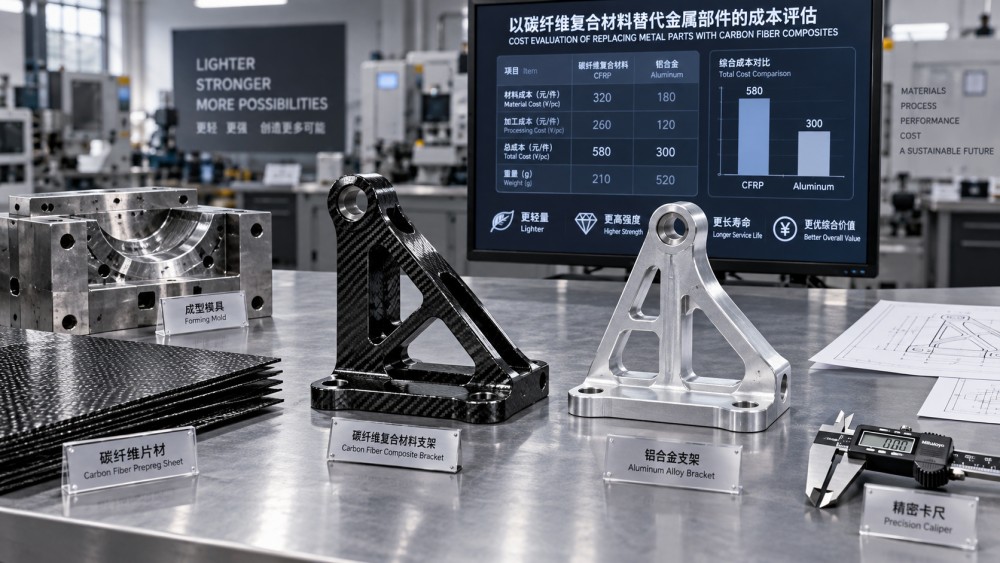
Replacing a metal bracket, machine housing, or glass-fiber reinforced component with carbon fiber reinforced plastic can reduce weight, but it rarely reduces purchasing cost immediately. The switch usually brings higher material costs and may require new tooling, process development, testing, and assembly methods. It becomes economically attractive when those expenses are offset by measurable benefits such as fewer parts, lower operating loads, reduced maintenance, or improved production efficiency.
For a team asking what are the cost implications of switching to carbon fiber reinforced plastics, the first task is to define the proposed material and manufacturing route. Injection-molded carbon-fiber reinforced thermoplastic pellets and continuous-fiber composite laminates have very different economics. Comparing either one with the existing part by price per kilogram alone can produce a misleading business case.
Will the finished component cost more than the existing part?
It may, especially when carbon fiber is introduced without redesigning the component. A direct material substitution can retain the original assembly complexity while adding more expensive feedstock, tighter processing controls, and additional inspection. The strongest cost case often comes from redesigning the part around the composite’s capabilities rather than reproducing a metal geometry.
Start with an equivalent functional requirement: load capacity, stiffness, dimensional tolerance, temperature exposure, impact resistance, and expected service life. A lighter component that meets a static strength target but fails under creep, fatigue, or fastening loads is not an equivalent replacement.
Separate the financial assessment into three layers:
- Conversion investment: engineering, tooling, equipment changes, qualification, and training needed before production release.
- Recurring manufacturing cost: material, processing, finishing, inspection, scrap, assembly, and production overhead.
- In-service economics: operating energy, maintenance, downtime, repair, replacement, and disposal.
This separation also exposes who receives the savings. A manufacturer may pay more to produce a lightweight component while the equipment owner receives the operating benefit. Unless the selling price or commercial arrangement captures some of that value, favorable lifecycle economics do not automatically improve the manufacturer’s margin.
Which type of carbon-fiber reinforced plastic are you pricing?
“Carbon fiber reinforced plastic” describes a family of materials, not a single purchasing category. Fiber length, fiber content, resin chemistry, reinforcement architecture, and supply format all affect cost and processing requirements.
A high-temperature resin can add substantial cost even before carbon fiber is considered. Conversely, a less expensive matrix may be unsuitable for the application’s thermal or chemical conditions. Request quotations for a defined grade and format, including reinforcement content, delivery condition, order quantity, packaging, and shelf-life restrictions where applicable.
How should material consumption and scrap be calculated?
Use the mass of material purchased per accepted component, not simply the finished part’s mass. Continuous-fiber cutting patterns can generate offcuts; molding can create runners, purge waste, and rejected parts. Machining adds further losses. A low finished-part weight does not guarantee low material expenditure.
For molded compounds, distinguish between processing yield and permission to reuse scrap. Regrind may alter fiber length and performance, while customer specifications can restrict its use. Do not assume that all waste can return to the same structural application.
For sheet, fabric, and prepreg, ask for a proposed cutting layout and its expected utilization. Include trial material, storage losses where relevant, and the cost of unusable inventory when a design changes. Credits from selling scrap should only enter the model when an actual recovery route and commercial terms exist.
Can existing machines and tools be retained?
Sometimes, but equipment compatibility is not the same as production readiness. An injection-molding machine may process a carbon-fiber compound while still needing wear-resistant plasticizing components, suitable drying equipment, revised operating conditions, or different material-handling arrangements. Reinforced materials can increase wear on screws, barrels, gates, and other contact surfaces.
Existing molds need a separate assessment. Gate location and flow paths influence fiber orientation, weld-line strength, shrinkage, and warpage. Changes intended to meet structural requirements may require mold modification or replacement. A mold designed for an unfilled polymer should not be assumed suitable simply because the new compound has the same base resin.
Continuous-fiber processing can introduce a different equipment package: cutting, layup, forming, consolidation, curing, vacuum systems, trimming, and extraction. Autoclaves are necessary for some routes, not for every carbon-fiber composite. The cost estimate must follow the selected process rather than assume one universal manufacturing method.
Where do cycle time and labor change the economics?
Measure the complete route from incoming material to an accepted, assembled part. A quoted molding or forming cycle may exclude loading, preheating, curing, cooling, trimming, drilling, bonding, and inspection. Those operations can determine actual throughput.
Manual layup and complex reinforcement placement can make labor a major cost driver. Automation may improve repeatability and output, but it adds investment, programming, fixtures, and maintenance. For short-fiber molding, the critical issue may instead be stable filling and cooling without unacceptable distortion.
Capacity calculations should use the bottleneck operation. A fast forming press provides little benefit if every component waits for a long bonding cure or constrained inspection station. Include changeovers, planned maintenance, and realistic equipment availability when estimating annual output.
Training also belongs in the launch budget. Operators may need new procedures for material drying, layup, contamination control, adhesive preparation, or machining. Conductive carbon-fiber dust requires appropriate extraction, housekeeping, and protection of nearby electrical equipment.
What testing and qualification costs are easy to miss?
Composite properties depend on processing and reinforcement direction. Supplier datasheets are useful for screening, but they do not establish the performance of a particular component with its actual geometry, fiber orientation, joints, and manufacturing defects.
Budget for the tests that address credible failure modes. These can include stiffness, fatigue, creep, impact, thermal cycling, moisture conditioning, chemical exposure, and joint performance. Not every application needs every test; the service conditions and consequences of failure should determine the program.
Continuous-fiber parts may require controls for voids, consolidation, cure state, or delamination. Molded compounds can require attention to weld lines, orientation, dimensional variation, and fiber degradation. Nondestructive inspection can add equipment and interpretation costs, but its need and method depend on part criticality and customer requirements.
Qualification expenses can recur after a material, supplier, tooling, or process change. Include this exposure when considering a lower-priced alternative grade: a purchasing saving may be outweighed by revalidation and production disruption.
Will assembly savings offset the material premium?
They can when redesign removes operations rather than merely changes material. Integrating brackets, ribs, cable guides, or mounting features into one molded component may eliminate separate parts, fasteners, and assembly steps. The savings must be calculated against the resulting tooling complexity and inspection requirements.
Joining can also introduce costs. Bolted connections may need inserts, local reinforcement, or measures to distribute bearing loads. Adhesive bonding adds surface preparation, dispensing control, fixtures, cure time, and verification. These are production operations, not minor accessories.
Electrical conductivity creates another design consideration. Carbon-fiber composites can contribute to galvanic corrosion when coupled with susceptible metals in the presence of an electrolyte. Isolation measures and environmental testing may be necessary at interfaces, particularly where moisture exposure is expected.
How does production volume affect the break-even point?
Low volumes make development and tooling difficult to spread across enough components. At higher volumes, recurring costs become more influential, but larger demand may also require automation, duplicate tools, or additional production cells.
A useful manufacturing comparison is:
Cost per accepted part = recurring cost per accepted part + allocated conversion investment ÷ expected accepted production volume.
Use accepted production volume rather than nominal machine output. Keep the model consistent: if depreciation already appears in the manufacturing rate, do not add the same equipment investment again through amortization.
Where the new route has lower recurring cost, an initial break-even estimate is:
Break-even volume = additional fixed investment ÷ recurring saving per accepted part.
If recurring cost is higher, increasing volume alone will not recover the investment through manufacturing savings. The justification must instead come from captured selling value, assembly savings outside the part-level calculation, or verified operating benefits. Discount future cash flows for a longer project and show the effect of delayed launch or lower demand.
When should weight reduction count as a financial saving?
Only when the reduced mass changes a measurable cost or creates usable value. In moving machinery, a lighter component may reduce inertia, but energy savings depend on the motion profile, drive efficiency, and control strategy. In a static housing, lower mass may simplify installation without materially changing operating energy.
Do not translate a percentage weight reduction directly into the same percentage reduction in energy consumption. Use a system model or representative testing, and separate benefits that are demonstrated from those still awaiting validation.
Durability savings need similar discipline. Composite materials do not rust like steel, but they can still experience matrix degradation, impact damage, delamination, or joint failure. Compare maintenance and replacement assumptions against the actual environment, including inspection access and repairability.
What should procurement request before approving the switch?
Request a costed manufacturing route, not just a material quotation. The submission should identify the proposed material, processing sequence, tooling scope, expected yield, inspection plan, finishing operations, and production capacity. Ask which assumptions come from trials and which remain estimates.
- Establish the baseline: document the existing part’s accepted manufacturing cost, assembly cost, failure exposure, and service requirements.
- Evaluate the redesigned component: confirm that geometry, reinforcement, interfaces, and processing can meet those requirements.
- Run representative trials: measure consumption, cycle time, scrap, dimensional stability, and relevant performance using production-intent conditions where practical.
- Test financial sensitivity: vary volume, yield, labor content, material price, and launch timing rather than relying on one favorable forecast.
Supply continuity belongs in this review. Verify lead times, minimum orders, storage conditions, and whether an alternative source can provide a genuinely equivalent material. A nominally similar reinforcement percentage does not guarantee equivalent processing or structural behavior.
The approval threshold should be explicit: the switch must meet the required performance and produce an acceptable financial result under credible production assumptions. If profitability depends on unproven yield, unrestricted scrap reuse, or operating savings that nobody can capture, resolve those assumptions before committing to production tooling.
Have questions about this sector analysis, or seeking best practices specific to your niche? Drop us a line below and let the senior consultants at APIM assist you.
We respect your privacy. Your information is strictly confidential.
Related News
- 00
0000-00
Do polyolefin hot melt adhesives bond well to polyethylene? - 00
0000-00
Korean Study Finds PLA Barely Degrades in Landfill After 320 Days - 00
0000-00
How to assess batch consistency from a thermal potting compounds supplier - 00
0000-00
How much weight can carbon fiber reinforced plastics save in cars? - 00
0000-00
Switching from PS to ABS Sheet Extrusion: Equipment Checks