




Reinforced Thermoplastics Material Comparison for Weight, Heat, and Cost
A solid reinforced thermoplastics material comparison starts with three pressures that now shape industrial design at the same time: lower weight, higher thermal demand, and tighter cost control.
That combination matters across automotive parts, electrical housings, machinery components, electronics structures, and industrial assemblies where polymers are replacing metal or upgrading standard plastics.
In practice, the decision rarely comes down to one number.
Glass-fiber, carbon-fiber, and mineral-reinforced thermoplastics can all improve stiffness, dimensional control, and service performance, but they do so with different tradeoffs in density, heat resistance, processing behavior, and total landed cost.
For that reason, a useful reinforced thermoplastics material comparison must connect material data with molding conditions, part geometry, sourcing risk, and end-use expectations rather than viewing reinforcement as a simple upgrade.
What reinforcement changes in a thermoplastic system
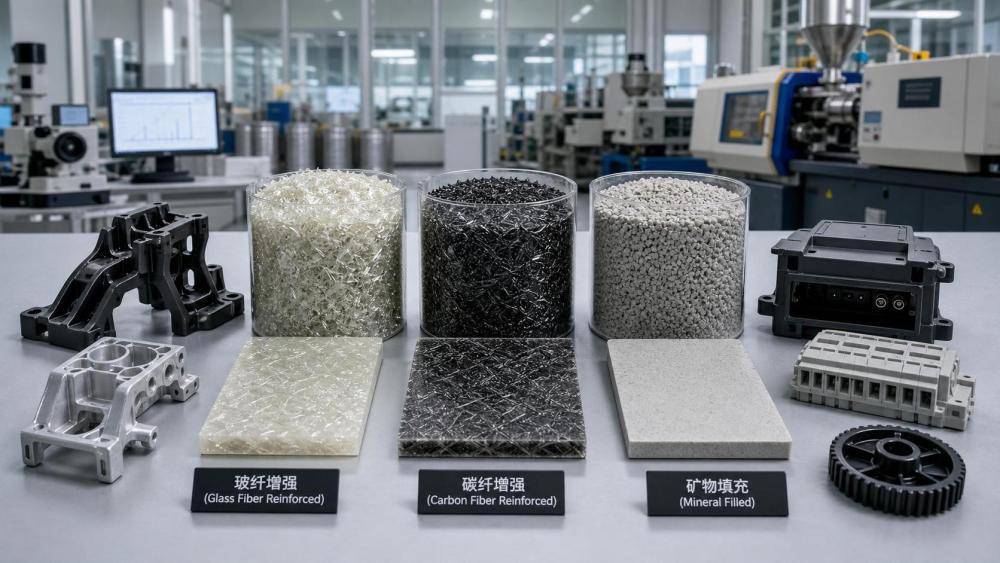
Reinforcement modifies how a polymer behaves under load and heat.
The base resin still matters, whether the platform is PA, PBT, PPS, PC, PEEK, or another engineering plastic, but filler choice often determines whether a part remains stable in real service.
Glass fiber usually raises stiffness and strength at a relatively accessible cost.
Carbon fiber pushes weight reduction further and can add conductivity, but price and supply complexity rise quickly.
Mineral reinforcement often supports dimensional stability, lower warpage, and cost balance, especially where ultra-high structural performance is not essential.
This is why reinforced thermoplastics material comparison work should begin with function, not with filler type alone.
Why the topic is getting more attention
The shift is tied to broader manufacturing priorities.
Products must use less material, survive higher operating temperatures, fit tighter assemblies, and still meet cost targets across volatile supply chains.
At the same time, design teams are under pressure to replace metal where possible, simplify assembly, and improve energy efficiency during use.
A reinforced thermoplastics material comparison therefore supports more than material substitution.
It supports decisions on processing windows, part consolidation, tool wear, dimensional repeatability, and long-term field reliability.
This broader view matches the way APIM approaches advanced polymers and modified compounds.
Structured material knowledge becomes more valuable when thermal, mechanical, and procurement variables must be judged together rather than separately.
Weight, heat, and cost at a practical level
A quick comparison is helpful, but only if the logic stays grounded in industrial use.
The table gives direction, not a final answer.
A 30% glass-filled PA and a mineral-filled PPS may serve very different jobs, even if both claim heat resistance improvements on a datasheet.
That is why reinforced thermoplastics material comparison should always include the base polymer family, reinforcement loading, and expected service environment.
Where each option tends to fit
Glass-fiber reinforced grades are often chosen when structural gain is needed without a dramatic jump in raw material price.
They are common in brackets, under-hood components, pump parts, connectors, and frames where creep resistance and stiffness matter.
Carbon-fiber reinforced compounds tend to appear in lightweight structures, precision components, and higher-end industrial systems where every gram matters or where metal replacement is aggressive.
Mineral-reinforced grades often make sense in covers, electrical housings, appliance parts, and geometries where flatness, surface quality, or cost discipline outrank maximum tensile performance.
From an application logic standpoint, reinforced thermoplastics material comparison is less about ranking materials from best to worst and more about matching the reinforcement style to the part’s failure mode.
The heat question is broader than HDT
Heat deflection temperature is useful, but it is only one lens.
Real parts face cycling, localized hot spots, load under temperature, chemical exposure, and aging.
A resin that performs well in a short lab test may still warp, embrittle, or lose retention force over time.
In electrical and electronics applications, flame performance, dielectric behavior, and dimensional stability can matter as much as pure thermal numbers.
In machinery, friction, oil contact, and repeated stress may redefine what heat resistance really means.
Cost is more than resin price per kilogram
A useful reinforced thermoplastics material comparison should separate raw material cost from system cost.
More expensive compounds can still reduce total cost if they enable thinner walls, fewer metal inserts, shorter assembly time, or lower failure risk.
The opposite is also true.
A lower-priced compound may introduce higher scrap rates, longer cycles, unstable shrinkage, or higher tool maintenance because of abrasive fillers.
This is especially relevant in compounded materials, where formulation design and process consistency strongly influence actual value.
APIM’s focus on compounding and extrusion technology is relevant here because screw design, dispersion quality, feeding control, and pellet consistency all shape part performance and processing cost.
Cost items often missed early
- Drying requirements and moisture sensitivity
- Mold wear from fiber-filled compounds
- Warpage control in complex geometries
- Secondary finishing or surface appearance correction
- Certification, traceability, and batch validation work
- Supplier support during tooling and qualification stages
These items often decide whether an apparently attractive grade remains attractive at scale.
How to read supplier data with more discipline
Datasheets are necessary, but they are not decision-ready by themselves.
A better reinforced thermoplastics material comparison checks how data was generated and what conditions it does not capture.
Tensile strength may look strong, yet weld line performance may be weak.
A high stiffness value may come with poor impact resistance.
A low-density carbon-fiber compound may still lose the business case if molding windows are narrow or lead times are unstable.
Usually, the most reliable comparisons combine supplier data, molded sample testing, and application-specific review of geometry, load path, and environment.
A practical path for the next decision
The next step is to narrow the comparison around the part, not around generic material categories.
Start with the true performance limit: mass target, continuous-use temperature, dimensional tolerance, chemical exposure, electrical need, and expected service life.
Then compare reinforcement systems against processing limits, tooling constraints, and supply reliability.
Where choices remain close, prototype testing and total cost modeling usually reveal more than another round of headline property comparison.
That is where a reinforced thermoplastics material comparison becomes genuinely useful: it turns material selection from a broad discussion into a structured industrial decision with clear tradeoffs, relevant evidence, and better next questions.
Have questions about this sector analysis, or seeking best practices specific to your niche? Drop us a line below and let the senior consultants at APIM assist you.
We respect your privacy. Your information is strictly confidential.
Related News
- 00
0000-00
How does washing affect contamination in post-consumer recycled PP resins? - 00
0000-00
How does feedstock affect depolymerization equipment selection? - 00
0000-00
US Sets 213.44% Preliminary Antidumping Deposit on Chinese PTMEG - 00
0000-00
When should epoxy be used as a thermal interface material for semiconductors? - 00
0000-00
US Midterm Results Unlikely to Quickly Shift Recycled Plastics Market or Legislation