




Recycled Polymer Compounds for Injection Molding: When Performance Is Good Enough
When Recycled Polymer Compounds for Injection Molding Make Sense
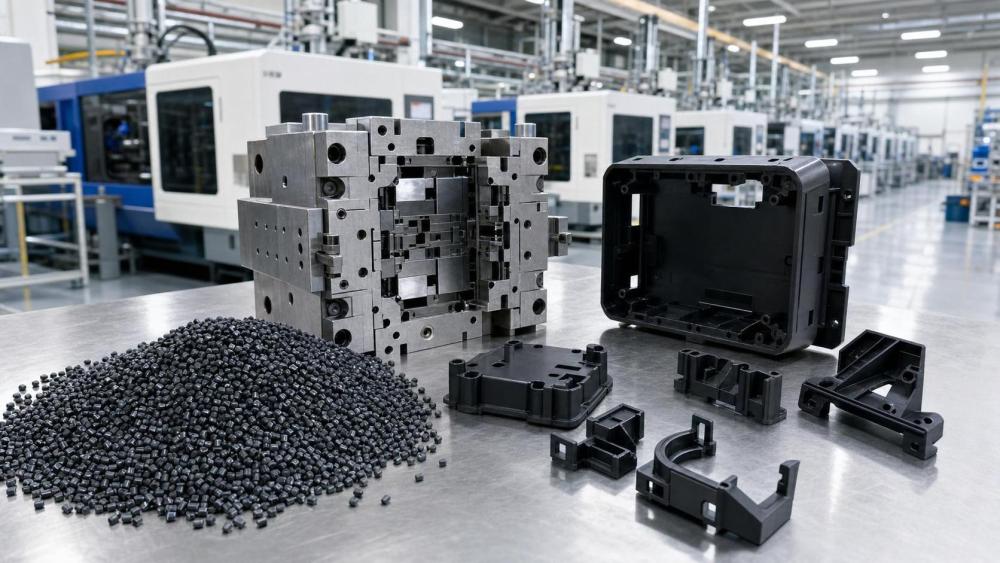
Recycled polymer compounds for injection molding now sit in a practical middle ground.
They are no longer limited to simple, low-visibility parts.
In many industrial programs, the better question is about fit, not perfection.
A virgin-grade benchmark still matters, especially for highly regulated or safety-critical applications.
But many molded parts do not need maximum performance on every property.
They need stable flow, acceptable strength, predictable shrinkage, and reliable supply.
That is where recycled polymer compounds for injection molding deserve a closer look.
Across automotive, electronics, packaging, appliances, and industrial goods, the demand profile changes by part function.
APIM follows these shifts by linking material behavior with processing realities, formulation choices, and downstream performance.
Actual Use Conditions Change the Decision
Two molded parts may use the same polymer family yet require very different decisions.
A cosmetic housing and a load-bearing clip often fail for different reasons.
One may be rejected for color drift or surface haze.
The other may fail because impact strength drops after repeated reprocessing.
This is why recycled polymer compounds for injection molding cannot be judged by tensile strength alone.
Melt flow stability, odor, contamination risk, moisture sensitivity, and lot-to-lot variation can matter just as much.
For filled or modified compounds, dispersion quality and additive consistency also change molding behavior.
In practice, the material decision sits between part design, mold conditions, target cost, and quality tolerance.
A quick comparison of where the thresholds move
For Internal Industrial Parts, Process Stability Often Wins
A large share of successful projects starts with non-cosmetic industrial components.
Examples include spacers, brackets, cable guides, housings, trays, and equipment covers.
These parts may face moderate loads, but their failure mode is usually dimensional or process-related.
Here, recycled polymer compounds for injection molding can work well if the melt behavior is tightly controlled.
A stable MFI window often matters more than chasing top-line mechanical numbers.
When cycle time, fill balance, and part flatness stay within tolerance, production economics improve quickly.
This is also where compound quality becomes visible.
Poor filtration, uncontrolled moisture, or inconsistent pellet size can create short shots, flash, or unstable shrinkage.
APIM often frames this as a materials-plus-processing issue rather than a resin-only issue.
Consumer-Facing Parts Need Better Control Than Many Teams Expect
The discussion changes when the molded part is visible, touched often, or linked to brand perception.
In appliance panels, electronics housings, caps, closures, and interior trim, defects show immediately.
Recycled polymer compounds for injection molding may still fit, but the acceptance window narrows.
Color variation, black specks, gloss inconsistency, and odor can block adoption before strength becomes an issue.
More common success comes from dark colors, textured surfaces, or multilayer design strategies.
Those choices help absorb normal recycled-content variation without compromising the finished part.
The mistake here is assuming that a data sheet confirms market-ready appearance.
Pilot tooling trials under final coloring and real mold temperatures usually reveal the true answer.
In Technical Parts, “Good Enough” Depends on Failure Consequences
Some injection molded parts sit in a tougher category.
They are not always safety-critical by regulation, yet failure carries system cost.
Think of snap-fits, pump elements, under-hood clips, connectors, fan components, or moving assemblies.
For these cases, recycled polymer compounds for injection molding need more than average tensile data.
Heat aging, creep, repeated stress, and dimensional retention become the real checkpoints.
A compound can pass short-term testing and still underperform after months of service.
That risk rises with mixed feedstock, degraded molecular weight, or poorly matched additives.
A practical route is partial replacement.
Blending recycled content with virgin resin, impact modifiers, mineral fillers, or stabilizers can create a better balance.
The technical decision is rarely binary.
Questions that usually separate workable grades from risky ones
- Does the part carry load continuously or only during assembly?
- Will the component see oil, cleaners, humidity, or elevated temperature?
- Is dimensional accuracy more important than maximum toughness?
- Can the design tolerate a wider processing window?
- Is the recycled content post-industrial, post-consumer, or blended from several streams?
Supply Reliability Matters as Much as Material Performance
A recycled compound that performs well in trial runs can still create sourcing problems later.
This is especially true when molded parts support global programs or long qualification cycles.
Recycled polymer compounds for injection molding depend on feedstock quality, sorting discipline, and compounding control.
Changes in collection streams or contamination levels can shift performance unexpectedly.
That is why traceability, batch documentation, and filtration methods deserve direct attention.
In APIM coverage, equipment factors such as vacuum degassing, melt filtration, screw design, and feeder accuracy are part of the quality discussion.
The compounder’s process discipline often explains more than the recycled label itself.
Where Misjudgments Usually Happen
Several mistakes repeat across sectors.
One is treating similar parts as if they share the same material threshold.
Another is comparing recycled polymer compounds for injection molding only against virgin-resin lab values.
That misses what happens in actual molding, assembly, storage, and field exposure.
There is also a cost mistake.
A lower pellet price may be offset by longer cycles, higher scrap, extra drying, or color correction.
On the other hand, some projects reject recycled content too early.
They over-specify performance for parts that mainly need processing repeatability and acceptable fit.
The useful judgment is not whether recycled content is ideal.
It is whether the total application profile stays within a controlled risk range.
A Practical Way to Move from Interest to Qualification
The most effective path starts with part segmentation.
Separate visible parts, stressed parts, regulated parts, and process-sensitive parts before discussing resin grades.
Then define which properties are critical, which are negotiable, and which can be managed through design or processing.
For recycled polymer compounds for injection molding, shortlisting works best when material data is matched with molding trials and aging checks.
A disciplined qualification plan often includes the following steps.
- Map the part by load, visibility, compliance exposure, and replacement cost.
- Review feedstock origin, recycled content ratio, and additive system.
- Run molding trials with final tools, not only lab specimens.
- Check dimensional drift, appearance, odor, and scrap rate together.
- Confirm batch-to-batch consistency over more than one supply lot.
That approach creates a realistic benchmark.
It also fits the broader APIM view that material selection should connect formulation, processing, and end-use conditions.
When the application is defined clearly, recycled polymer compounds for injection molding can move from a sustainability discussion to a sound manufacturing decision.
Have questions about this sector analysis, or seeking best practices specific to your niche? Drop us a line below and let the senior consultants at APIM assist you.
We respect your privacy. Your information is strictly confidential.
Related News
- 00
0000-00
How does washing affect contamination in post-consumer recycled PP resins? - 00
0000-00
How does feedstock affect depolymerization equipment selection? - 00
0000-00
US Sets 213.44% Preliminary Antidumping Deposit on Chinese PTMEG - 00
0000-00
When should epoxy be used as a thermal interface material for semiconductors? - 00
0000-00
US Midterm Results Unlikely to Quickly Shift Recycled Plastics Market or Legislation