




Recycled Plastic Materials for Automotive: Performance Limits and Cost Trade-Offs
Recycled plastic materials automotive programs are no longer limited to interior trim experiments or low-risk cosmetic parts. They are now part of real sourcing and engineering discussions, where cost, compliance, and durability must be balanced with recycled content targets. The opportunity is clear: recycled polymers can reduce dependency on virgin resin, support circularity goals, and lower vehicle mass in some applications. The harder question is where performance limits begin, and when a lower material price is offset by higher processing risk, tighter quality control, or shorter service life.
Where recycled polymers fit in vehicle design
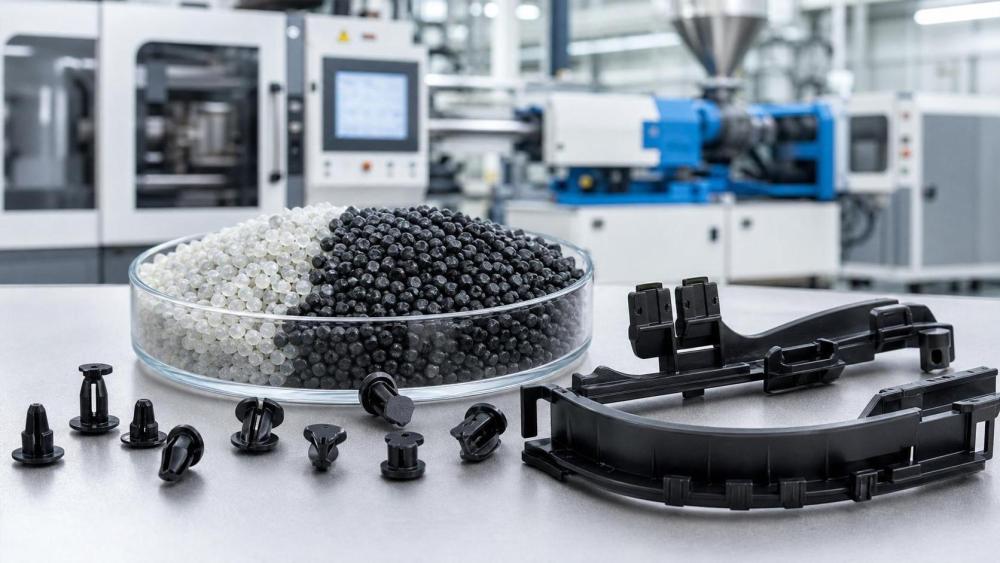
In practice, recycled plastic materials automotive use cases are usually chosen by risk level, not by sustainability ambition alone. Non-visible parts, ducting, underbody shields, brackets, housings, and selected interior components often offer the best entry point. These parts can tolerate broader color variation, moderate cosmetic inconsistency, and some property drift if the design window is wide enough.
That does not mean recycled content is automatically easy to apply. Vehicle programs still depend on stable mechanical performance, predictable shrinkage, and repeatable molding behavior. If a recycled grade varies in melt flow, contamination, or additive residue, downstream effects can appear in warpage, surface defects, odor, or inconsistent assembly fit.
APIM’s material-focused perspective is useful here because it links polymer properties to actual manufacturing decisions. The same logic used for engineering plastics, modified compounds, and compounding control also applies to recycled streams. Material selection is never isolated from process settings, part geometry, and final-use requirements.
Performance limits are usually system limits
The phrase performance limits often sounds like a simple material rating, but automotive reality is more complex. Recycled plastic materials automotive applications can be limited by heat resistance, impact strength, chemical exposure, and long-term aging. Even when a recycled resin meets a basic tensile target, it may still fall short under vibration, humidity cycling, fuel contact, or thermal loading.
This is why recycled content needs to be evaluated as a system. Additives, fillers, stabilizers, and compounding quality matter as much as the base polymer. A recycled PP compound with good odor control and consistent density may work well in semi-structural parts. A poorly sorted stream, by contrast, may create batch instability that makes process windows too narrow for volume production.
The gap between lab data and plant performance is where many programs are won or lost. A resin that performs acceptably in a test plaque may behave differently after regrind history, moisture exposure, or repeated heating in the production line. For this reason, recycled plastic materials automotive sourcing should always include processing trials, not just datasheet review.
Common limit points
- Heat and aging resistance in engine-adjacent or sun-exposed parts.
- Impact retention after multiple processing cycles.
- Odor, color, and surface consistency for visible components.
- Contamination sensitivity in precision molding or thin-wall parts.
Cost trade-offs are broader than resin price
At first glance, recycled plastic materials automotive programs look attractive because recycled resin often carries a lower per-kilogram price than virgin material. Yet the true cost picture is wider. Sorting, cleaning, compounding, testing, certification, and tighter incoming inspection can add meaningful expense. In some cases, the total system cost is reduced; in others, the resin discount disappears in process overhead.
There is also a hidden cost in design adaptation. Parts may need thicker walls, different gate locations, or revised tolerances to accommodate property variation. If a recycled grade requires slower cycles or more frequent purge operations, plant productivity can decline. These changes matter more than a narrow material quote comparison.
For many programs, the best result is not the cheapest resin, but the lowest total risk per part. That is a more realistic way to assess recycled plastic materials automotive decisions in a volume environment.
Applications that usually make sense first
The most practical adoption path is incremental. Recycled PP, recycled PET, and recycled PE often enter applications where mechanical requirements are moderate and appearance tolerance is wider. Interior back panels, wheel arch liners, cable management parts, fluid reservoirs with controlled chemistry, and packaging-related transport components can be suitable candidates.
More demanding applications can also be possible, but only with tighter formulation control. Recycled content blended into modified compounds may support higher consistency, especially when stabilizers, impact modifiers, or fillers are used to restore performance. This is where the broader APIM knowledge base is relevant: the same principles used for reinforced polyamides, flame-retardant polycarbonate, and functional compounds apply to recycled systems as well.
Automotive suppliers often gain the best outcome when they map parts by function, exposure, and failure consequence. A non-critical trim piece and a safety-relevant structural element should never be treated the same way. That simple distinction helps define where recycled plastic materials automotive adoption can move quickly, and where it should remain cautious.
What to check before scaling up
A reliable rollout depends on more than a material declaration. Batch traceability, contamination limits, melt flow consistency, color stability, and odor performance should all be checked early. It also helps to confirm how the recycled stream is sourced, whether mechanical recycling or chemical recovery is involved, and how often quality data is refreshed.
Processing behavior deserves equal attention. Screw design, drying conditions, filtration, and residence time can all influence final compound quality. APIM often highlights this connection between extrusion control and end-use performance, because recycled plastic materials automotive success depends heavily on how well the material is converted, not just how it is specified.
- Run trials under production-like temperatures and cycle times.
- Compare mechanical data after aging, not only at shipment.
- Track variation by lot, source, and compounding route.
- Separate cosmetic tolerance from functional tolerance.
A practical way to move forward
Recycled plastic materials automotive strategies work best when they are treated as a portfolio, not a single substitution plan. Some parts can absorb more recycled content immediately. Others need engineered compounds, supply chain tightening, or longer validation cycles before they are ready for volume use.
The next step is usually to define the part list, identify the performance threshold for each application, and compare material cost against qualification cost. From there, teams can prioritize where recycled plastic materials automotive adoption creates real business value, not just a sustainability statement. In a competitive supply environment, that disciplined approach is often the difference between a promising pilot and a scalable program.
Have questions about this sector analysis, or seeking best practices specific to your niche? Drop us a line below and let the senior consultants at APIM assist you.
We respect your privacy. Your information is strictly confidential.
Related News
- 00
0000-00
NAPCOR Report: US PET Bottle Recycling Rate Fell to 29% in 2025 - 00
0000-00
How does washing affect contamination in post-consumer recycled PP resins? - 00
0000-00
How does feedstock affect depolymerization equipment selection? - 00
0000-00
US Sets 213.44% Preliminary Antidumping Deposit on Chinese PTMEG - 00
0000-00
When should epoxy be used as a thermal interface material for semiconductors?