




Material Selection for Plastics Lightweighting: Cost vs Performance
Material selection for plastics lightweighting rarely comes down to a simple choice between a cheaper resin and a lighter part. In practice, the decision shapes stiffness, thermal behavior, processing stability, compliance risk, and long-term cost across the product lifecycle.
That is why material selection for plastics lightweighting has become a core issue in automotive, electronics, packaging, industrial equipment, and medical applications. When weight targets rise, the wrong polymer can erase savings through tooling changes, scrap, field failures, or supply disruption.
A useful evaluation starts with application logic. Weight reduction matters, but only when it supports the load case, service temperature, chemical environment, surface requirements, and manufacturing route that the finished part must survive.
Why Lightweighting Decisions Have Become More Complex
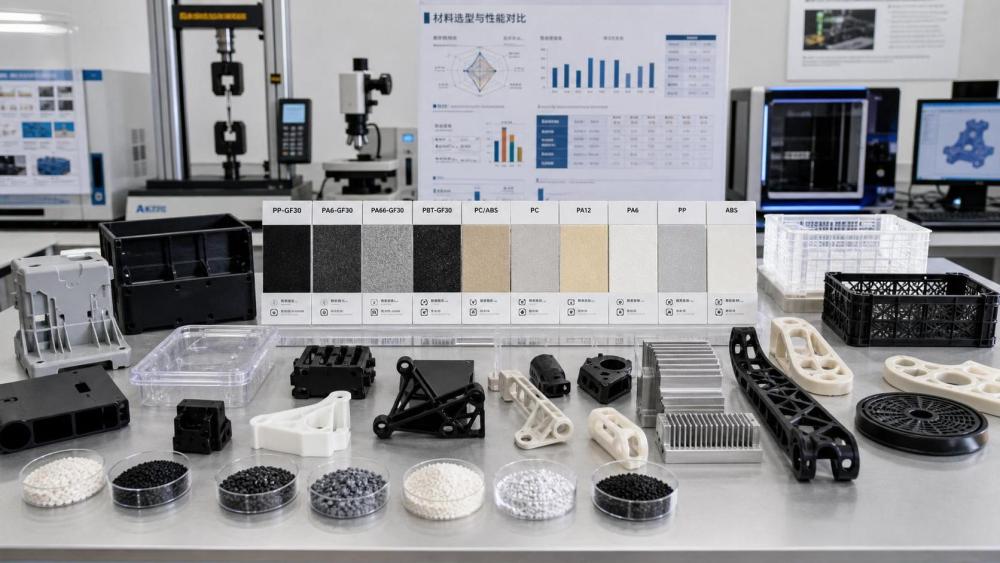
The image fits this section because lightweighting is no longer limited to replacing metal with plastic. It now includes structural redesign, part consolidation, thinner walls, hybrid assemblies, and recycled or bio-based content.
Advanced polymers are replacing metal, glass, rubber, and standard plastics in more demanding uses. That shift expands design freedom, but it also raises the cost of poor assumptions about creep, impact, heat aging, or dimensional stability.
The business context matters as much as the material data sheet. APIM tracks engineering plastics, modified compounds, specialty films, adhesives, and processing technologies because material performance is shaped by formulation, equipment, and downstream conditions together.
For example, a reinforced polyamide may offer excellent weight reduction in a bracket, yet moisture uptake can shift dimensions. A polycarbonate blend may hold tolerances well, but impact retention under heat must still match the actual duty cycle.
Cost vs Performance Means Total Cost, Not Resin Price
Material selection for plastics lightweighting often fails when teams compare only price per kilogram. Lighter parts change geometry, molding windows, cycle time, joining methods, and rejection rates. A more expensive polymer can still lower total cost.
This is especially true when the chosen material enables wall-thickness reduction, part integration, or lower assembly complexity. In those cases, the price gap at the resin level may be offset by fewer fasteners, less machining, or lower logistics weight.
On the other hand, chasing high-performance grades too early can overdesign the part. Materials such as PEEK or PPS may be technically attractive, but their value depends on whether heat resistance, chemical durability, and dimensional retention are truly required.
Which Polymers Usually Enter the Shortlist
The shortlist depends on load, temperature, appearance, and process. Still, several material families appear repeatedly in material selection for plastics lightweighting because they balance density, mechanics, and manufacturability in different ways.
Engineering plastics for structural and functional parts
PA, PBT, POM, PC, ABS, and PET remain common choices for lightweight parts. They are broadly available, familiar to converters, and supported by large compounding ecosystems with reinforced, flame-retardant, conductive, and impact-modified options.
Glass-fiber reinforced PA often performs well where stiffness and cost must stay balanced. PBT and PET are useful when dimensional stability and electrical performance matter. POM can work well for precision and low-friction applications.
High-performance materials for severe environments
PEEK, PPS, and other high-temperature polymers enter the discussion when lighter parts must survive elevated heat, aggressive chemicals, or continuous mechanical stress. These materials justify their premium only when failure consequences are expensive.
Material selection for plastics lightweighting in these cases must include realistic thermal aging, exposure media, and compliance demands. The technical margin may be critical, but so is the ability to process the grade consistently.
Modified compounds and hybrid solutions
Many lightweighting gains come from compounding rather than base resin changes alone. Mineral-filled blends, carbon-fiber compounds, UV-stabilized grades, and thermally conductive plastics can tailor properties without forcing a full platform redesign.
Adhesives also matter. Structural polyurethane or acrylic systems can support lightweight assemblies where mixed materials, vibration resistance, or sealing performance make mechanical fastening less attractive.
Processing Reality Often Decides the Best Material
A promising polymer on paper may still underperform in production. Shrinkage, warpage, melt stability, fiber dispersion, drying sensitivity, and cooling behavior all influence whether the lightweight design can be manufactured at acceptable yield.
This is one reason APIM places compounding and extrusion technologies alongside material coverage. Screw design, feeding accuracy, degassing, residence time, melt filtration, and pellet quality all affect consistency before the material reaches molding or film conversion.
In practical terms, material selection for plastics lightweighting should never be separated from process capability. A thinner-wall part using a premium compound can become uneconomic if the process window is too narrow for stable mass production.
- Check whether the material needs tight moisture control before molding.
- Review fiber orientation effects on stiffness and dimensional variation.
- Confirm weld line behavior for thin sections or integrated features.
- Estimate the impact of regrind limits on cost and consistency.
- Validate surface finish if appearance is part of the product value.
Where Lightweighting Choices Create the Most Value
The value of material selection for plastics lightweighting changes by application. The same polymer may be a cost saver in one product and a poor choice in another because the performance target shifts.
In automotive components, lower mass supports energy efficiency, but thermal cycling, impact, and chemical contact limit the acceptable material range. In electronics, weight matters, yet flame resistance, dimensional control, and insulation performance often dominate.
Packaging follows a different logic. Lightweight films and rigid containers must balance downgauging with barrier performance, stiffness, seal integrity, and recyclability. A lighter substrate that weakens shelf life may destroy the cost case.
Industrial equipment and medical devices add another layer. Precision, sterilization, long service life, and regulatory documentation can outweigh pure weight reduction. The best lightweight solution is the one that protects function without creating hidden qualification delays.
A Practical Framework for Better Material Decisions
A strong review process narrows risk before formal validation begins. The aim is not to find the lightest polymer, but to identify the most credible option set for the intended part and production environment.
Start with the failure mode
Ask what failure looks like in real use. That could mean cracking, deformation, chemical attack, haze, creep, delamination, electrical breakdown, or loss of bond strength.
Then compare realistic candidates
Build a shortlist around property fit, process fit, and supply fit. Include at least one lower-cost option, one balanced option, and one higher-performance option if the application risk justifies it.
Use data that reflects the final application
Generic data sheets are only a starting point. More reliable decisions use end-use temperature, humidity, loading direction, certification needs, and actual joining or coating methods.
Treat sustainability as a technical variable
Recycled or bio-based content may support lightweighting goals, but only when traceability, property stability, and processing behavior are acceptable. Circular material decisions still need the same rigor as conventional resin choices.
What to Review Next
The next step in material selection for plastics lightweighting is usually a tighter comparison between two or three candidates, not a broad survey of every possible polymer. That comparison should connect part design, process limits, testing scope, and supply risk.
Useful follow-up questions include whether the part can be redesigned around a reinforced compound, whether adhesive bonding changes the weight equation, and whether a specialty film or multilayer structure creates a better balance of mass and function.
Structured technical references help at this stage because the trade-off is rarely isolated to one parameter. The better path is to define the required performance window, map it against processing reality, and let cost be judged in the context of the finished application.
Have questions about this sector analysis, or seeking best practices specific to your niche? Drop us a line below and let the senior consultants at APIM assist you.
We respect your privacy. Your information is strictly confidential.
Related News
- 00
0000-00
How does washing affect contamination in post-consumer recycled PP resins? - 00
0000-00
How does feedstock affect depolymerization equipment selection? - 00
0000-00
US Sets 213.44% Preliminary Antidumping Deposit on Chinese PTMEG - 00
0000-00
When should epoxy be used as a thermal interface material for semiconductors? - 00
0000-00
US Midterm Results Unlikely to Quickly Shift Recycled Plastics Market or Legislation