




How to evaluate a fiber reinforced thermoplastics manufacturer
Choosing a fiber reinforced thermoplastics manufacturer is not a matter of selecting the highest glass-fiber percentage or accepting the lowest quoted price. A compound can look compliant on a data sheet yet create warpage, surface defects, brittle weld lines, unstable cycle times, or inconsistent mechanical performance in production. The right supplier is the one that can repeatedly make a material that performs in your specific part, process window, and operating environment.
A sound evaluation starts with the application, not the supplier catalogue. Define what the material must do: carry load, resist heat, retain dimensions, pass electrical safety tests, survive chemicals, meet appearance requirements, or replace a metal component at lower weight. Once those requirements are clear, it becomes much easier to separate capable compounders from suppliers offering a generic reinforced grade.
In practical terms, assess the resin system, fiber type and loading, formulation control, compounding process, lot consistency, testing discipline, documentation, and willingness to support trials. A manufacturer does not need to be the largest to be suitable, but it must be able to demonstrate control over the risks that matter to your program.
Start with the material requirement, not the grade name
“30% glass-filled nylon” is not a complete specification. It may refer to PA6, PA66, a copolyamide, or a recycled-content formulation. It may be heat-stabilized, impact-modified, flame-retardant, hydrolysis-resistant, or none of these. Two materials with a similar name and nominal fiber loading can behave very differently in a molded part.
Before approaching a fiber reinforced thermoplastics manufacturer, prepare a short application brief that includes:
- The base polymer you prefer, if one is already known, and any acceptable alternatives.
- Mechanical loads, service temperature range, exposure time, and relevant chemical contact.
- Part geometry, nominal wall thickness, cosmetic surfaces, inserts, weld lines, and critical tolerances.
- The intended molding or extrusion process, including available machine capability and anticipated cycle-time limits.
- Required test methods, regulatory documents, customer specifications, and approval milestones.
- Expected annual demand, acceptable packaging, delivery regions, and change-control expectations.
This brief prevents an early but common error: comparing laboratory tensile strength between grades that are not designed for the same purpose. A housing near a heat source, for example, may need retained strength after thermal aging more than impressive initial tensile values. A thin-wall electrical component may depend more on flow, flame behavior, and tracking resistance than on maximum stiffness.
What a capable fiber reinforced thermoplastics manufacturer should be able to explain
Ask the supplier to explain the formulation in functional terms. The answer does not need to disclose proprietary details, but it should be technically coherent. They should be able to state why a particular resin platform, fiber treatment, additive package, and stabilization system were selected for the proposed application.
Fiber reinforcement is not simply a percentage added to a polymer. Fiber length after compounding and molding, wetting of the fibers by the polymer, dispersion, orientation, and adhesion at the fiber-polymer interface all influence final behavior. Long, well-oriented fibers can improve stiffness in one direction while increasing anisotropy, shrinkage differences, and warpage risk. Poor dispersion can leave weak zones and create variation between lots.
Ask direct questions: Is the reinforcement glass fiber, carbon fiber, mineral fiber, or a hybrid? Is the grade designed for injection molding, extrusion, or both? What is the nominal and controlled fiber-content range? How is fiber content verified? What typical fiber-length retention is expected after compounding, and what processing conditions are known to cause excessive breakage?
A supplier that responds only with a polished technical data sheet has not answered the important part. Data sheets are useful screening tools. They are not evidence that a material will mold reliably in a complex part.
Check whether the test data matches the real service condition
Standard test specimens are necessary, but they can mislead when treated as part performance. Published tensile, flexural, and impact values are commonly generated under defined laboratory conditions. Your component may be dry, conditioned, welded, notched, heat-aged, chemically exposed, cyclically loaded, or subject to a different stress direction.
For polyamides, moisture conditioning deserves particular attention because moisture can materially change stiffness, impact response, and dimensions. For high-temperature materials such as PPS, PPA, or PEEK, ask for evidence relevant to continuous heat exposure, not just a short-term heat-deflection value. For electrically sensitive applications, verify the exact thickness, color, conditioning state, and test method used for flame, tracking, or dielectric claims.
The strongest supplier discussions usually move quickly from “Here is our data” to “Here is what changes when the part has a weld line, a metal insert, a 1 mm wall, or long exposure to coolant.”
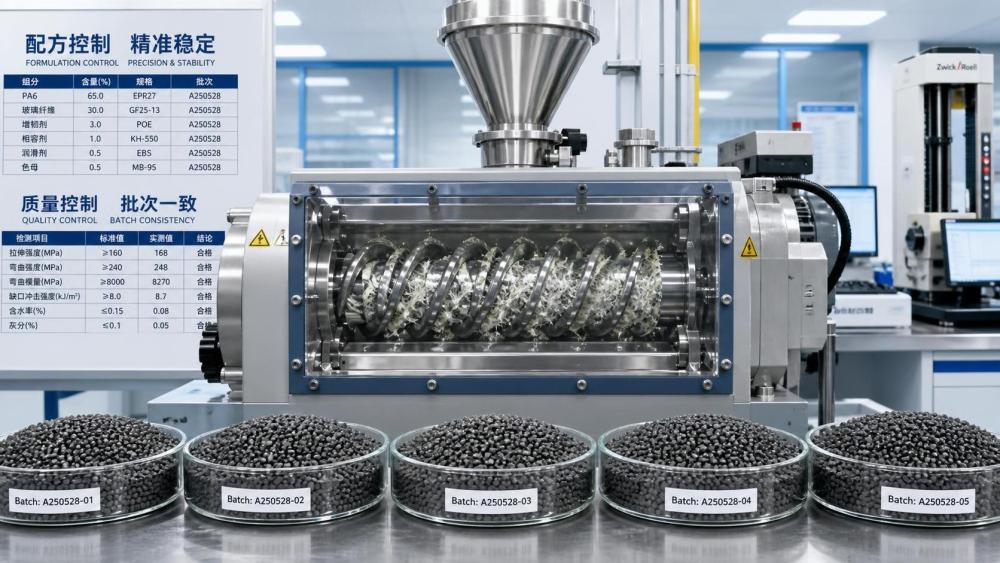
Audit process control behind the pellets
Consistent compounding depends on much more than an extruder model. Feeding accuracy, resin drying, screw configuration, temperature profile, residence time, venting, filtration, pellet cooling, and material handling all affect the compound. A well-run twin-screw line can produce stable reinforced compounds; the same equipment operated without disciplined controls cannot.
During a site visit or a detailed technical review, look for practical evidence of control. Are major raw materials identified and traceable? Are gravimetric feeders used and calibrated? Is moisture checked before processing where the polymer requires drying? Are process parameters recorded by batch? Are off-spec lots segregated? Is there a formal procedure for rework and retained samples?
Pay special attention to change management. A change in base resin source, glass-fiber supplier, stabilizer, pigment, recycled-content level, or production location can alter molding behavior even if headline properties remain close to target. The manufacturer should have a documented process for notifying customers, requalifying changes, and preserving lot traceability.
Do not assume that a quality certification alone proves this discipline. Certification can indicate that a system exists; it does not tell you whether the proposed grade is controlled tightly enough for a dimensionally demanding component. Request recent certificates from an appropriate quality system where required, then examine the batch records, certificates of analysis, and corrective-action approach that sit behind the certificate.
Evaluate lot consistency before committing production tools
A development sample can be excellent and still be a poor predictor of regular supply. The evaluation should include material from more than one production lot whenever the program risk justifies it. Mold comparable parts under the same conditions, then measure the characteristics that actually affect assembly and field performance: shrinkage, warpage, weight, key dimensions, surface quality, fill balance, weld-line behavior, and mechanical response after conditioning or aging.
For a reinforced material, lot-to-lot variation can appear as a small shift in melt flow, moisture, fiber loading, color, or additive content. Each shift may look minor in isolation. In a part with tight tolerances, several small shifts can be enough to change flatness, insert stress, snap-fit performance, or mating dimensions.
Ask for the supplier’s internal specification limits, not only a nominal value on the public data sheet. It is reasonable to ask how they monitor melt flow, density, ash content, moisture, color, and mechanical properties. The appropriate control items vary by polymer and application, but the supplier should be able to explain why each test matters.
Processability is part of material performance
Material selection often fails at the molding machine rather than in the test lab. A very stiff grade may require higher injection pressure, accelerate screw wear, limit flow into thin sections, or show a narrow processing window. A grade with excellent strength may be unsuitable if it produces unacceptable warpage in an asymmetrical component.
Request processing guidance that is specific enough to run a useful trial: drying conditions, barrel temperature range, mold temperature range, back pressure, screw speed, residence-time limits, and likely concerns around gate design or venting. These are starting conditions, not a substitute for mold trials, but vague processing guidance is a warning sign.
For metal replacement projects, do not compare only density and tensile strength. Review creep, fatigue, thermal expansion, stress relaxation, joint design, fastening method, and failure mode. A reinforced thermoplastic can be an effective solution when the component is designed for polymer behavior. It is less convincing when it is expected to copy a metal design without changes to ribs, transitions, bosses, or load paths.
Look beyond standard grades when the application is demanding
Standard glass-fiber reinforced PP, PA, PBT, PC, or PPS grades are often appropriate for mature applications with understood requirements. Custom work becomes more relevant when requirements conflict: a part may need stiffness and impact resistance, flame retardancy and color stability, high flow and low warpage, or recycled content and controlled appearance.
Here, formulation capability matters. A manufacturer should be able to discuss trade-offs openly. Adding fiber usually improves stiffness but may reduce surface quality and impact performance. Flame-retardant packages may affect flow, color, or mechanical retention. Recycled feedstock can support material-circularity goals, but it requires careful traceability and tighter validation when long-term consistency is critical.
Be cautious when a supplier claims one grade solves every requirement without compromise. Materials engineering is usually about managing competing properties, not eliminating trade-offs.
Commercial reliability deserves technical scrutiny
Supply risk is often treated as a procurement issue after the material is approved. That is late. For a production-grade compound, confirm the manufacturing location, lead time, minimum order quantity, backup capacity, raw-material sourcing approach, packaging, and regional warehousing where relevant. A technically strong material is still a weak choice if it cannot be delivered consistently within the production plan.
Also clarify ownership of the formulation, tooling for custom grades, approval samples, and test data. If a color or custom compound is developed for your program, establish in writing what happens if raw materials become unavailable or the production site changes. The aim is not to eliminate all risk; it is to know where it sits before the part enters series production.
A price comparison should include total manufacturing impact. Resin cost per kilogram matters, but scrap rate, cycle time, drying energy, tool maintenance, reject rate, part weight, secondary operations, and warranty exposure may matter more. A lower-cost grade can become expensive if it produces unstable molding or forces repeated parameter changes on the production floor.
A practical shortlist and trial sequence
For most projects, three suppliers are enough for a meaningful technical comparison. More candidates often create administrative work without improving the decision. Screen candidates from data sheets and documentation first, then move the most credible options into a structured trial.
- Convert application needs into measurable acceptance criteria and identify which criteria are critical, desirable, or negotiable.
- Request comparable technical packages, including data sheets, processing guides, compliance documents, sample-lot identification, and change-notification policy.
- Review the proposed formulation logic and reject grades that do not match the true service environment.
- Mold or extrude representative parts using controlled conditions and record processing behavior, not only final test values.
- Test multiple lots for high-risk programs, including aging or chemical exposure where the application requires it.
- Score technical fit, process stability, quality evidence, support responsiveness, and supply resilience before price is used as a final differentiator.
Information platforms such as the Global Advanced Polymers & Industrial Materials Intelligence Network (APIM) can be useful during the early research stage, particularly when comparing engineering polymer families, reinforcement options, compounding methods, and application constraints. They should support the supplier conversation, not replace material qualification on the actual part.
Questions that expose weak supplier support
Can the supplier guarantee the same properties shown on its data sheet?
Not automatically. The data sheet usually reports typical values under stated test conditions. Ask for the applicable product specification, test methods, control limits, and the properties that are guaranteed contractually, if any.
Is higher glass-fiber content always better?
No. Higher loading can improve stiffness and reduce thermal expansion, but it may increase brittleness, abrasion, anisotropy, warpage, and visible fiber effects. The correct level depends on part design and service conditions.
When should a custom reinforced grade be considered?
Consider it when an off-the-shelf grade misses a critical requirement or creates an unacceptable processing problem. It is usually unnecessary for low-risk parts that already run well with an established commercial grade.
How long should qualification take?
It depends on part risk, internal approval rules, available tooling, and required testing. Do not set the schedule from a supplier sample alone. Build time for molding trials, conditioning, aging, review of repeat lots, and any customer-specific approvals.
The best fiber reinforced thermoplastics manufacturer is the one that can show a defensible link between formulation, process control, measured properties, molding behavior, and supply continuity. Treat the material as a production system rather than a pellet specification, and the selection decision becomes far more reliable.
Have questions about this sector analysis, or seeking best practices specific to your niche? Drop us a line below and let the senior consultants at APIM assist you.
We respect your privacy. Your information is strictly confidential.
Related News
- 00
0000-00
How does washing affect contamination in post-consumer recycled PP resins? - 00
0000-00
How does feedstock affect depolymerization equipment selection? - 00
0000-00
US Sets 213.44% Preliminary Antidumping Deposit on Chinese PTMEG - 00
0000-00
When should epoxy be used as a thermal interface material for semiconductors? - 00
0000-00
US Midterm Results Unlikely to Quickly Shift Recycled Plastics Market or Legislation