




How to Source Mineral Filled Compounds in South Africa Without Quality Trade-Offs
What makes sourcing mineral filled compounds South Africa more complex than it first appears?
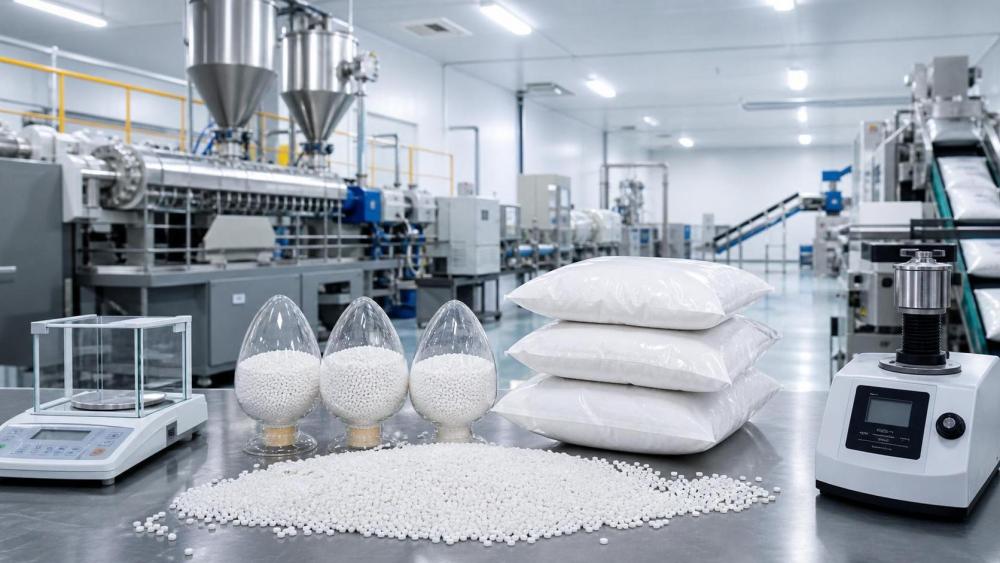
Sourcing mineral filled compounds South Africa is rarely just a price exercise.
The real challenge is balancing filler economics with stable processing, part performance, and dependable supply.
In practical terms, a lower quote can hide weaker dispersion, wider batch variation, or incomplete technical documentation.
That trade-off usually shows up later as warpage, poor surface finish, brittle parts, or higher reject rates.
This matters across automotive, electrical, packaging, appliance, and industrial applications where filled polymers support stiffness and dimensional control.
Mineral-filled formulations can improve rigidity and reduce resin cost, but only when the compound is engineered for the intended process.
A PP compound for injection molding is not evaluated the same way as a PA or PBT grade for higher-heat environments.
That is where structured material intelligence becomes useful.
APIM follows modified polymers, compounding quality, extrusion control, and industrial material performance in a way that supports clearer sourcing decisions.
Instead of treating mineral filled compounds South Africa as a generic commodity, the better approach is to assess formulation logic and downstream risk together.
Which mineral filled compounds South Africa buyers usually compare first?
The first useful question is not who sells the material.
It is which polymer base, filler type, and loading level fit the application without creating avoidable processing issues.
Common options in mineral filled compounds South Africa include talc-filled PP, calcium carbonate-filled PP or PE, and filled engineering plastics.
Each option solves a different problem.
- Talc-filled PP is often selected for higher stiffness and improved dimensional stability.
- Calcium carbonate-filled compounds are often considered when cost reduction is a stronger priority.
- Filled PA, PBT, or other engineering plastics are usually evaluated for more demanding thermal or mechanical conditions.
What changes the decision is the end-use environment.
If the part faces heat cycling, chemical exposure, or tight tolerance requirements, cheap filler economics can quickly become expensive.
More experienced buyers also check whether the supplier controls moisture, pellet quality, color consistency, and filtration during compounding.
Those details affect machine stability and finished-part repeatability far more than a basic data sheet suggests.
A quick comparison helps narrow the shortlist
This kind of side-by-side review usually prevents the wrong discussion from dominating early negotiations.
How do you judge supplier quality without relying on marketing claims?
The most reliable way is to compare process evidence, not brochure language.
For mineral filled compounds South Africa, ask how the material is compounded, tested, and controlled between batches.
A supplier should be able to explain filler selection, loading consistency, dispersion method, pelletizing quality, and lot traceability.
It also helps to understand the equipment behind the material.
Twin-screw compounding, feeder accuracy, melt filtration, degassing, and cooling control all influence final compound consistency.
APIM often frames these process variables as business risks, not just technical details.
That perspective is useful because unstable processing usually appears first as cost leakage.
- Request recent COA samples from multiple batches, not only one approved lot.
- Check whether the supplier offers application-specific test data, not generic resin values.
- Ask for recommended processing conditions and known limitations.
- Confirm whether technical support is available during line trials or part qualification.
If these answers remain vague, the material may still be usable, but the sourcing risk is clearly higher.
Local supply or imports: which route makes more sense for mineral filled compounds South Africa?
There is no universal answer, because the right route depends on tolerance for lead time, qualification cost, and technical complexity.
Local sourcing can reduce logistics friction and improve response time when formulation adjustments are needed.
That is valuable for recurring production with changing demand patterns.
Imported material may offer broader grade selection, stronger documentation, or better fit for specialized applications.
However, lower ex-works pricing does not automatically mean lower landed cost.
Freight, customs timing, foreign exchange exposure, and requalification delays can erase the apparent savings.
A practical comparison should include four cost layers.
- Material price per kilogram
- Freight, duties, and working capital impact
- Trial, approval, and downtime risk
- Scrap, yield, and machine efficiency during routine production
For many programs, the best answer is a dual-source strategy.
One approved local option improves resilience, while one imported benchmark supports performance comparison and negotiation discipline.
Where do quality trade-offs usually hide when comparing quotations?
They usually hide in specifications that look similar on paper but behave differently in production.
A quotation may match resin family and filler percentage, yet still differ in impact strength, particle treatment, color package, or flow consistency.
For mineral filled compounds South Africa, several warning signs deserve early attention.
More often than not, quality trade-offs are not hidden by technical complexity.
They are hidden by incomplete questioning.
What should be confirmed before placing a larger order?
A successful first trial is useful, but it is not enough.
Before scaling mineral filled compounds South Africa purchases, confirm whether the approved sample truly represents future production lots.
This is especially important when volumes increase or when a supplier uses more than one production line.
The most practical pre-order checklist usually includes:
- Approved technical specification with test methods and tolerance ranges
- Defined packaging format, pallet condition, and moisture protection
- Lead-time agreement and safety-stock expectation
- Change notification process for resin, filler, additive, or process changes
- Clear response path for claims, replacements, and corrective action
It is also sensible to track one production KPI during the first three shipments.
That KPI could be scrap rate, cycle time, part weight variation, or dimensional rejection.
The point is simple.
A compound should be judged by line behavior and finished-part consistency, not by lab values alone.
So what is the smarter way to source without sacrificing quality?
Start by defining the application requirement in measurable terms.
That means stiffness target, impact need, heat exposure, color expectation, processing method, and acceptable cost range.
Then compare mineral filled compounds South Africa suppliers against that requirement, not against headline price alone.
A disciplined sourcing process usually combines technical review, supply-chain checks, and controlled trials.
APIM is useful in this context because it connects material performance, compounding methods, and industrial application logic in one place.
That makes it easier to ask better questions before committing volume.
The most durable decisions usually come from a simple sequence.
- Map the real performance requirement.
- Shortlist qualified local and imported options.
- Verify processing stability with representative lots.
- Calculate total cost, not just purchase price.
- Lock in specification, documentation, and change control.
When that discipline is in place, sourcing mineral filled compounds South Africa becomes less about avoiding problems and more about building reliable supply with predictable performance.
The next practical step is to organize current grades by application, test what actually matters, and compare suppliers through the same approval framework.
Have questions about this sector analysis, or seeking best practices specific to your niche? Drop us a line below and let the senior consultants at APIM assist you.
We respect your privacy. Your information is strictly confidential.
Related News
- 00
0000-00
Do polyolefin hot melt adhesives bond well to polyethylene? - 00
0000-00
Korean Study Finds PLA Barely Degrades in Landfill After 320 Days - 00
0000-00
How to assess batch consistency from a thermal potting compounds supplier - 00
0000-00
How much weight can carbon fiber reinforced plastics save in cars? - 00
0000-00
Switching from PS to ABS Sheet Extrusion: Equipment Checks