




How to Compare High Stiffness Reinforced Thermoplastics for Lightweight Parts
Choosing high stiffness reinforced thermoplastics for lightweight parts is rarely a simple material swap. A grade that looks strong on paper may create molding limits, warpage, or cost pressure in production. What matters is the balance between stiffness, density, processing behavior, heat performance, and dimensional control under real service conditions.
That balance has become more important as automotive, electronics, industrial equipment, and consumer product designs continue to remove metal and reduce mass. In this environment, comparing high stiffness reinforced thermoplastics means understanding not only mechanical values, but also how formulation and processing shape part performance across the full supply chain.
Why the comparison matters now
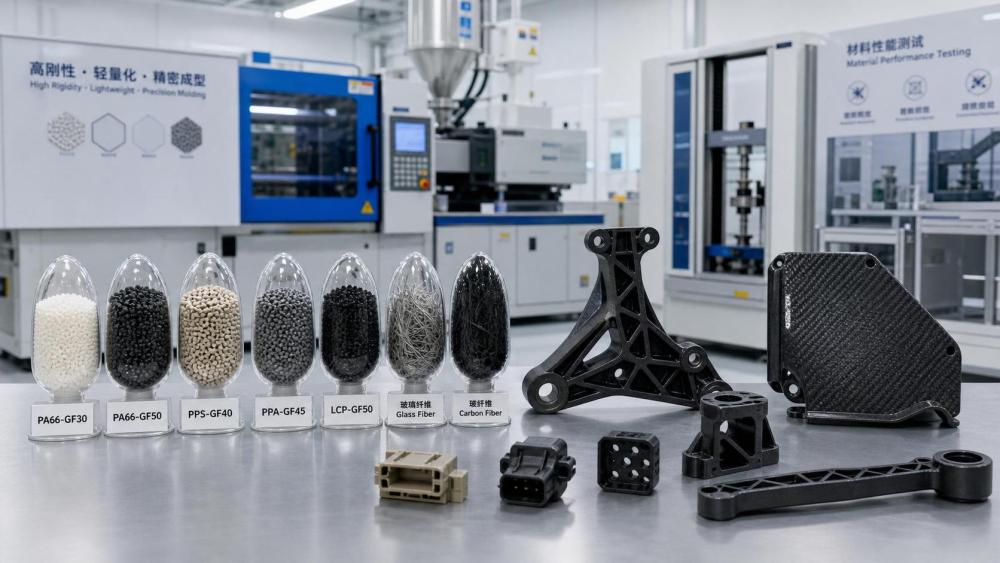
Lightweight design is no longer limited to transportation. Housings, brackets, covers, structural frames, electrical carriers, and precision components all face pressure to reduce weight without losing rigidity.
This is where high stiffness reinforced thermoplastics stand out. Glass fiber, carbon fiber, and mineral reinforcement can raise modulus significantly, allowing thinner walls or smaller sections than unfilled polymers.
The current challenge is that more stiffness does not automatically mean better performance. A highly reinforced grade may become heavier, less impact resistant, more abrasive to tooling, or harder to mold into complex geometry.
APIM tracks these tradeoffs across engineering plastics, modified compounds, and industrial processing technologies. That broader view is useful because material choice depends on both resin chemistry and manufacturing reality.
What counts as a high stiffness reinforced thermoplastic
In practical terms, these materials are thermoplastic resins engineered to resist deformation under load. The base polymer contributes heat resistance, toughness, and chemical stability. Reinforcement provides much of the stiffness gain.
Common examples include glass fiber reinforced PA, PBT, PET, PPS, and PEEK, as well as carbon fiber reinforced compounds for higher performance applications. Mineral-filled systems also appear where cost and dimensional stability matter.
When comparing them, stiffness should be interpreted through several related metrics, not one number alone. Flexural modulus, tensile modulus, creep resistance, and stiffness retention at temperature can lead to different conclusions.
A useful starting distinction
- Glass fiber reinforced grades: strong stiffness-to-cost option for many structural parts.
- Carbon fiber reinforced grades: higher specific stiffness and lower weight, usually at much higher cost.
- Mineral-filled compounds: improved rigidity and dimensional control, often with less dramatic strength gains.
- Hybrid formulations: used when stiffness, surface quality, and processing need a more balanced profile.
The comparison should begin with the part, not the resin
Many material selections go wrong because the discussion starts with grade names. A better method starts with the part function, loading direction, allowable deflection, operating temperature, and target weight.
A bracket under short-term static load needs a different comparison than a connector housing exposed to heat cycling. A thin-wall fan component behaves differently from a thick ribbed machine part.
High stiffness reinforced thermoplastics should therefore be screened against the actual design window. The most relevant question is not which material is stiffest, but which one delivers enough stiffness with acceptable manufacturing and lifecycle risk.
Core design inputs to define first
- Load type: static, dynamic, cyclic, or impact-related.
- Temperature range during assembly and use.
- Exposure to moisture, oils, solvents, or cleaners.
- Wall thickness, rib design, and weld line sensitivity.
- Electrical, flame, or dimensional tolerances.
Key parameters that change the decision
Datasheets remain useful, but they need context. Comparing high stiffness reinforced thermoplastics works best when each parameter is tied to a business or design consequence.
Specific stiffness deserves special attention. A compound with a very high modulus may still underperform in lightweight design if density rises too much. This is one reason carbon fiber reinforced systems are attractive in some high-value applications.
Material families behave differently in real use
Reinforced polyamides often offer strong mechanical efficiency and broad availability. They fit many automotive and industrial components, but moisture absorption can shift dimensions and stiffness over time.
PBT and PET compounds usually bring better dimensional stability and electrical performance. They are often considered for connectors, housings, and parts where moisture sensitivity must stay lower.
PPS and PEEK move into harsher environments. They support high stiffness reinforced thermoplastics strategies where heat, chemicals, and long service life outweigh initial material cost.
That is why APIM’s material coverage matters. Comparing reinforced compounds requires understanding not only polymer families, but also compounding quality, additive design, and processing consistency between suppliers.
Where each family often fits
- PA reinforced compounds: structural brackets, under-hood parts, mechanical housings.
- PBT or PET reinforced compounds: electrical carriers, precision molded components, connectors.
- PPS reinforced compounds: pump parts, electronic components, chemical-contact applications.
- PEEK reinforced compounds: aerospace, medical, and extreme industrial service environments.
Processing can change the result more than expected
A high-performance resin still depends on stable compounding and molding. Fiber length retention, dispersion quality, moisture control, melt temperature, and screw design all influence final stiffness and part consistency.
This is especially important for high stiffness reinforced thermoplastics because reinforcement orientation creates directional behavior. The same grade may perform very differently across flow direction and transverse direction.
In practice, this affects rib strength, flatness, hole integrity, and long-term creep. It also means simulation, mold design, and supplier process data should be reviewed together rather than separately.
APIM’s focus on extrusion and compounding technologies reflects this reality. Equipment setup, residence time, melt filtration, and cooling conditions can influence the quality of the pellets long before molding begins.
A practical comparison framework
When several candidate materials look close, a structured shortlist prevents overreliance on a single property. The goal is to compare high stiffness reinforced thermoplastics through application fit, not through isolated peak values.
A workable sequence
- Define the allowable deflection, temperature range, and target weight.
- Screen polymer families by environment and compliance needs.
- Compare reinforced grades using specific stiffness, creep, and dimensional stability.
- Check processability against wall thickness, geometry, and tooling limits.
- Review supplier consistency, test data depth, and commercial risk.
- Validate the top options with molded samples or application-level testing.
This sequence helps prevent a common mistake: selecting an advanced grade too early, then discovering a lower-cost reinforced compound already meets the real load case.
What deserves closer scrutiny before a final choice
Several issues deserve more attention than they usually get in early screening. Batch stability matters because lightweight parts often run with tighter safety margins. Small changes in fiber content or viscosity can shift warpage and mechanical behavior.
Sustainability is also entering the comparison. Recycled content, traceability, and end-of-life strategy may influence supplier selection, especially where performance claims and regulatory documentation need to align.
Adhesion and assembly can also matter. Some lightweight designs combine reinforced plastics with metals, films, foams, or structural adhesives. In those cases, stiffness cannot be judged separately from bonding behavior and thermal mismatch.
The next step is usually not to search for one perfect material. It is to build a narrower comparison set, define the failure risks that matter most, and test high stiffness reinforced thermoplastics in the geometry and environment they will actually face.
A disciplined review of properties, processing, supplier quality, and application conditions will produce a better answer than a faster datasheet comparison. That is the point where material intelligence becomes a practical design decision.
Have questions about this sector analysis, or seeking best practices specific to your niche? Drop us a line below and let the senior consultants at APIM assist you.
We respect your privacy. Your information is strictly confidential.
Related News
- 00
0000-00
Do polyolefin hot melt adhesives bond well to polyethylene? - 00
0000-00
Korean Study Finds PLA Barely Degrades in Landfill After 320 Days - 00
0000-00
How to assess batch consistency from a thermal potting compounds supplier - 00
0000-00
How much weight can carbon fiber reinforced plastics save in cars? - 00
0000-00
Switching from PS to ABS Sheet Extrusion: Equipment Checks