




Engineering Resin Selection for Lightweighting: Stiffness, Weight, and Cost Tradeoffs
Why Lightweighting Has Become a Material Decision
Engineering resin selection for lightweighting is no longer a narrow design exercise. It now sits at the intersection of performance targets, processing limits, and cost discipline across many industrial sectors.
A lighter part can improve fuel efficiency, ease assembly, reduce shipping load, or support miniaturized product design. That benefit matters only when stiffness, durability, and dimensional control still meet the application requirement.
This is why engineering resin selection for lightweighting deserves close attention. The material choice affects not just mass reduction, but tooling behavior, cycle time, scrap rate, compliance risk, and long-term service performance.
In practice, the discussion often moves beyond replacing metal with plastic. It becomes a broader evaluation of resin family, reinforcement strategy, geometry redesign, and total system cost.
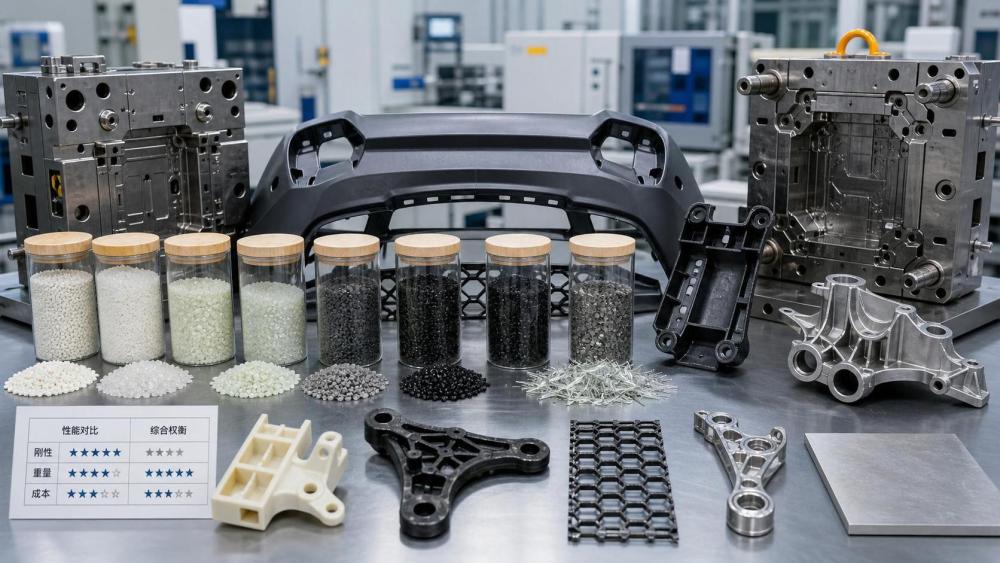
For that reason, APIM’s structured coverage of engineering plastics, modified compounds, extrusion technology, and industrial material performance is directly relevant to current selection work.
What Engineering Resin Selection for Lightweighting Really Means
The term sounds straightforward, but the decision is rarely about choosing the lightest polymer available. Density is only one variable, and often not the decisive one.
A resin with lower density may require thicker walls to achieve the same rigidity. A stiffer grade may allow thinner sections, changing part weight in a more favorable way.
This is where modulus, creep resistance, impact behavior, and heat performance begin to matter. Lightweighting succeeds when the part retains its function under real use conditions.
Materials such as PA, PBT, PC, POM, PPS, and PEEK are frequently evaluated in this context. Their modified forms often matter even more than the base resin itself.
Glass fiber, carbon fiber, mineral fillers, impact modifiers, and flame-retardant packages can change stiffness, warpage, weight, appearance, and processing response in very different ways.
The key tradeoff is structural efficiency
A practical lightweighting review asks how much performance is delivered per unit mass, not simply which material has the lowest specific gravity on a datasheet.
That perspective helps explain why reinforced compounds often remain attractive, even when they raise resin cost. They may reduce part thickness, cut fastener count, or improve dimensional stability.
Why Stiffness, Weight, and Cost Do Not Move Together
In many projects, stiffness improves through reinforcement, but density also rises. Cost can rise again because the compound is harder to process or because tool wear becomes more serious.
The reverse is also common. An unfilled resin may be cheaper per kilogram and easier to mold, yet require a heavier part or more complex design features.
That is why engineering resin selection for lightweighting should be framed as a three-way comparison rather than a one-step substitution decision.
Simple cost-per-kilogram comparisons often miss these interactions. Better decisions usually come from cost-per-functional-part or cost-per-performance-window analysis.
Where the Current Industry Focus Is Shifting
The current market is pushing resin selection toward more exact performance matching. Broad assumptions about “strong plastic” or “premium polymer” are becoming less useful.
Automotive applications continue to drive lightweighting, but similar pressures appear in electronics, industrial machinery, medical components, and packaging systems.
Thermal exposure, electrical performance, chemical contact, and sustainability targets are now entering the same decision path as weight reduction.
That creates more demand for modified compounds with application-specific properties. Flame-retardant PC, reinforced PA, conductive plastics, wear-resistant POM, and high-temperature PPS are typical examples.
APIM’s value in this context is not promotional. It lies in organizing how formulation, compounding quality, and processing control shape the final part, not just the nominal resin grade.
Supply chain and process stability are now part of material performance
A technically attractive resin may still be a weak option if lead times are unstable, certifications are incomplete, or lot-to-lot variation creates downstream problems.
For lightweighting projects, this matters because narrow wall sections and high-performance geometries tend to be less forgiving of material inconsistency.
Material Families Often Considered in Lightweighting Programs
Different resin families support lightweighting in different ways. The right candidate depends on load profile, temperature range, processing route, and expected service environment.
- PA and reinforced PA: strong balance of stiffness, cost, and broad industrial use, with moisture sensitivity requiring careful review.
- PBT and PET: useful for dimensional stability and electrical applications, especially where moisture exposure must be managed differently than nylon.
- PC and PC blends: chosen when impact resistance and dimensional precision matter, though stiffness may require reinforcement.
- POM: valuable for low friction and precision parts, but design limits under heat and some chemical environments remain important.
- PPS and PEEK: premium options for heat, chemical resistance, and structural stability, usually justified only when operating conditions are severe.
Modified compounds often outperform base resins in realistic service conditions. The tradeoff is that process settings, screw design, residence time, and cooling control become more critical.
Application Logic Matters More Than Generic Material Ranking
Engineering resin selection for lightweighting should start from the part function, not from a list of popular materials. Two parts with similar dimensions may need completely different resin strategies.
A bracket under continuous load needs creep resistance and stiffness retention. A housing near heat-generating electronics may need flame retardancy and dimensional accuracy.
A packaging substrate may pursue downgauging, but barrier properties, haze, and sealing behavior still define success. In that case, film structure can matter more than resin density alone.
Lightweight assembly can also shift the decision beyond molded parts. Structural adhesives and bonding materials may remove metal fasteners, simplify geometry, or support hybrid material design.
That broader system view often creates more realistic savings than chasing a single low-density resin grade.
How to Evaluate Options Without Missing Hidden Costs
A disciplined review usually combines material data, part redesign potential, and process capability. Datasheets help, but they are only the starting point.
Useful checkpoints during comparison
- Check specific stiffness, not only tensile strength or density.
- Review heat aging, creep, and chemical exposure against the actual duty cycle.
- Estimate wall-thickness reduction potential before comparing part weight.
- Confirm moldability, shrinkage behavior, and warpage risk for the part geometry.
- Include tooling wear, drying requirements, scrap rate, and cycle time in cost calculations.
- Ask whether recycled or bio-based content changes consistency or certification status.
These checkpoints reflect why engineering resin selection for lightweighting is often a cross-functional review. Material properties, compounding quality, and processing stability are tightly linked.
APIM’s industry coverage is useful here because it connects resin behavior with extrusion, compounding, and downstream application realities, rather than treating them as separate topics.
A Practical Direction for the Next Evaluation Step
The most effective next step is to narrow the decision around a defined performance window. Weight reduction targets should be tied to stiffness retention, process capability, and expected service life.
From there, a shorter candidate list becomes more useful than a broad material survey. Compare base resin and modified compound options against the same geometry and test conditions.
Engineering resin selection for lightweighting works best when the review includes application logic, supply consistency, and total conversion cost from the beginning.
That approach leads to better technical discussions, fewer false savings, and more reliable material choices across automotive, electronics, industrial, medical, and packaging applications.
For ongoing assessment, it is worth tracking how compound formulation, processing methods, and sustainability requirements continue to reshape lightweighting decisions in advanced polymer systems.
Have questions about this sector analysis, or seeking best practices specific to your niche? Drop us a line below and let the senior consultants at APIM assist you.
We respect your privacy. Your information is strictly confidential.
Related News
- 00
0000-00
Do polyolefin hot melt adhesives bond well to polyethylene? - 00
0000-00
Korean Study Finds PLA Barely Degrades in Landfill After 320 Days - 00
0000-00
How to assess batch consistency from a thermal potting compounds supplier - 00
0000-00
How much weight can carbon fiber reinforced plastics save in cars? - 00
0000-00
Switching from PS to ABS Sheet Extrusion: Equipment Checks