




Engineering Plastic Applications: Common Failures and Material Selection Fixes
Engineering Plastic Applications: Common Failures and Material Selection Fixes
Engineering plastic applications are used because they reduce weight, resist chemicals, and support demanding designs.
Still, many parts fail early for one simple reason.
The resin looked right on paper, but the real service environment was not fully matched.
That gap shows up as cracking, warpage, wear, stress whitening, or unstable dimensions.
In practical production, failure rarely comes from material name alone.
It usually comes from the mismatch between load, temperature, chemical exposure, geometry, and processing history.
This is why better engineering plastic applications start with better failure reading.
Once the failure mode is clear, material selection fixes become much more direct and practical.
Why Engineering Plastic Applications Fail in Real Service
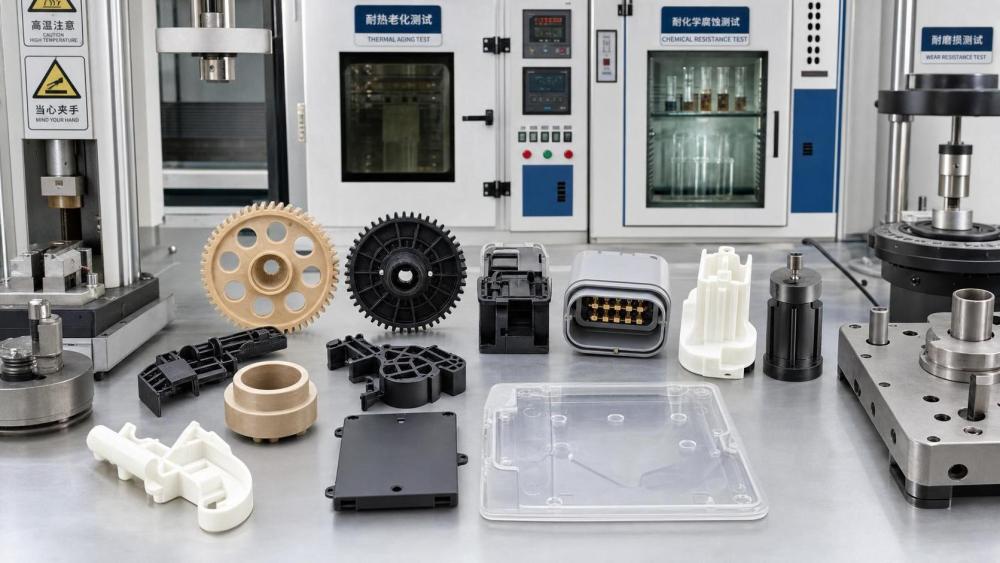
Most engineering plastic applications are designed around one main performance target.
For example, teams may focus on strength, cost, flame resistance, or appearance.
The problem is that service conditions are usually multi-factor.
A housing may face heat cycling, cleaning chemicals, fasteners, vibration, and impact at the same time.
A gear may pass initial testing, then fail after moisture pickup or continuous friction.
A transparent cover may survive assembly, then craze during solvent contact.
From a selection standpoint, the common failure pattern is predictable.
- Mechanical demand was underestimated.
- Heat resistance was judged only by short-term data.
- Chemical compatibility was assumed, not tested.
- Moisture, UV, or creep behavior was ignored.
- Processing damage changed final part properties.
That also explains why two parts made from the same resin can perform very differently.
In engineering plastic applications, service life depends on material grade, formulation, and processing control together.
Failure Mode 1: Cracking and Stress Fracture
Cracking is one of the most expensive failures in engineering plastic applications.
It often starts small, then spreads under repeated load or chemical contact.
Typical signs include stress whitening, edge fractures, brittle breakage, and cracks near screws or snap-fits.
What usually causes it
- Low impact strength at service temperature.
- Residual molding stress.
- Poor notch design.
- Environmental stress cracking from oils, cleaners, or fuels.
Material selection fixes
Move from general-purpose grades to tougher engineering plastic applications with proven impact retention.
Impact-modified PA, PC/ABS, TPU, and selected PBT compounds can improve crack resistance.
If solvents are involved, chemical resistance matters more than room-temperature toughness.
In that case, POM, PPS, fluoropolymers, or high-performance polyamides may be better choices.
Also review mold stress, gate position, sharp corners, and fastener compression.
A stronger resin cannot fully compensate for a highly stressed part design.
Failure Mode 2: Warpage and Dimensional Instability
Warpage creates assembly issues, sealing gaps, vibration, and appearance defects.
In many engineering plastic applications, this failure appears after molding, after storage, or during heat exposure.
Why it happens
- Uneven shrinkage across wall sections.
- Fiber orientation imbalance.
- High moisture absorption.
- Insufficient heat deflection resistance.
Material selection fixes
For tighter tolerances, choose engineering plastic applications with low shrinkage and better dimensional stability.
Glass-fiber reinforced PBT, mineral-filled PP, PPS, and stable POM grades are common solutions.
If humidity changes are severe, standard PA may need conditioning control or replacement.
Lower-moisture materials such as PBT, PET, or PPS often hold dimensions better.
This is especially important in connectors, precision housings, and moving assemblies.
Failure Mode 3: Wear, Friction, and Surface Damage
Some engineering plastic applications fail quietly.
The part does not crack, but the surface slowly wears down.
That leads to noise, poor fit, dust generation, and loss of function.
Common high-risk applications
- Gears and bushings.
- Sliding guides.
- Valve components.
- Conveyor and handling parts.
Material selection fixes
Use wear-optimized engineering plastic applications instead of relying only on hardness.
POM, PA with lubricant additives, UHMW-grade materials, PEEK, and PTFE-modified compounds are typical choices.
If heat from friction is building up, a thermally stable resin may matter more than a low initial coefficient.
Counterface material, lubrication condition, and contact pressure must also be checked.
Many wear failures come from pair mismatch, not just polymer weakness.
Failure Mode 4: Heat Aging and Loss of Strength
A resin can pass short-cycle testing and still fail under long-term heat.
That is a frequent issue in engineering plastic applications near motors, batteries, lighting, and under-hood systems.
Typical warning signs
- Embrittlement after service.
- Color shift or yellowing.
- Loss of stiffness.
- Permanent deformation under load.
Material selection fixes
Choose engineering plastic applications based on continuous-use temperature, not just melting point or short HDT data.
PPS, PEEK, PEI, high-temperature nylons, and heat-stabilized PBT are often used where thermal aging is critical.
For loaded parts, creep resistance is just as important as temperature resistance.
This is where reinforced grades can improve retention of shape and strength over time.
Failure Mode 5: Chemical Attack and Environmental Exposure
Chemical exposure is often underestimated in engineering plastic applications.
Even low-level contact can trigger swelling, crazing, extraction, or surface softening.
The source may be fuel, grease, disinfectant, coolant, detergent, UV, or outdoor humidity.
Material selection fixes
Match the resin to the exact media, concentration, temperature, and exposure time.
Broad chemical labels are not enough for reliable engineering plastic applications.
PPS, PEEK, fluoropolymers, selected POM grades, and specialty polyamides often outperform PC or ABS in harsh chemical settings.
For outdoor use, UV-stabilized grades and carbon-black formulations may extend service life significantly.
A Practical Selection Framework That Prevents Repeat Failure
Better engineering plastic applications come from a disciplined selection process.
The most useful approach is simple and repeatable.
- Define the real load case, including peaks, cycles, and assembly stress.
- Map service temperature, humidity, media contact, and UV exposure.
- Review dimensional limits, creep risk, and surface life requirements.
- Check process sensitivity, drying needs, and molding window.
- Compare at least two candidate materials with application-specific testing.
This step is where many engineering plastic applications improve quickly.
Once failure conditions are written clearly, weak resin choices become easier to eliminate.
What to Check Before Changing the Resin
Not every failure in engineering plastic applications should trigger an immediate material switch.
A better resin helps, but only if the root cause is actually material-related.
- Check drying records and melt history.
- Inspect gates, knit lines, and wall transitions.
- Review torque, friction, and assembly force.
- Confirm actual chemical exposure, not assumed exposure.
- Test aged samples, not only fresh molded parts.
This creates a cleaner decision path.
The most effective engineering plastic applications are built through failure analysis, process review, and targeted grade selection together.
Closing Insight
Engineering plastic applications succeed when material choice reflects the real operating environment, not only catalog data.
Cracking, warpage, wear, heat aging, and chemical attack each leave clear signals.
Reading those signals correctly turns failure into a practical selection advantage.
For better engineering plastic applications, start with the failure mode, narrow the service conditions, then validate the new grade under realistic use.
That approach improves reliability, processing stability, and long-term product performance without adding unnecessary material cost.
Have questions about this sector analysis, or seeking best practices specific to your niche? Drop us a line below and let the senior consultants at APIM assist you.
We respect your privacy. Your information is strictly confidential.
Related News
- 00
0000-00
Do polyolefin hot melt adhesives bond well to polyethylene? - 00
0000-00
Korean Study Finds PLA Barely Degrades in Landfill After 320 Days - 00
0000-00
How to assess batch consistency from a thermal potting compounds supplier - 00
0000-00
How much weight can carbon fiber reinforced plastics save in cars? - 00
0000-00
Switching from PS to ABS Sheet Extrusion: Equipment Checks