




Can mechanically recycled automotive polycarbonate meet impact needs?
For many automotive applications, mechanically recycled polycarbonate can meet impact requirements, but only within a controlled material-and-part system. It should not be treated as a direct, drop-in substitute for virgin PC simply because a datasheet reports a comparable room-temperature impact value. Automotive impact performance depends on retained molecular weight, feedstock consistency, residual contaminants, stabilizer package, processing history, part geometry, and the temperature range in which the part must survive.
The practical question for a technical evaluator is therefore narrower: can a specified recycled-PC compound repeatedly meet the impact requirement for this component, after its intended molding process and throughout its service environment? For non-structural and moderately demanding parts, the answer may be yes with an appropriately qualified grade. For safety-relevant, highly stressed, thin-wall, exterior, optical, or low-temperature applications, the approval burden is much higher and recycled content may need to be limited, blended with virgin resin, or avoided altogether.
Impact strength is linked to molecular weight, not just polymer identity
Polycarbonate is valued in automotive design because its molecular structure can absorb substantial energy before fracture. Mechanical recycling, however, subjects the resin to additional heat, shear, moisture exposure, and residence time. Each step can promote hydrolytic or thermo-oxidative chain scission if drying and melt processing are not tightly managed. Shorter polymer chains generally reduce melt strength and can lower resistance to impact, especially where a molded part contains stress concentrators.
A recycled grade may still show a respectable notched impact result under one laboratory condition. That does not establish equivalence to virgin PC across vehicle use cases. Impact data can be sensitive to specimen thickness, notch geometry, test temperature, conditioning, injection-molding direction, and the presence of weld lines. A component that performs well in a thick test bar may behave very differently at a thin rib junction, around a fastening point, or at the edge of a molded opening.
This is why molecular-weight retention deserves attention early in material qualification. Melt flow rate is often a useful production-control indicator: a significant increase relative to the intended baseline can indicate degradation and reduced average molecular weight. It is not a complete proxy for impact performance, since formulation and molecular-weight distribution also matter, but it can reveal lot-to-lot movement before a failure appears in finished-part testing.
For mechanically recycled automotive polycarbonate, the most credible performance claim is not “recycled PC has high impact strength.” It is a controlled claim tied to a known feedstock stream, a defined recycled-content level, a specific compound formulation, and validated processing conditions.
Feedstock determines whether recycled PC is predictable
“Automotive recycled PC” covers very different material streams. Production scrap from a known molding operation, with traceable resin grade and controlled segregation, is fundamentally different from mixed post-consumer scrap collected from dismantled vehicles or broader durable-goods streams. Both may be mechanically recycled, but their technical risk profiles are not comparable.
Closed-loop post-industrial material can retain a clear connection to the original resin family, color system, additives, and prior processing history. It may be suitable for regrind use or re-compounding when contamination is controlled and the number of thermal cycles is limited. Post-consumer material carries more uncertainty. It can contain other engineering plastics, coatings, adhesives, metal particles, elastomers, flame retardants, pigments, residues from vehicle use, or polymer grades with different stabilizer packages.
Even small amounts of incompatible contamination can create localized weak points. In a tough polymer such as PC, dispersed foreign particles or poorly bonded phases can initiate cracks under impact. Contamination does not have to be visible to be consequential. A compound may look uniform and process acceptably while still showing a wider spread in impact results or greater sensitivity at low temperature.
Source control should therefore be assessed alongside the final technical data. A supplier should be able to describe how feedstock is collected, sorted, identified, cleaned, ground, filtered, and separated from unsuitable materials. Technical teams do not need a generic sustainability narrative; they need enough traceability to understand whether the incoming stream can plausibly support the stated performance window.
Low-temperature behavior often decides the application boundary
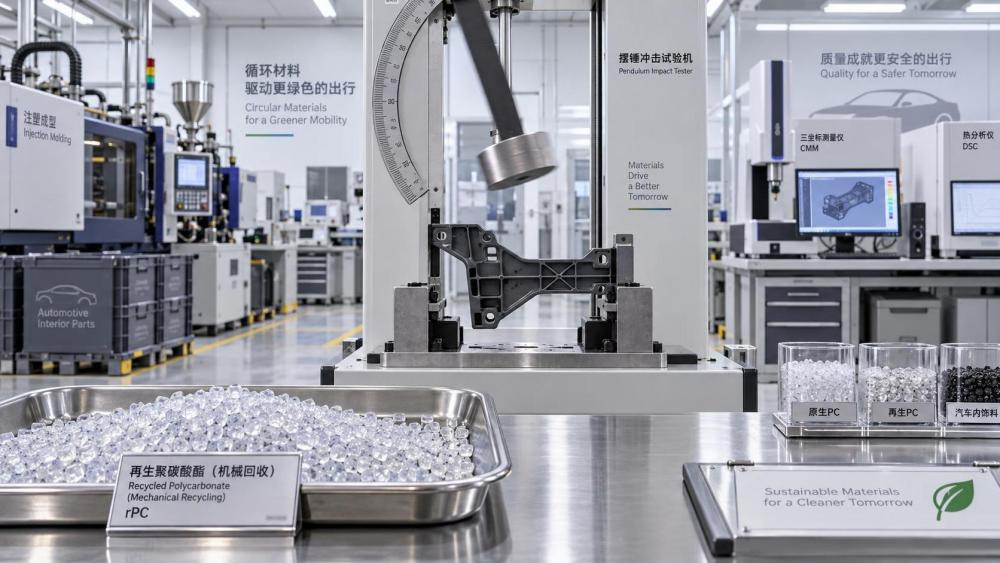
Room-temperature impact testing is useful, but it can conceal the conditions that matter most for vehicle components. Polycarbonate is generally tough, yet impact resistance becomes more sensitive as temperature falls, molecular weight declines, residual stress rises, or contaminants are introduced. A grade that passes an internal test at ambient conditions can become borderline in cold-weather handling, transport damage, stone-impact exposure, or a vehicle crash-related loading event.
The severity of this issue depends on the component. An interior trim carrier may mainly face assembly impacts, occupant contact, fastening loads, and thermal aging. A glazing-adjacent part, exterior trim feature, battery-enclosure element, sensor housing, or underhood component may face a more complicated combination of temperature cycling, vibration, moisture, chemicals, UV exposure, and localized impact. In these environments, a single initial impact result says little about retained toughness after aging.
Technical evaluators should define the failure mode before comparing materials. A material specification based only on a generic notched-impact minimum can be too broad for a real automotive part. The qualification plan should reflect whether the concern is brittle fracture during assembly, crack growth from a screw boss, damage from a dropped tool, deformation during a minor collision, or impact after thermal and chemical aging. Those scenarios call for different specimen designs and component-level checks.
Questions that should be answered before approval
- What is the recycled-content range, and is it fixed or allowed to vary by batch?
- Is the feedstock primarily post-industrial, post-consumer, or a blend of both?
- How is polymer identity verified before compounding, and what contaminants are screened out?
- What molecular-weight or melt-flow controls are used for incoming material and finished pellets?
- Are impact results available at the relevant temperatures, after the aging exposures expected by the component?
- Have weld lines, knit lines, thin sections, sharp corners, and fastening features been represented in part-level validation?
- Can the supplier demonstrate consistent color, flow, moisture control, and mechanical performance across production lots?
Stabilization and compounding can recover performance, but not remove all risk
A well-designed recycled-PC compound can perform much better than untreated recycled flake or simple regrind. Chain extenders, processing stabilizers, hydrolysis stabilizers, impact modifiers, compatibilizers, UV packages, and carefully selected virgin-PC fractions may help restore or protect performance. Filtration and vacuum degassing can reduce particulate contamination and volatile residues. Controlled compounding also improves additive distribution and makes the final pellet more consistent for the molder.
These measures should be evaluated as part of the grade design, not assumed to be universally effective. An impact modifier may improve one impact metric while changing stiffness, heat resistance, surface quality, paintability, flow, or chemical resistance. A higher-flow compound can make a thin-wall part easier to mold but may also signal a lower molecular-weight base resin. Adding virgin PC can narrow variability, although the required blend ratio may alter cost and recycled-content targets.
There is also a difference between recovering an average property and reducing variability. Automotive programs are usually constrained by the lower end of the distribution, not the best result achieved by a development batch. A compounder may formulate a grade that reaches the target mean value, while occasional feedstock excursions create lots closer to the acceptance limit. For a high-volume molded part, that spread can become a production issue even when the nominal datasheet appears satisfactory.
Material approval should therefore include both capability and consistency. Repeated lot data, defined incoming-control procedures, and change-notification discipline are often more valuable than a single high impact-strength figure. This is especially important where the recycled grade replaces a long-established virgin resin with a well-understood process window.
Processing can create failure modes that resin testing will miss
Polycarbonate is sensitive to moisture during melt processing. Inadequate drying can accelerate hydrolysis in the molding machine, reducing molecular weight during conversion even if the delivered pellets met their release specification. Recycled PC may have a narrower tolerance for poor drying or extended residence time because it has already experienced one or more processing cycles.
Molders evaluating a recycled grade should review drying conditions, hopper residence time, barrel temperatures, back pressure, screw speed, shot size, and hot-runner exposure. A recycled compound that works on one press may show discoloration, splay, reduced ductility, or unstable flow on another if the thermal history is harsher. Recycled content can also affect mold-fill balance and weld-line placement, which matters when impact loading occurs near a knit line.
Part design remains part of the material decision. Tight radii, abrupt wall transitions, aggressive snap fits, heavily loaded screw bosses, and unrelieved molded-in stress can turn modest material variation into brittle failure. Before concluding that recycled PC cannot meet impact needs, teams should separate resin limitations from design and processing factors. Conversely, a favorable flat-specimen test should not be used to excuse a geometry that concentrates stress beyond the compound’s practical capability.
Where mechanically recycled PC is most likely to fit
Recycled PC is often more feasible where the part is non-safety-critical, the loading mode is understood, wall thickness is adequate, and the design can tolerate a defined material-performance range. Interior brackets, trim substrates, covers, ducts, consoles, and selected housings may offer an entry point, provided the relevant environmental, appearance, odor, emissions, and durability requirements are also met.
Applications become more difficult when impact resistance is tied directly to occupant protection, structural load transfer, transparent optical quality, severe outdoor aging, highly constrained color matching, or unusually low-temperature fracture resistance. This does not automatically rule out recycled content. It does mean that recycled PC must be qualified at the formulation and part level, rather than accepted through a broad material-family comparison.
A conservative first program often uses recycled material in a component with a clear performance margin and a stable process. The resulting qualification work can establish how the grade behaves across lots, molding equipment, and aging conditions. Moving directly into a highly stressed application without that control history creates avoidable uncertainty.
A defensible qualification path
Technical teams should start by converting the component requirement into a testable decision framework. Define the impact event, temperature range, aging conditions, load direction, geometry, and acceptance criteria. Then compare the recycled compound against the approved virgin reference using molded specimens produced under representative processing conditions. Where the part has known weak locations, component testing should take priority over generic coupon data.
The evaluation should include baseline impact performance, post-aging behavior, melt-flow stability, visual and dimensional consistency, and evidence of feedstock control. Testing several production lots is more informative than testing a single development lot. If the application is sensitive to chemical contact, UV exposure, heat, humidity, or repeated loading, those exposures should precede the impact assessment rather than be treated as separate, unrelated tests.
Mechanically recycled automotive polycarbonate can satisfy meaningful impact needs when the application has an appropriate margin and the material system is controlled from feedstock through molding. The decision becomes unreliable when recycled content is treated as a label instead of a variable affecting molecular structure, contamination risk, process behavior, and property variation. For evaluators, the right threshold is not whether recycled PC can pass an impact test once, but whether a defined recycled-PC grade can keep passing the tests that represent the actual part.
Have questions about this sector analysis, or seeking best practices specific to your niche? Drop us a line below and let the senior consultants at APIM assist you.
We respect your privacy. Your information is strictly confidential.
Related News
- 00
0000-00
How does washing affect contamination in post-consumer recycled PP resins? - 00
0000-00
How does feedstock affect depolymerization equipment selection? - 00
0000-00
US Sets 213.44% Preliminary Antidumping Deposit on Chinese PTMEG - 00
0000-00
When should epoxy be used as a thermal interface material for semiconductors? - 00
0000-00
US Midterm Results Unlikely to Quickly Shift Recycled Plastics Market or Legislation