




Can Pressure-Sensitive Adhesives Replace Fasteners in Car Interiors?
Pressure-sensitive adhesives can replace mechanical fasteners in selected automotive interior assemblies, but they are not a universal substitute. Lightweight decorative trim, acoustic pads, and some appliqués are reasonable candidates when the bond area, substrate, temperature exposure, and loading conditions are suitable. Parts that carry significant loads, interact with restraint systems, or require repeated removal generally need mechanical retention or a specifically validated hybrid design.
The question often arises when clips create visible witness marks, screws add assembly steps, or trim interfaces develop squeaks and rattles. Removing those fasteners can improve appearance and distribute loads more evenly, but it also changes how the part can fail. A panel that feels secure immediately after bonding may lift at an edge or creep after prolonged heat exposure. The decision therefore starts with the function of the attachment—not simply whether tape sticks to the surface.
Which interior parts are realistic candidates for adhesive-only attachment?
Engineers asking, “Can pressure-sensitive adhesives replace mechanical fasteners in automotive interior assemblies?” should first separate appearance and noise-control attachments from load-bearing or safety-related attachments. A decorative strip experiences different demands from a grab handle, even when both attach to the same door panel.
This is a screening guide, not an approval list. Even a small decorative part can be unsuitable for adhesive-only attachment if occupants pull on it, its geometry concentrates peel forces, or detachment creates an unacceptable hazard. Conversely, a larger lightweight panel may be feasible when its support geometry prevents lifting and the bond is qualified for the actual duty cycle.
Does strong initial tack mean the fasteners can be removed?
No. Initial tack describes how readily a PSA establishes contact under light pressure. It does not establish long-term resistance to sustained loads, thermal cycling, or edge lifting. Pressure-sensitive adhesives remain viscoelastic: they can accommodate movement, but they can also deform over time under load.
A useful distinction is between shear, where the parts try to slide parallel to the bond, and peel or cleavage, where an edge is pulled away. A broad bonded strip may resist distributed shear effectively yet fail when a small corner lifts. The lifted corner concentrates stress and gives the separation a path to propagate.
Before removing a clip, identify every function it performs. It may locate the part, hold a curved section flat, establish a gap, or provide retention during an impact. Tape replacing only its nominal holding force does not necessarily replace these other functions.
Small locating features or hidden retainers can remain useful even when adhesive becomes the primary attachment. They can control position during assembly and limit edge opening without requiring the original number of screws or clips.
What makes a bond fail on interior plastics?
The bonding surface is the actual production surface, not just the polymer name on the drawing. Polypropylene and other low-surface-energy plastics can be difficult to bond with general-purpose PSAs. PC/ABS may offer easier adhesion, but paint, texture, contamination, and surface treatments can change the result.
A molded component can carry mold-release residue or additive deposits. A painted part introduces another interface: the adhesive may adhere strongly to the coating while the coating separates from the plastic. Soft-touch finishes, plasticized skins, and porous fabrics introduce further compatibility questions.
- Clean separation at the substrate: investigate contamination, insufficient wet-out, unsuitable adhesive chemistry, or ineffective surface treatment.
- Adhesive splitting within the bond: examine cohesive strength, temperature exposure, load duration, and tape thickness.
- Coating or substrate tearing: assess the underlying material; stronger adhesive alone may worsen the failure.
- Lifting confined to corners: inspect panel curvature, installation tension, bond coverage, and local peel forces.
Surface preparation must be compatible with the part. An aggressive solvent may damage a coating or stress-sensitive plastic. Primers, plasma, or other treatments can improve adhesion, but they add process controls and must be validated for durability, appearance, and interior-material requirements. Treatment effectiveness can also change between preparation and bonding.
How should tape chemistry and thickness be selected?
Start with the substrate pair and service conditions rather than choosing the highest advertised peel strength. Acrylic PSAs are common candidates for durable trim attachment, although performance varies substantially by formulation. Rubber-based systems can provide strong initial tack but require careful checking for heat and aging limitations. Silicone PSAs may suit particular temperature or surface challenges, but they are not automatically preferable for ordinary interior plastics.
Foam-backed tapes can conform to modest irregularities, accommodate differential movement, and reduce direct contact between vibrating parts. Thin film-carrier tapes can suit flatter interfaces where dimensional control matters. Neither construction compensates for a badly fitting panel or uncontrolled molding variation.
Thickness is a design variable, not a repair for every gap. A thicker tape may improve contact across texture or absorb movement, yet it can also permit more displacement under load. A thinner tape may maintain a tighter joint but fail to contact enough surface area. Evaluate the complete tape construction, including adhesive layers, carrier or foam, and release liner.
Supplier data should identify test substrates, conditioning, application pressure, dwell time, and failure mode. A peel value measured on stainless steel cannot directly establish performance on textured polypropylene.
Will the bond survive cabin heat and thermal cycling?
A parked vehicle can expose interior trim to substantial heat, particularly near glazing and dark surfaces. Temperature also varies across the assembly. Evaluate the expected bond-line environment rather than relying only on a general cabin temperature estimate.
Two mechanisms deserve separate attention. First, heat can reduce the adhesive’s resistance to sustained shear, allowing a part to move gradually. Second, dissimilar materials expand differently. A decorative metal strip bonded to a plastic panel may repeatedly stress the joint as temperatures rise and fall.
Room-temperature pull testing does not capture either mechanism adequately. Qualification should include sustained loading at relevant elevated temperatures, thermal cycling, and examination for edge lift, displacement, and appearance changes. Where moisture or cleaning chemicals can reach the interface, include those exposures as well.
Inspect the part while hot when service performance matters. A bond may regain stiffness after cooling, masking movement or weakness that occurs during actual exposure.
What changes are needed on the assembly line?
PSA attachment avoids screw driving and many cure-related operations, but it still requires a controlled bonding process. Pressure creates intimate contact; simply placing a part against the tape is not enough. Adhesion may also build during a specified dwell period, so immediate handling loads must be considered separately from fully developed bond performance.
- Control incoming surfaces. Define acceptable cleanliness, finish, texture, and any required treatment. Use production parts for validation.
- Establish assembly conditions. Specify acceptable part and tape temperatures, storage conditions, and the interval after surface preparation.
- Apply controlled pressure. Use a fixture or roller that reaches the intended bond area without damaging visible surfaces.
- Manage placement and handling. Prevent stretching, wrinkles, contamination, and premature loading. Do not assume repositioning preserves performance.
- Verify the process window. Test realistic variation in pressure, alignment, dwell, and part geometry rather than only ideal samples.
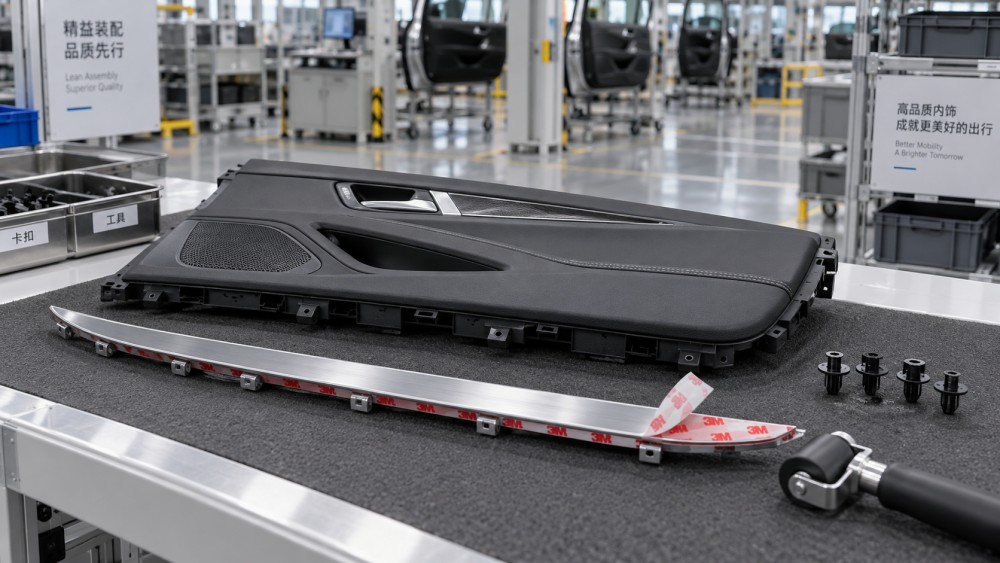
Curved trim deserves particular attention. Forcing a warped component flat stores restoring force in the assembly, which can continuously peel the tape. Correcting fit or adding localized retention is often more reliable than selecting a more aggressive adhesive.
Inspection should confirm tape presence, position, liner removal, and contact—not merely that the finished part looks aligned. Hidden bonds require process verification because an attractive exterior does not prove adequate wet-out.
Which tests should be completed before changing the drawing?
Use coupon tests to screen candidates, then test representative assemblies. Coupons help compare substrate preparation and adhesive options, but they omit panel bending, dimensional tolerances, and loads introduced by installation.
An assembly-level validation plan should connect each test to a credible failure mechanism:
- Peel and pull-off loading: assess edge vulnerability, occupant handling, and local attachment strength.
- Sustained shear and creep: evaluate movement under prolonged loads, especially at elevated temperature.
- Environmental aging: check thermal cycling, humidity, and relevant chemical exposure, followed by retention testing.
- Vibration and noise evaluation: confirm that the attachment does not introduce movement, rubbing, or new squeak paths.
- Interior compatibility: assess applicable odor, emissions, fogging, flammability, and visible-surface requirements for the complete material system.
- Service removal trials: document removal damage, residue, replacement preparation, and reattachment performance where servicing is expected.
Acceptance criteria should come from the component’s requirements and the vehicle program, not from a generic tape datasheet. Record displacement, lifted-edge length, visible defects, and failure mode alongside maximum force. A strong result with substrate damage tells a different story from clean adhesive release.
Safety-related assemblies and airbag deployment areas require the responsible engineering team’s specific validation and approval. Changing retention can affect deployment or detached-part behavior even when routine adhesion testing looks satisfactory.
Can a hybrid attachment solve the remaining problems?
Yes, when the functions are deliberately divided. Tape can distribute loads, damp vibration, and prevent rubbing, while a smaller number of clips or screws provides positive retention, positioning, or service access. This can be more practical than trying to make adhesive perform every function of the original fastening system.
The design still needs a defined load path. A retainer should not inadvertently hold the part away from the tape, and tightening a screw should not introduce distortion that starts edge peeling. If a mechanical feature is intended as backup retention after adhesive failure, test that condition explicitly.
How do serviceability and cost affect the final decision?
A permanent PSA can complicate repair even when production assembly becomes easier. Removal may require controlled tools or heat, and painted or soft-touch surfaces may be damaged. Unless the system is specifically designed and qualified for reuse, replacement normally requires new tape and a defined surface-restoration procedure.
Compare total installed and service cost rather than tape price against fastener price. Include die-cutting, liners, preparation, fixtures, inspection, scrap, rework, and replacement labor. Credit eliminated holes or hardware only where the redesigned assembly actually removes them.
Approve adhesive-only attachment when the production surfaces are controlled, the joint geometry limits peel, environmental and load testing meets component requirements, and the repair strategy is acceptable. Keep mechanical or hybrid retention when those conditions cannot be demonstrated. The useful outcome is not the fewest fasteners; it is an attachment whose manufacturing, durability, and service behavior are understood.
Have questions about this sector analysis, or seeking best practices specific to your niche? Drop us a line below and let the senior consultants at APIM assist you.
We respect your privacy. Your information is strictly confidential.
Related News
- 00
0000-00
How does washing affect contamination in post-consumer recycled PP resins? - 00
0000-00
How does feedstock affect depolymerization equipment selection? - 00
0000-00
US Sets 213.44% Preliminary Antidumping Deposit on Chinese PTMEG - 00
0000-00
When should epoxy be used as a thermal interface material for semiconductors? - 00
0000-00
US Midterm Results Unlikely to Quickly Shift Recycled Plastics Market or Legislation