




Can PCR content lower the cost of industrial polymer materials?
Can PCR content lower the cost of industrial polymer materials?
Can post-consumer recycled (PCR) content lower industrial polymer materials cost without compromising performance? Yes, in suitable applications—but the resin quotation alone cannot establish the saving. Batch consistency, contamination, additive requirements, processing yield, and qualification costs all influence what a manufacturer actually pays for an acceptable part.
The strongest opportunities usually involve matching a controlled recycled feedstock to an application that can tolerate its characteristics. The weakest proposals start with a recycled-content target and assume processing and product performance will fall into place afterward. For procurement, the useful question is not simply whether PCR is cheaper. It is whether a particular PCR-containing formulation remains cheaper after it runs through your production process.
A lower resin price is only the starting point
PCR comes from products that have completed their consumer use, rather than manufacturing scrap. That distinction matters commercially. Collection, sorting, washing, separation, filtration, and reprocessing all carry costs. A tightly controlled recycled grade may therefore cost more than a less demanding virgin alternative, particularly when buyers compete for limited quantities of material with consistent color, low odor, or documented origin.
Virgin resin prices also move. A PCR grade that offered an attractive discount during one purchasing cycle may offer little advantage when virgin prices decline. Recycled feedstock costs do not necessarily follow virgin resin prices at the same speed or in the same direction.
Compare equivalent purchasing conditions: delivered price, order quantity, payment terms, packaging, inspection requirements, and the same level of technical responsibility. A quotation for unmodified recycled pellets is not directly comparable with a finished virgin compound containing reinforcement, stabilizers, and a controlled color package.
Also establish whether the quoted material is ready to process. If it requires another compounding pass, blend preparation, or additional quality checks, those costs belong in the comparison—not in a separate budget that makes the material saving look better.
Choose the application before choosing the recycled percentage
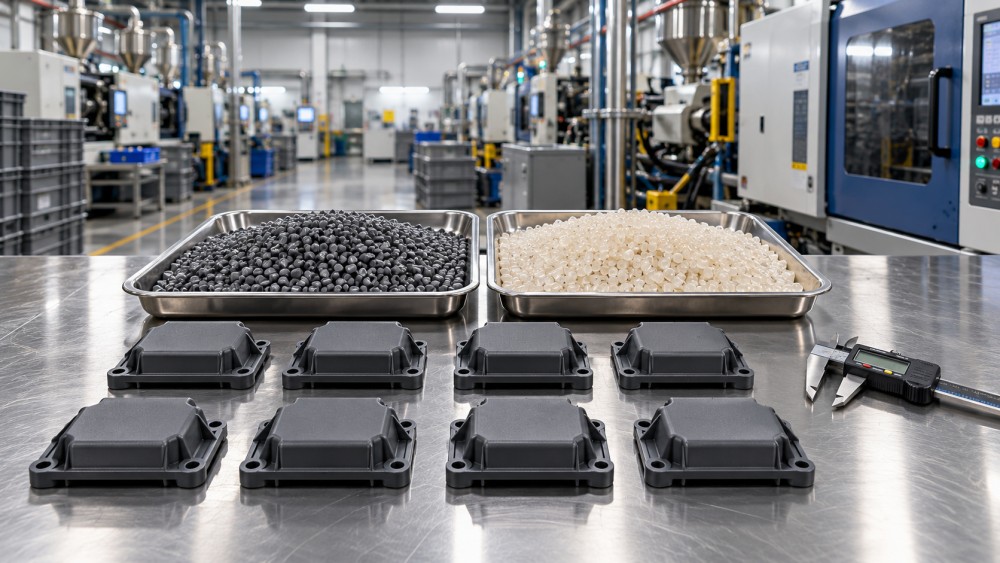
A dark-colored industrial cover with moderate mechanical requirements presents a different opportunity from a transparent film or a safety-critical electrical housing. PCR may be commercially attractive in the cover because appearance variation can be less restrictive. In the film, small gels or contamination may create unacceptable defects. In the housing, flame performance, electrical properties, and approval requirements can dominate the economics.
That does not make recycled materials unsuitable for demanding applications. It means the material needs to be supplied and qualified as an engineered grade, not purchased as a generic substitute.
For regulated uses, a recycled-content declaration is not evidence of suitability. Requirements depend on the material, intended use, recycling process, and destination market. Confirm those requirements before investing in production trials.
A controlled blend can be a sensible starting point. However, properties do not always change proportionally with PCR percentage. Contamination, incompatible polymers, and additive interactions can produce nonlinear effects, so the final formulation still needs validation.
Calculate cost per accepted part, not just cost per kilogram
The most useful purchasing comparison connects material cost to saleable production:
Cost per accepted part = total relevant production cost ÷ number of accepted parts.
Use the same accounting boundary for both candidates. Include delivered formulation cost, processing, inspection, unrecovered scrap, and any additional qualification costs allocated over a realistic production volume. Avoid counting material losses twice if they are already included in total material consumption.
For film or sheet, the equivalent measure may be cost per accepted square meter at the required thickness. For extrusion profiles, it may be cost per accepted meter. These measures expose savings that disappear when output falls or rejects rise.
Part weight deserves attention too. A change in filler content or formulation density can affect the mass required for the same geometry. A cheaper kilogram is not automatically a cheaper component.
Separate recurring costs from one-time costs. Testing and initial process development may be manageable over a long production program but difficult to recover on a short order. Report both the steady-state saving and the expected payback rather than hiding qualification expenditure.
Where a promising discount can disappear
Moisture control is one example. Recycled PET or polyamide may require carefully managed drying, just as their virgin counterparts do. Poorly controlled moisture can contribute to degradation during melt processing. The purchasing issue is whether the delivered material and its storage conditions create additional drying, handling, or rejection costs compared with the current grade.
Filtration is another. Finer filtration may help manage solid contamination, but it can also increase pressure, screen changes, and material losses. It does not remove every dissolved contaminant or correct an incompatible polymer mixture.
Additives can improve performance, but they are not free insurance. Stabilizers, compatibilizers, impact modifiers, and odor-control measures each address particular problems. Ask the compounder which property the proposed package restores, how that improvement is measured, and whether it introduces another trade-off.
Buy consistency, not a good sample
A successful sample trial establishes possibility. It does not establish supply consistency. PCR feedstock can vary with collection sources, sorting practices, and changes in the recycler’s input stream. Procurement needs to understand how the supplier controls that variation before signing a volume agreement.
Melt flow rate is useful, but it is not a complete specification. Two lots with similar flow can differ in impact performance, contamination, odor, or aging behavior. Likewise, a broad technical data sheet may describe typical properties without defining contractual acceptance limits.
- Define critical limits: Choose properties tied to the application, including moisture, ash or filler content, contamination, color, and relevant mechanical performance.
- Clarify test conditions: Specify methods, conditioning, sampling, and reporting so results are genuinely comparable.
- Check multiple production lots: Evaluate variation rather than relying on a single prepared sample.
- Require change notification: Agree which feedstock, formulation, or process changes trigger review or requalification.
- Verify content claims: Establish how PCR percentage and origin are documented, including the basis used for any certification claim.
Distinguish physical recycled content from any allocation-based claim where relevant. They are not interchangeable purchasing descriptions. The appropriate documentation depends on the contractual claim and applicable requirements.
Run a trial that can answer a commercial question
Before material arrives, agree what success means. “Runs well” is too vague. Record accepted output, reject categories, cycle time or line speed, energy where measurable, screen changes, purging, and operator interventions. Keep the virgin reference and PCR trial conditions comparable, while allowing documented process adjustments needed by the candidate grade.
Do not stop at freshly molded test bars if the product will experience heat, chemicals, sustained loads, or outdoor exposure. Select tests that reflect those conditions. A material can pass initial tensile requirements yet behave differently in creep, impact after aging, or assembly.
Check downstream operations as well. Surface variation may affect coating or adhesive bonding; dimensional changes may affect assembly. A resin saving at molding can become an extra expense elsewhere in the factory.
This is the connection emphasized across APIM’s coverage of recycled polymers, modified compounds, and extrusion technologies: formulation, equipment behavior, and application performance need to be evaluated together. Treating them as separate purchasing decisions leaves important costs unassigned.
Protect the saving through the supply agreement
Once the material is technically acceptable, check whether the supplier can support the required volume with the same controlled grade. Ask about normal lead times, feedstock sourcing, lot segregation, retained samples, and the response to an out-of-specification delivery.
Price reviews should reflect the actual supply arrangement. Automatically linking PCR prices to a virgin resin index may be inappropriate if collection and reprocessing costs behave differently. Whatever mechanism is selected, define review timing and avoid assuming today’s discount is permanent.
Maintain an approved fallback where supply continuity matters. Switching back to virgin material may still require process adjustments, customer approval, or changes to recycled-content labeling. Those practical consequences belong in contingency planning.
PCR lowers industrial polymer materials cost when its delivered formulation price, production behavior, and supply reliability produce a lower cost per accepted unit. Request the specification and traceability evidence first, qualify multiple lots, and then calculate the saving using actual production results. If the saving depends on ignoring rejects, extra additives, or approval work, it is not yet a dependable purchasing advantage.
Have questions about this sector analysis, or seeking best practices specific to your niche? Drop us a line below and let the senior consultants at APIM assist you.
We respect your privacy. Your information is strictly confidential.
Related News
- 00
0000-00
Do polyolefin hot melt adhesives bond well to polyethylene? - 00
0000-00
Korean Study Finds PLA Barely Degrades in Landfill After 320 Days - 00
0000-00
How to assess batch consistency from a thermal potting compounds supplier - 00
0000-00
How much weight can carbon fiber reinforced plastics save in cars? - 00
0000-00
Switching from PS to ABS Sheet Extrusion: Equipment Checks