




Can High-Strength Polymers Replace Metal? Weight, Tooling, and Lifetime Costs
Can High-Strength Polymers Replace Metal? Weight, Tooling, and Lifetime Costs
Can high-strength polymers replace metal without compromising reliability or increasing long-term costs? Yes, in selected applications—but rarely through a straight material swap. Reinforced engineering plastics can reduce component weight, consolidate parts, and eliminate some machining operations. Tooling investment, production volume, heat exposure, creep, and maintenance requirements can also change the business case.
The useful comparison is not resin price against metal price per kilogram. It is the cost of two qualified designs delivering the same function over the same service life. A polymer component that costs more to purchase may still reduce assembly and operating costs. A cheaper molded part may become expensive if it loses dimensional accuracy or requires premature replacement.
Start with the job the metal actually performs
A metal housing may carry loads, dissipate heat, shield electronics, hold threaded fasteners, and maintain alignment. Replacing it with a reinforced polymer means addressing every necessary function, not just matching tensile strength. This is where otherwise promising substitution projects can stall: the material passes an initial strength comparison, but the finished assembly fails a thermal or dimensional requirement.
Strength and stiffness are different. A reinforced thermoplastic may withstand the applied load yet deflect more than the metal design permits. Ribs, deeper sections, or revised mounting points can improve stiffness, but those changes consume space and affect molding. Where the installation envelope is fixed, the redesign may have limited room to work.
Material selection must also move beyond the polymer family name. Glass-fiber-reinforced polyamide, PPS, and PEEK offer different combinations of mechanical performance, environmental resistance, processing demands, and cost. Fiber content, fiber length, additives, moisture condition, and processing history all influence the result. “High-strength polymer” describes a broad category, not a purchasing specification.
Before requesting quotations, define the load cases, allowable deformation, continuous and peak temperatures, chemical exposure, dimensional tolerances, and expected service life. Include assembly loads and foreseeable misuse. These requirements give suppliers a defensible basis for proposing grades—and prevent procurement from comparing materials that are not functionally equivalent.
Weight savings come from the design, not just density
Many engineering polymers have lower density than common structural metals, even after reinforcement. However, density alone does not determine finished-part weight. The relationship is straightforward: part mass equals material density multiplied by material volume. If the polymer design needs thicker sections, some of the apparent advantage disappears.
The stronger opportunity often lies in changing the construction. A molded housing can incorporate cable guides, mounting features, and locating surfaces that previously required separate brackets or machined details. Removing those parts can reduce fasteners, handling, and assembly work as well as mass. Compare the complete assembly, including inserts, seals, coatings, and joining materials.
A hybrid design deserves consideration. Metal compression limiters can protect bolted polymer joints; threaded inserts can support repeated servicing; local metal reinforcement can carry concentrated loads. These features add cost and process steps, but they may preserve most of the lightweighting benefit without forcing the polymer to perform poorly suited tasks.
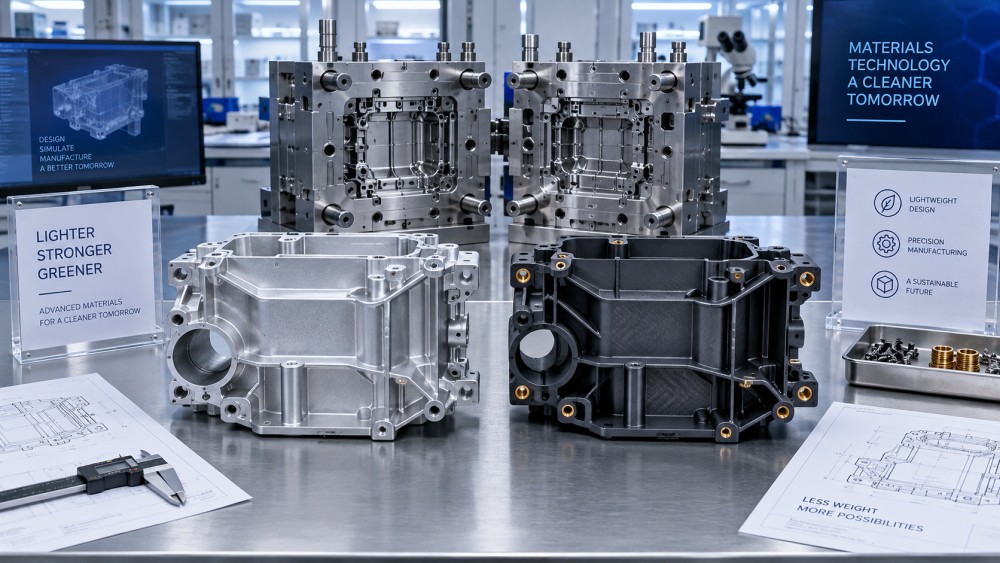
Weight reduction has different financial value across applications. It can matter directly in moving machinery, vehicle components, and manually handled equipment. In a stationary enclosure, part consolidation or corrosion resistance may be more valuable. Do not assign operating savings unless the lighter design actually changes energy consumption, payload, handling, or another measurable cost.
Tooling can make—or erase—the unit-cost advantage
Injection molding can be attractive when demand is repeatable and the geometry is stable. It can produce complex features without machining each one individually. The trade-off is upfront spending on mold design, manufacture, trials, inspection fixtures, and qualification. Slides, tight tolerances, insert loading, and demanding surface requirements can make that investment substantial.
The metal baseline matters. Replacing a heavily machined component presents a different opportunity from replacing an efficient stamping or an established die casting. Metal processes can already offer low conversion costs at suitable volumes. A polymer quotation should be compared with the realistic metal route, not an unnecessarily expensive version of it.
A useful initial calculation is:
Break-even quantity = incremental upfront investment ÷ recurring savings per accepted assembly.
Incremental investment includes redesign and validation, not just the mold. Recurring savings should reflect material, conversion, secondary operations, assembly, inspection, and scrap. If the polymer route has no recurring savings, volume alone will not recover the investment. Benefits such as lower operating weight must then justify the premium separately.
Use conservative demand assumptions. A tool justified by an optimistic forecast can become stranded capital if the program changes. Ask who owns the mold, where it will be stored, how maintenance is charged, and what happens if production transfers. Tool ownership without access to drawings, process records, and transfer provisions offers limited protection.
For low-volume or evolving designs, machining engineering-polymer stock may avoid an early mold commitment. However, stock shapes and injection-molded reinforced parts can have different structures and properties. A machined prototype can confirm fit and assembly access; it does not automatically validate molded-part strength, weld lines, or warpage.
Lifetime performance is where the comparison gets harder
Short-term datasheet values are screening tools. They do not establish how a component behaves after years under load, heat, moisture, chemicals, or vibration. For metal replacement, long-term deformation can matter more than the load that causes immediate failure.
Creep and joint relaxation
Polymers can deform progressively under sustained stress, particularly at elevated temperatures. In a bolted joint, this can reduce clamp force; in a precision support, it can shift alignment. Request creep data relevant to the stress, temperature, and duration involved. A room-temperature tensile result cannot answer those questions.
Heat, moisture, and chemical exposure
Heat-deflection temperature is not a continuous-service rating. The allowable operating temperature depends on the property that must be retained and the conditions of use. Moisture absorption can alter the dimensions and mechanical behavior of polyamides. Chemical resistance must be checked against actual fluids, concentrations, temperatures, and exposure periods, including cleaners and lubricants.
Thermal expansion also deserves attention where polymers meet metal. Repeated temperature changes can affect seals, clearances, adhesive bonds, and insert retention. Reinforcement can reduce expansion in particular directions, but it does not make every part behave uniformly.
Processing changes the part’s performance
Fiber orientation makes reinforced molded parts direction-dependent. Gate location, weld lines, wall transitions, and filling conditions can influence strength and distortion. Test specimens may therefore perform differently from critical areas of the finished component. Simulation helps identify risks, but production-representative testing remains necessary.
Lifetime costing should include replacement parts, service labor, downtime, and access for repair. Part consolidation can simplify production while making maintenance more expensive if a small failed feature requires replacing an entire housing. That trade-off belongs in the business case before the architecture is approved.
Compare delivered assemblies and qualified supply chains
A useful supplier quotation separates resin consumption, conversion cost, secondary operations, inserts, testing, packaging, and tooling. Ask what assumptions support the price: cavity count, cycle time, yield, annual volume, and inspection requirements. The cheapest quoted part may rely on conditions the project cannot sustain.
Compound consistency is another cost variable. Fiber dispersion, degradation during processing, drying control, and permitted regrind can affect final properties. Purchasing documents should identify the approved grade, traceability requirements, change-notification rules, and acceptance criteria. A nominally similar resin from another supplier is not necessarily interchangeable without validation.
- Confirm resin and molding lead times separately, including tooling modifications and qualification samples.
- Establish whether an alternative grade or production site requires partial or complete requalification.
- Verify application-specific compliance evidence for the exact material and intended use.
- Specify how dimensional and mechanical acceptance will be measured under relevant conditioning.
The Global Advanced Polymers & Industrial Materials Intelligence Network (APIM) approaches material selection through these connected issues: compound formulation, processing, application performance, and procurement risk. Its structured coverage can help teams prepare technical discussions with suppliers, while project approval still requires evidence for the selected grade, process, and component.
Sustainability claims need similar discipline. Lower weight does not automatically mean lower lifetime environmental impact. Durability, manufacturing yield, operating benefits, recycled-content consistency, and end-of-life options all matter. Fiber reinforcement, inserts, coatings, and adhesives can complicate recovery; compare credible pathways rather than assuming every polymer part is readily recyclable.
Approve the substitution in stages
High-strength polymers are strong candidates where geometry can be redesigned, multiple functions can be consolidated, and long-term loads and environmental exposure are manageable. Metal remains compelling where extreme stiffness, heat conduction, concentrated loads, or demanding service conditions dominate. Hybrid construction often provides a practical middle ground.
A disciplined approval sequence starts with functional requirements, moves to grade and process selection, and then tests production-representative parts. Release major tooling investment only when technical risks and conservative volume assumptions support it. Before authorizing the change, ask for an assembly-level cost comparison, a validation plan, and a documented supply-continuity strategy. Those three items reveal whether the proposal is a genuine cost improvement or simply a lighter part.
Have questions about this sector analysis, or seeking best practices specific to your niche? Drop us a line below and let the senior consultants at APIM assist you.
We respect your privacy. Your information is strictly confidential.
Related News
- 00
0000-00
Do polyolefin hot melt adhesives bond well to polyethylene? - 00
0000-00
Korean Study Finds PLA Barely Degrades in Landfill After 320 Days - 00
0000-00
How to assess batch consistency from a thermal potting compounds supplier - 00
0000-00
How much weight can carbon fiber reinforced plastics save in cars? - 00
0000-00
Switching from PS to ABS Sheet Extrusion: Equipment Checks