




Can Circular Materials Strategies Reduce Manufacturers' Total Cost of Ownership?
Circular materials strategies can reduce total cost of ownership, but recycled content alone does not create savings. The cost benefit appears only when a circular material system improves the economics of the whole manufacturing loop: material yield, process stability, product reliability, compliance exposure, supply continuity, and the value recoverable after use.
A resin grade with a lower purchase price can increase total cost if it causes more drying, filtration, scrap, cycle-time variation, color inconsistency, tool wear, warranty risk, or qualification work. Conversely, a circular material with a higher price per kilogram can lower ownership cost when it reduces virgin-material dependence, enables controlled internal regrind, avoids disposal charges, stabilizes access to recycled feedstock, or supports a product design that is easier to recover and reuse.
The practical question is not whether circular materials are “cheaper.” It is whether the manufacturing system can convert circularity into repeatable operating value without transferring hidden costs to production, quality, customers, or the downstream recovery chain.
Start with a total-cost baseline, not the resin price
Material purchase price is visible and easy to compare. Total cost of ownership is less visible because it sits across procurement, engineering, production, quality, logistics, and end-of-life management. A meaningful baseline should include every cost that changes when a virgin material, a recycled polymer, a bio-based feedstock, or a recoverable design is introduced.
For a molded, extruded, thermoformed, or converted product, the relevant cost model generally includes:
- delivered material cost, including freight, duties, packaging, and inventory carrying cost;
- usable yield rather than nominal material consumption;
- drying, blending, dosing, filtration, melt processing, and energy requirements;
- cycle time, throughput, changeover losses, and start-up scrap;
- sorting, grinding, reprocessing, disposal, and waste-hauling costs;
- labor and inspection required to control batch variability;
- tooling maintenance, wear, contamination events, and unplanned downtime;
- field performance, returns, repair, and replacement exposure;
- qualification, testing, traceability, and document-management requirements;
- residual value of production scrap, returned products, and recoverable components.
This baseline prevents a common error: assigning all circularity costs to the new material while treating the existing waste stream, virgin-material risk, and end-of-life liabilities as if they had no cost. A production line already generating edge trim, sprues, off-spec rolls, purge material, or rejected parts has a material-loss problem whether or not it is described as a circularity problem.
It is useful to calculate cost per accepted finished unit, not cost per kilogram of input resin. That single change often reveals whether a lower-cost feedstock is genuinely economical. If a compound requires a higher rejection allowance or reduces line output, its apparent saving can disappear quickly.
Separate circular strategies because their economics are different
“Circular materials” covers several distinct operating models. They should not be evaluated with one generic sustainability scorecard.
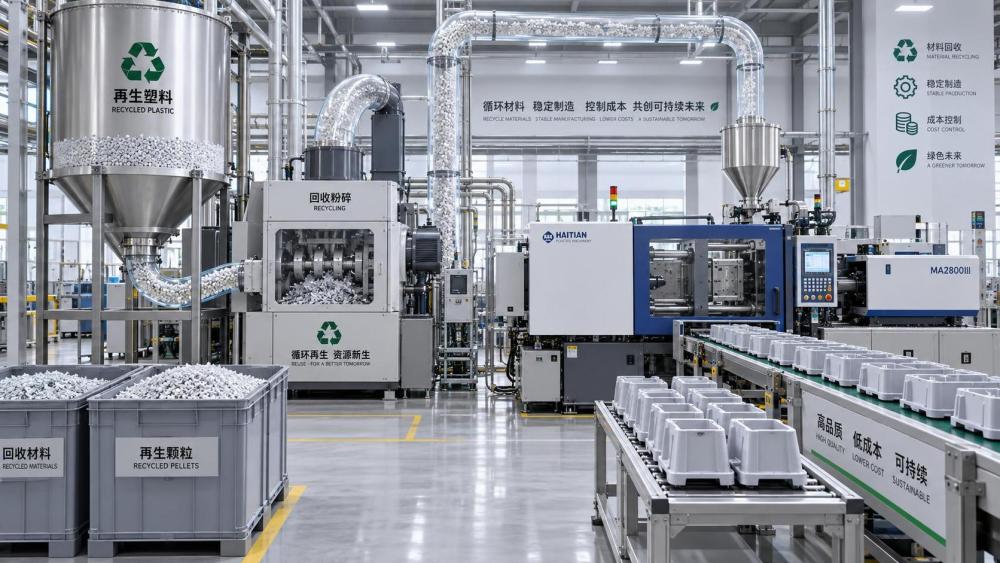
Internal regrind is often the most direct route to lower cost because the manufacturer knows the original formulation and controls contamination. Yet even this route has technical limits. Repeated heat histories can reduce molecular weight in some polymers, alter viscosity, weaken impact performance, increase yellowing, or create gel particles. For filled and reinforced compounds, repeated processing may affect dispersion, fiber length, and mechanical consistency. A closed internal loop is economically attractive only when the maximum regrind ratio is established against actual part requirements, not assumed from nominal resin compatibility.
Post-industrial recycled material may offer greater consistency than post-consumer feedstock, but it still requires clear rules on source material, additives, pigments, moisture control, and allowable contamination. Post-consumer recycled polymers create a different challenge: feedstock quality is tied to collection and sorting realities. The decision cannot rely on a supplier’s average technical data sheet alone. It must account for lot-to-lot variation and the manufacturer’s own tolerance for that variation.
Make performance stability the first decision gate
Circular material cannot reduce ownership cost if it compromises the function that the finished product is required to deliver. The risk is especially high in safety-relevant, electrical, medical, food-contact, high-temperature, pressure-bearing, precision, or long-service-life applications. In these uses, a small shift in material behavior can create costs far larger than any resin saving.
The relevant question is not whether a recycled grade can pass a single laboratory test. It is whether the material remains within an agreed processing and performance window across normal supply variation. That means assessing the properties that actually govern product performance: melt flow or viscosity behavior, moisture sensitivity, tensile and impact retention, elongation, warpage, thermal aging, dimensional stability, color, odor, volatile content, electrical properties, flame performance, chemical resistance, and surface quality.
For films and sheet products, small changes in gel count, contamination, haze, thickness control, seal behavior, or barrier performance can lead to disproportionate conversion losses. In injection molding, unstable flow behavior can affect fill balance, weld lines, shrinkage, and cycle repeatability. In extrusion, inconsistent bulk density or particle shape can disrupt feeding, while excessive fines or contamination can increase screen-change frequency and pressure fluctuation.
Qualification should therefore use a production-representative trial, not only a short machine run. The test should capture start-up behavior, steady-state output, scrap rate, changeover conditions, and the quality of finished parts over a meaningful operating period. It should also establish what happens at the edges of the supplier’s specification range. A material that works only under tightly optimized conditions may carry more operating risk than its price indicates.
Identify where circularity removes cost and where it adds cost
There are several legitimate routes to a lower total cost of ownership. Clean in-house scrap can offset purchases of virgin resin. A mono-material structure can simplify production scrap handling and improve recovery value. A more durable polymer component can extend service life and reduce replacement demand. A stable recycled-content grade can provide an alternative feedstock route when a manufacturer wants less dependence on one virgin-resin supply chain.
But circularity also introduces potential costs that must be budgeted rather than discovered after launch. These include incoming inspection, material segregation, supplier audits, additional drying or filtration, upgraded gravimetric dosing, color-management constraints, modified mold settings, added inventory buffers, testing, and traceability administration. In a closed-loop program, collection and reverse logistics may be more expensive than the recovered material is worth unless the return stream is concentrated, clean, and predictable.
The decision is strongest when the same action improves both economics and control. Examples include reducing a high-scrap process through better trim recovery; redesigning a multi-material component into a compatible material family; using durable components where replacement and field service are expensive; or installing process controls that reduce both virgin resin consumption and batch-to-batch quality variation.
Build the material specification around variation, not average values
Many circular-material failures are specification failures. A purchase specification that only states recycled-content percentage, polymer family, color, and nominal melt flow leaves too much ambiguity. It does not define what the converter needs to operate reliably.
A robust specification should distinguish between material identity and material usability. In addition to the base polymer and recycled-content claim, it may need limits for moisture, ash, volatile content, contamination, particle-size distribution, odor, black specks, gel formation, color tolerance, bulk density, filterability, and prohibited substances. The relevant controls depend on the process and application. A black, mineral-filled injection-molded industrial part has a very different tolerance profile from a clear PET sheet, a light-colored appliance housing, or a thin-wall electrical connector.
For compounded materials, formulation control matters as much as recycled feedstock quality. Stabilizers, chain extenders, impact modifiers, compatibilizers, pigments, and fillers can restore or tune performance, but they can also complicate future recycling and make composition harder to verify. The appropriate approach is not to reject additives categorically. It is to understand whether the formulation supports the intended service life and the likely recovery route.
Do not confuse recyclable design with recoverable value
A product may be technically recyclable while having little practical value at end of life. Recovery depends on whether material can be identified, separated, collected, transported, sorted, and processed into a usable feedstock. A complex assembly made from compatible materials may be more recoverable than an assembly containing several incompatible polymers, bonded metal inserts, coatings, foams, and adhesives that cannot be separated economically.
Design choices should be reviewed through the likely recovery pathway. Material marking can assist sorting where parts are large enough for identification. Avoiding unnecessary combinations of incompatible polymers can preserve value. Detachable components may improve disassembly when the recovered fractions are valuable enough to justify the labor or automation. Color selection also matters: some recovery routes have limited outlets for dark, heavily pigmented, or highly variable color streams.
There is no universal rule that a mono-material design is always superior. Barrier packaging, electrical insulation, structural assemblies, and bonded composites may need multi-layer or multi-material solutions to meet performance requirements. The relevant comparison is between functional performance and the actual ability to recover value after use, not between a simple label and a complex one.
Control supply risk before claiming a cost advantage
Circular feedstocks may be exposed to different supply risks than virgin resins. Their availability can depend on collection quality, sorting capacity, seasonal changes in waste composition, competing demand from other applications, and geographic limitations on feedstock movement. Procurement should treat the feedstock source, sorting method, preprocessing steps, and quality-control system as part of the material qualification.
Dual sourcing can be useful, but it is not enough to approve two suppliers based on similar polymer names. Their recycled feedstocks, additive packages, color systems, and processing history may differ materially. A practical approval process defines which properties are interchangeable, which require notification before change, and which changes trigger requalification.
Contracts should address technical consistency as clearly as commercial terms. The important provisions may include specification ranges, certificate requirements, change-control obligations, traceability expectations, nonconformance handling, retention samples, and a process for resolving disputed quality. These measures do not eliminate variability; they prevent variability from becoming an unmanaged manufacturing cost.
Use a staged implementation rather than a full conversion
The lowest-risk route is usually to begin where the material stream is clean, the product tolerance is broad, and the process data are available. Internal scrap recovery, non-cosmetic industrial parts, secondary packaging, or components with controlled geometry can provide a more informative starting point than the most demanding product in the portfolio.
A staged conversion should establish a baseline before the change, run controlled trials, compare accepted-unit cost, and monitor the variables that matter after launch. These may include throughput, scrap, regrind rate, screen changes, energy use, drying time, inspection burden, customer complaints, and material inventory. The decision should remain reversible until the process is stable and quality requirements are proven.
Financial evaluation should also distinguish one-time conversion costs from recurring operating costs. Tool adjustments, testing, supplier qualification, and documentation may be material at the beginning, while savings from lower scrap disposal, higher recovery yield, or reduced virgin purchases accumulate over the operating life of the program. Treating both categories as if they occur in the same period produces misleading comparisons.
The decisive measure is cost per functional service delivered
Circular materials strategies reduce total cost of ownership when they lower the cost of delivering the required function over the product’s full life. That function may be a durable automotive component, a protective package that prevents product loss, a stable electrical enclosure, a precision molded part, or a film structure that runs efficiently on a converting line.
The circular option is commercially credible when it meets that function with controlled process risk and creates a better balance of material use, waste cost, supply exposure, and recoverable value. It is not credible when recycled content is added to a specification while quality variation, process losses, and end-of-life limitations are ignored.
The most useful decision rule is therefore straightforward: approve circular materials only after testing their effect on accepted output, operating stability, product lifetime, and recovery economics together. When those conditions are measured as one system, circularity can become a disciplined cost-control strategy rather than an additional compliance expense.
Have questions about this sector analysis, or seeking best practices specific to your niche? Drop us a line below and let the senior consultants at APIM assist you.
We respect your privacy. Your information is strictly confidential.
Related News
- 00
0000-00
How does washing affect contamination in post-consumer recycled PP resins? - 00
0000-00
How does feedstock affect depolymerization equipment selection? - 00
0000-00
US Sets 213.44% Preliminary Antidumping Deposit on Chinese PTMEG - 00
0000-00
When should epoxy be used as a thermal interface material for semiconductors? - 00
0000-00
US Midterm Results Unlikely to Quickly Shift Recycled Plastics Market or Legislation