




When do bio-based polymers for injection molding meet heat resistance needs?
A molding team may first notice the problem after a part has already moved beyond the press. A bio-based resin runs cleanly in the mold, the parts look acceptable at room temperature, and the sustainability target appears to be covered. Then the component is exposed to a warm vehicle interior, a charging enclosure, a hot-water cleaning cycle, or a nearby electronic heat source. Tabs begin to relax, a flat surface develops visible distortion, an assembled part loses fit, or a load-bearing feature feels less rigid than expected.
This is frustrating because the failure is often described too simply: “the bio-based material cannot take heat.” In practice, the issue may come from an unsuitable thermal metric, an optimistic service-temperature assumption, insufficient reinforcement, moisture effects, unfavorable part geometry, or molding conditions that created residual stress. Bio-based polymers for injection molding can meet meaningful heat-resistance requirements, but only when the selection is tied to the actual thermal event the part must survive.
Start with the heat event, not the renewable-content claim
“Heat resistance” is not one property. A material may tolerate a brief high-temperature exposure but creep during continuous use at a lower temperature. Another grade may retain stiffness well but become difficult to mold without degradation. A third may have a favorable datasheet temperature value under one test method while warping in a thin, stressed geometry.
The first useful question is: What happens to the part when it gets hot? The answer determines the property that matters most. For a clip near a power module, retention force and long-term creep may control the decision. For a housing that must remain flat after a paint-bake-adjacent operation or sterilization-like cycle, dimensional stability is more relevant. For a consumer appliance component, repeated heating and cooling may be more damaging than one peak temperature. A container or cap may need resistance to heat while also retaining chemical contact performance and seal geometry.
Before comparing candidate grades, define the actual exposure in practical terms:
- the highest temperature at the part, rather than the ambient air temperature nearby;
- whether exposure is continuous, intermittent, or a short processing event;
- the mechanical load present during heating, including assembly stress and fastener load;
- the surrounding medium, such as dry air, humidity, oils, cleaning agents, or electrical insulation conditions;
- the allowed change in shape, stiffness, appearance, and functional fit after exposure.
That framing prevents a common selection mistake: choosing a resin based on a single heat-deflection figure before establishing whether the part’s real risk is deflection, creep, softening, hydrolysis, stress cracking, or post-mold shrinkage.
The usual source of confusion: processing temperature is not service temperature
Some renewable or partly renewable engineering materials require relatively high melt temperatures to flow through thin walls or reinforced features. That does not mean the molded part will perform at those temperatures in service. Conversely, a polymer with an attractive published thermal transition may still show poor part-level stability when it is heavily loaded, poorly supported, or exposed for long periods.
For bio-based polymers for injection molding, this distinction matters because the available material families vary widely. Bio-derived content can exist in polymers with structures similar to established engineering resins, in bio-derived polyamides, in polyester families, or in formulations designed around renewable fillers and additives. Their thermal behavior depends on molecular structure, crystallinity, reinforcement, nucleation, moisture sensitivity, and the balance of modifiers used to achieve toughness or flow.
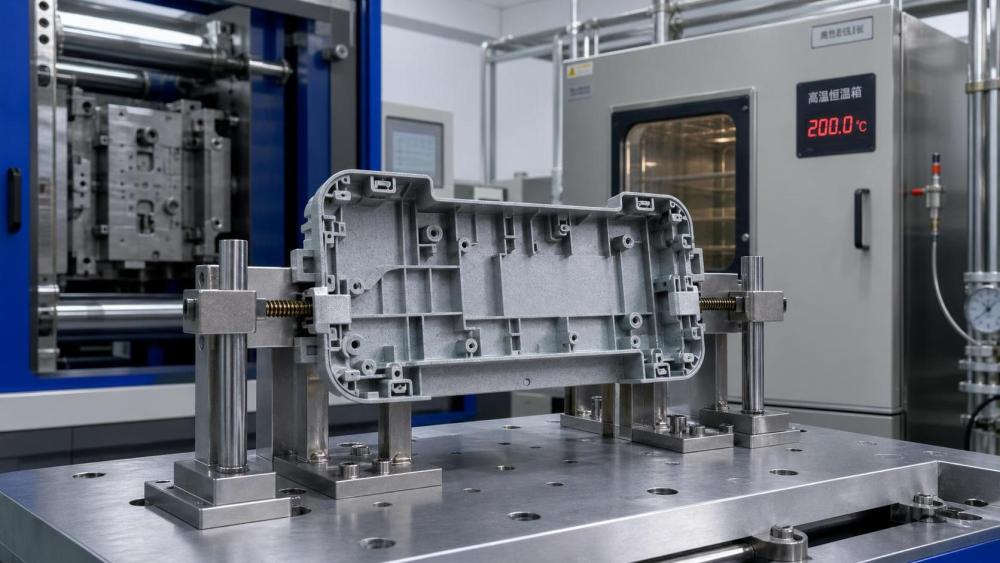
It is therefore better to separate three temperatures during evaluation. The first is the molding window: the range where melt flow, residence time, and degradation risk are manageable. The second is the part’s short-term thermal tolerance: the temperature excursion it can withstand without unacceptable immediate distortion. The third is the long-term operating range under load and environment. The third one is commonly the hardest to verify and the most important for durable industrial components.
Where bio-based options are often credible
Heat-resistant bio-based choices are most realistic when the application requirement is defined rather than assumed to be “high heat.” Many parts operate in a moderate-to-elevated thermal range but need better stiffness retention and dimensional control than commodity bioplastics can offer. In these cases, a renewable-content engineering polymer, especially a reinforced or carefully stabilized grade, may be a serious candidate.
Bio-based polyamides are frequently considered when a molded part needs strength, toughness, and more demanding thermal performance than simple packaging-oriented materials provide. Their suitability still depends on moisture conditioning, chemical contact, weld-line strength, and the effect of water uptake on dimensions and mechanical behavior. A grade that appears strong and stiff when dry should not be accepted without considering the conditioned state that the finished product will see.
Bio-based polyesters may fit applications where thermal stability, surface quality, and processability must be balanced, although their suitability is highly formulation-dependent. Crystalline behavior, crystallization rate in the mold, and post-molding thermal history can substantially affect dimensional stability. For some applications, the right grade and mold-temperature control make the difference between a viable component and one that distorts after exposure.
Reinforcement expands the practical range. Glass fiber can improve stiffness and resistance to deformation under heat, while mineral fillers may help control shrinkage or improve dimensional consistency. These gains are not free. Reinforced formulations can become more anisotropic, meaning flow direction affects shrinkage and warpage. They may also demand attention to gate location, fiber orientation, surface finish, tool wear, and the strength of thin knit-line regions.
A material can pass a coupon test and still fail the part
Data-sheet comparisons are useful for narrowing options, but a flat test bar does not reproduce every condition inside an actual molded component. Ribs, bosses, snap features, local wall transitions, metal inserts, and restricted corners each create their own stress pattern. A material that retains stiffness in a standard test may still relax around a fastener boss or pull away from an insert after thermal cycling.
Part geometry should enter the decision early. Thin walls often require higher injection pressure and faster filling, which can increase orientation and residual stress. Thick sections cool differently from surrounding areas, creating differential shrinkage. Long unsupported spans amplify small changes in modulus. If a part must remain flat, the relevant question is not merely whether its polymer has acceptable heat resistance; it is whether the combination of polymer, fiber orientation, gate position, cooling pattern, and part design can hold the required shape.
For this reason, use the intended geometry in the first meaningful validation stage whenever possible. If tooling is not ready, a representative plaque, ribbed specimen, or simplified geometry can reveal more than a generic tensile bar. Include the assembly condition where it matters. A housing tested without screws, clips, seals, or inserts may miss the stress state that drives service distortion.
A practical route from shortlist to molding trial
Begin with a short list based on the required temperature exposure, load, environment, and sustainability criteria. Do not filter candidates only by bio-based content percentage. A lower renewable-content grade that maintains function may be more appropriate than a higher-content option that requires oversized walls, heavier geometry, or frequent replacement. The material decision should account for the finished part’s performance, not a single procurement attribute.
Next, request comparable technical information from potential suppliers. Look for test methods and specimen conditions behind reported thermal properties. Note whether values are given for dry-as-molded, conditioned, or humidity-equilibrated samples. For reinforced grades, confirm fiber content and direction-sensitive behavior. If the part will see electrical heat, liquids, cleaning cycles, or ultraviolet exposure, ask whether the proposed formulation was designed with those conditions in mind rather than assuming thermal performance alone covers them.
Then conduct a processing review before committing to a mold trial. Some bio-based engineering materials have narrower residence-time tolerance than familiar fossil-based resins. Drying requirements can be critical, especially for moisture-sensitive polymers. Poor drying may reduce molecular weight during processing, causing lower toughness, inconsistent viscosity, surface defects, or a decline in thermal-mechanical performance that is not apparent from appearance alone.
During the first trial, record more than cycle time and visual quality. Track melt temperature, mold temperature, injection profile, hold pressure, cooling time, actual drying conditions, regrind policy, and any signs of deposit, discoloration, or unstable fill. These records make it possible to distinguish a material limitation from a processing deviation later. A trial that uses an overly cold mold, excessive shear, or prolonged residence may produce parts that are not representative of the grade’s intended capability.
Test the failure mode that matters
Validation should reproduce the decision risk. For a structural clip, assess retention or deflection after heat exposure. For a cover, assess flatness, gap control, and assembly fit. For a fluid-adjacent part, examine heat together with the relevant medium. For a component exposed to repeated heating, evaluate cycles rather than only one exposure. If the part is loaded for long periods, include load during aging; removing the load during the test can hide creep-related weakness.
Thermal exposure should also be followed by a visual and dimensional review, not only a mechanical test. Discoloration may point to oxidation or processing damage. Surface cracking can indicate stress concentration or chemical interaction. Changes near gates, inserts, or weld lines may identify local weaknesses that a broad average measurement will not show.
When reinforcement helps—and when it shifts the problem
It is tempting to treat glass fiber as the universal answer to heat resistance. Reinforcement often improves stiffness retention and reduces deformation under load, but it changes flow behavior and creates orientation effects. In a simple bracket, that may be beneficial. In a large cosmetic panel with demanding flatness, it can create warpage challenges that offset the gain in stiffness.
If warpage is the primary concern, compare filled and reinforced grades using the actual gate strategy and cooling design. Consider whether a mineral-filled option provides more balanced shrinkage than a highly fiber-reinforced one. If impact resistance at low temperature is also required, check whether the formulation’s toughness modification affects heat performance or long-term creep. No single additive package is automatically optimal across all requirements.
For thin-wall parts, flow length and fiber orientation deserve particular attention. A grade with excellent thermal-mechanical values may not fill consistently within the allowed wall thickness. Raising melt temperature to force fill can introduce degradation risk. Sometimes the better outcome comes from a modest design adjustment—such as changing gate position, reducing a local restriction, or revising rib geometry—rather than selecting the most heavily reinforced material available.
Warning signs that the selection basis is too weak
Pause before release if the proposed material has only been compared through generic datasheets, if conditioning state is unknown, or if the service temperature was taken from a nearby system specification rather than measured at the part. The same caution applies when the part will be assembled under stress, when a mold trial used different drying conditions from production, or when a thermal test did not include the expected environment.
Another warning sign is a requirement written as “high temperature resistant” without duration, load, and dimensional limits. That wording encourages subjective judgment. Replace it with a functional statement: for example, the part must retain its locating function, remain within assembly tolerance, or sustain a specified load after the defined thermal exposure. Even without publishing a numerical threshold in a sourcing document, the internal team should agree on the exact acceptance method.
Making the final choice
Bio-based polymers for injection molding meet heat-resistance needs when the material is matched to a clearly defined thermal duty, processed within its stable window, and validated in a geometry and environment close to real use. They are less likely to succeed when “bio-based” is treated as a standalone performance category or when one laboratory temperature value is used as a substitute for part-level evidence.
The strongest selection decision usually combines polymer data with molding reality: moisture management, reinforcement effects, crystallization behavior, part stress, tool design, assembly conditions, and long-term exposure. If the required performance is near the edge of a candidate material’s capability, do not rely on appearance after molding. Use a controlled trial and a failure-mode-specific evaluation before treating the grade as a qualified replacement.
Have questions about this sector analysis, or seeking best practices specific to your niche? Drop us a line below and let the senior consultants at APIM assist you.
We respect your privacy. Your information is strictly confidential.
Related News
- 00
0000-00
Do polyolefin hot melt adhesives bond well to polyethylene? - 00
0000-00
Korean Study Finds PLA Barely Degrades in Landfill After 320 Days - 00
0000-00
How to assess batch consistency from a thermal potting compounds supplier - 00
0000-00
How much weight can carbon fiber reinforced plastics save in cars? - 00
0000-00
Switching from PS to ABS Sheet Extrusion: Equipment Checks