




Selecting PLA Compostable Packaging for Dry Foods, Produce, and Food Service
A buyer evaluating PLA compostable packaging is rarely choosing a material in isolation. The real decision sits at the intersection of product protection, filling-line behavior, consumer expectations, waste-management realities, and supplier accountability. A clear PLA clamshell may look like an obvious sustainable alternative to PET, while a compostable food-service lid may appear interchangeable with any other bioplastic format. In practice, their requirements can be very different.
For dry foods, moisture control and seal integrity often determine whether the pack is viable. For fresh produce, clarity, ventilation, condensation, and stiffness may carry more weight. In food service, heat exposure, grease resistance, and actual composting access can become the deciding factors. Procurement teams need to move beyond the broad label of “compostable” and define what the packaging must do throughout its full working life.
PLA, or polylactic acid, is a bio-based polymer commonly made from renewable feedstocks. It is widely used in thermoformed trays, clamshells, cups, lids, films, and coated paper-based formats. Yet “made from renewable resources” and “suitable for every food-packaging application” are not the same claim. Selecting the right format means matching material design to the food, distribution route, operating environment, and local end-of-life system.
Begin with the product’s real exposure conditions
A useful procurement brief starts with the food, not with the resin name. Ask how long the product remains in the package, where it travels, whether it is chilled or ambient, and what may happen between packing and consumption. A dry snack packed in a temperate warehouse has a different risk profile from cut fruit held under refrigeration or a hot meal served in a busy takeaway environment.
PLA packaging generally performs best when its temperature and humidity exposure are understood early. Standard PLA can soften or distort at elevated temperatures, particularly in applications involving hot filling, hot foods, microwave use, or hot storage. Crystallized PLA, heat-resistant blends, and alternative compostable structures may address some of these limits, but each should be verified against the intended use rather than accepted on a generic product claim.
For procurement, the critical question is not simply, “Is this PLA?” It is: “Can this specific converted structure protect this specific product through our actual supply chain?”
Dry foods: prioritize moisture, aroma, and sealing performance
Dry foods can seem like the easiest entry point for PLA compostable packaging, but their shelf-life demands are often unforgiving. Granola, tea, coffee, nuts, crackers, dried fruit, powdered mixes, and confectionery may be sensitive to moisture pickup, oxidation, aroma loss, or crushing. A package that looks good on the shelf but allows the product to lose crispness before its sell-by date creates waste rather than sustainability value.
Plain PLA film may not provide the same moisture or oxygen barrier performance as every conventional multilayer structure. Depending on the product, buyers may need to assess coated PLA films, compostable barrier layers, multilayer constructions, or a package redesign that reduces exposure. This is particularly important where a product’s existing packaging uses high-barrier laminates.
Request practical information rather than broad statements. Suppliers should be able to discuss film thickness, seal initiation range, seal strength, puncture resistance, coefficient of friction, tensile behavior, and barrier performance under relevant humidity conditions. If a package will run on vertical form-fill-seal equipment, flow-wrap machinery, or pouching lines, line trials are essential. Film behavior at normal laboratory conditions can differ from behavior under high-speed production, changing ambient humidity, or long production runs.
Dry-food buyers should also examine the closure system. A compostable pouch with an incompatible zipper, valve, label, or adhesive may complicate compostability claims. The entire pack does not always need to be made from one material, but every component should be reviewed as part of the certified packaging system.
Fresh produce: clarity is only one part of performance
For berries, tomatoes, leafy greens, grapes, mushrooms, and prepared produce, thermoformed PLA clamshells and trays are familiar formats. Their transparency can support product visibility, while rigidity provides a useful degree of crush protection. However, produce packaging is an active environment. Respiration, condensation, temperature fluctuation, and handling stress all influence the right specification.
A clear clamshell that traps excess moisture can accelerate spoilage. Conversely, too much ventilation may cause dehydration or reduce visual appeal. The aperture pattern, lid geometry, material thickness, stackability, and compatibility with pad, lidding film, or label all need to be considered as a combined system.
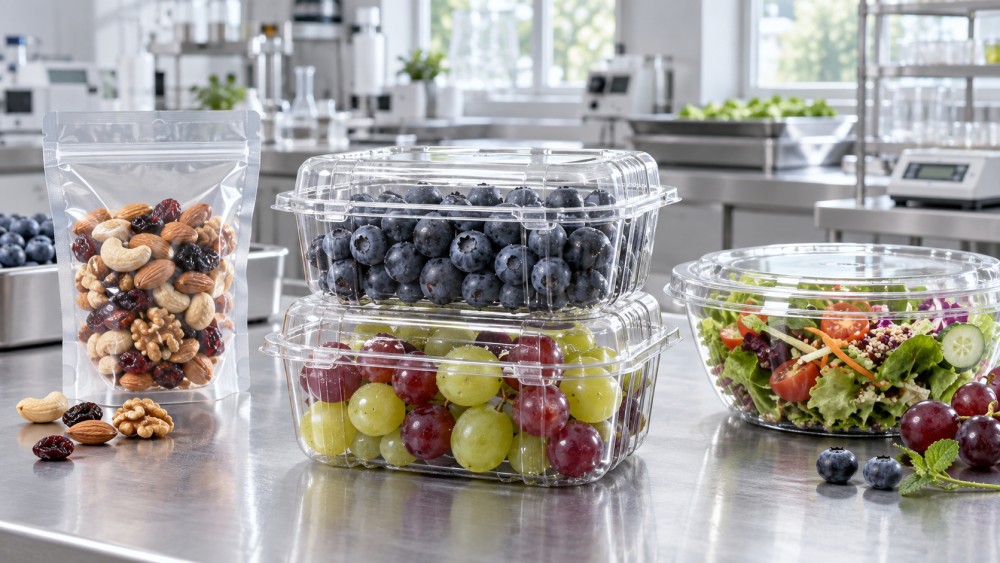
Procurement teams should ask whether the supplier has experience with the relevant produce category, not merely with generic PLA trays. A pack designed for whole grapes may not suit cut salad, and a berry punnet designed for refrigerated retail may not remain stable in warmer distribution conditions. Review performance during cold-chain breaks as well as at the target storage temperature; produce packs are often exposed to less controlled conditions during loading, display, and home transport.
For lidded produce formats, inspect the sealing window and peel behavior. If heat sealing is used, the tray, lidding film, sealant layer, and packing equipment settings must work together. An attractive compostable tray loses its value if seals fail, opening becomes difficult, or rework rates rise on the packing line.
Food service: distinguish cold service from hot, greasy, or wet use
Food-service sourcing can be especially vulnerable to oversimplification. PLA cups, deli containers, salad bowls, cold-drink lids, and clear takeaway packs may be appropriate for chilled and ambient foods. They are not automatically suitable for hot soups, hot beverages, fried foods, or dishes held under heat lamps.
Temperature is only one variable. Hot foods often release steam, while sauces and oils can challenge stiffness, lid fit, and leak resistance. A container may retain its shape when empty yet flex excessively when holding a hot, heavy meal. Buyers should test the complete use scenario: filling temperature, carrying time, stacking, lid engagement, delivery transit, and consumer handling.
For hot applications, specify the maximum expected contact temperature and duration. Confirm whether the proposed item is standard amorphous PLA, crystallized PLA, a mineral-filled formulation, or a blend with other compostable polymers. Material modifications can improve heat performance, but may also affect clarity, brittleness, forming consistency, printing, and end-of-life certification. A technically credible supplier should explain these trade-offs openly.
Compostability is a system claim, not a disposal instruction
One of the most important purchasing controls is to separate industrial compostability from home compostability. Many PLA packaging products are designed to break down under managed industrial composting conditions that involve controlled temperature, moisture, oxygen, and microbial activity. Those conditions are not consistently available in home compost heaps, general waste streams, or every municipal composting program.
Do not assume that a compostable certificate guarantees local collection or acceptance. A city may collect food waste but exclude compostable packaging; a commercial composter may accept certified serviceware but reject certain films, labels, or rigid formats. These practical limitations matter because unclear disposal instructions can lead to contamination, consumer frustration, and challenges to environmental claims.
During supplier qualification, request documentation for the finished packaging article, not only for the PLA resin. Inks, coatings, adhesives, labels, colorants, barrier layers, and closures can affect the certification status of the final item. Relevant standards vary by market, but recognized industrial compostability standards commonly include EN 13432 and ASTM D6400 or ASTM D6868, depending on product construction and region. Buyers should verify which standard applies, which exact SKU is covered, and whether the certificate remains current.
Claims on packs, websites, and tender documents should be precise. “Compostable where accepted” may be more responsible than a broad statement that implies the package will disappear harmlessly in any disposal setting. Legal and labeling requirements should be checked in each target market.
A procurement comparison framework that avoids false equivalence
Comparing PLA packaging solely against a conventional PET, PP, or multilayer pack by unit price creates a misleading result. A more useful evaluation weighs the package across operational, commercial, and end-of-life dimensions.
This approach makes trade-offs visible. A lower-cost tray that requires slower machine speeds, has higher breakage, or reduces shelf life may cost more in the finished operation. Similarly, an enhanced compostable barrier structure may have a higher unit cost but prevent product waste in a premium dry-food application. The most relevant number is total delivered performance, not resin price alone.
Questions that reveal supplier capability
PLA sourcing depends heavily on conversion expertise. Two items described as compostable PLA packaging can differ substantially in thickness control, forming quality, sealing consistency, odor, optical clarity, and batch-to-batch behavior. A short technical discussion can reveal whether a supplier understands the application or is simply reselling a generic format.
- What resin grade and structure are used, and why are they suitable for this food and service temperature?
- What are the recommended storage conditions and shelf life of the empty packaging before use?
- Which processing settings are critical for thermoforming, heat sealing, printing, or automated filling?
- Can the supplier support pilot trials, line troubleshooting, and specification adjustments?
- What changes in raw material, additives, tooling, or production location trigger revalidation?
- Which components are included in the compostability certification, and which are optional or excluded?
- How are food-contact declarations, lot traceability, and change notifications managed?
Storage deserves particular attention. PLA can be affected by heat and humidity before it ever reaches a packing line. Warehousing pallets near hot loading bays, prolonged container transit, or poorly controlled inventory rotation can affect appearance and processing behavior. Include storage requirements in purchase specifications and inbound quality controls.
Common mistakes when switching to PLA compostable packaging
The most frequent mistake is treating a material switch as a like-for-like packaging swap. Existing tooling, sealing temperatures, line speeds, and shelf-life assumptions may need adjustment. Another is selecting a format based on an attractive compostability claim without confirming collection access in the intended sales region.
Buyers also sometimes over-specify. If a product is sold and consumed quickly in a venue with established compost collection, a highly engineered barrier structure may add unnecessary cost and complexity. In contrast, under-specifying a pack for a long distribution chain can turn a sustainability initiative into a product-loss problem. The right answer follows the application, not a universal hierarchy of materials.
Finally, avoid allowing marketing language to replace technical documentation. “Plant-based,” “biodegradable,” and “eco-friendly” do not define heat resistance, food-contact compliance, barrier performance, or certified compostability. Procurement specifications should use measurable requirements and clear acceptance criteria.
Make the decision with a staged validation plan
A sensible transition begins with a limited SKU or regional launch, especially where end-of-life infrastructure can be identified. Define the non-negotiables: target shelf life, food-contact requirements, maximum use temperature, machine throughput, damage tolerance, and disposal claim. Then compare candidate formats through lab review, controlled line trials, distribution testing, and feedback from operations teams.
For dry foods, validate barrier and seal performance over the full intended shelf life. For produce, evaluate condensation, ventilation, stacking, and product condition through realistic cold-chain variation. For food service, test filled containers under the hottest, wettest, and most demanding handling conditions likely to occur.
PLA compostable packaging can be a credible choice when its design matches the product and the disposal pathway is communicated honestly. For procurement teams, the strongest decision is not the one carrying the broadest environmental label. It is the one that protects food effectively, runs reliably, meets documented compliance requirements, and gives customers a disposal instruction that reflects what can genuinely happen after use.
Have questions about this sector analysis, or seeking best practices specific to your niche? Drop us a line below and let the senior consultants at APIM assist you.
We respect your privacy. Your information is strictly confidential.
Related News
- 00
0000-00
How does washing affect contamination in post-consumer recycled PP resins? - 00
0000-00
How does feedstock affect depolymerization equipment selection? - 00
0000-00
US Sets 213.44% Preliminary Antidumping Deposit on Chinese PTMEG - 00
0000-00
When should epoxy be used as a thermal interface material for semiconductors? - 00
0000-00
US Midterm Results Unlikely to Quickly Shift Recycled Plastics Market or Legislation