




PLA PBAT Resin Price in 2026: Cost Drivers and Buying Timing
Why is the PLA PBAT resin price outlook for 2026 drawing so much attention?
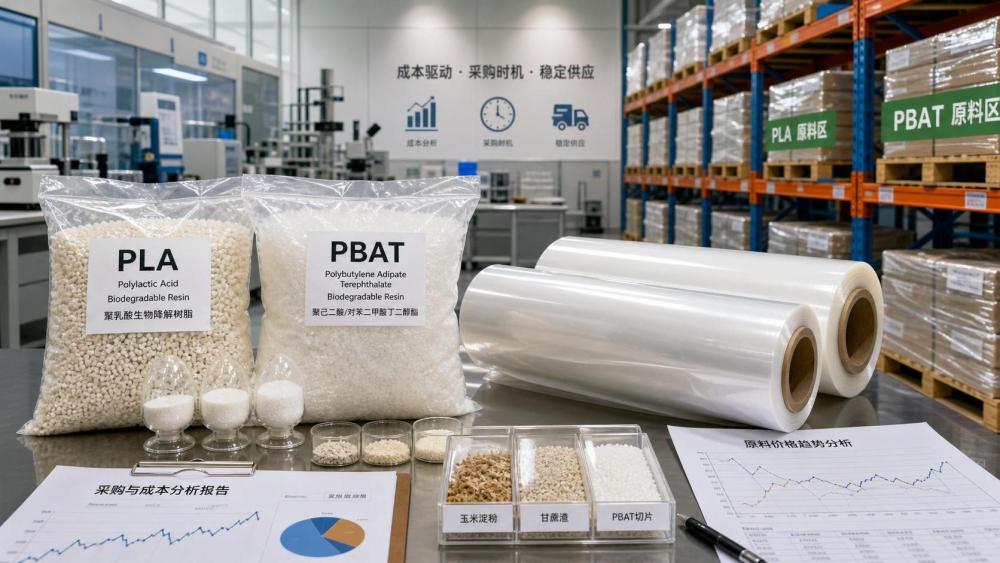
The PLA PBAT resin price discussion is no longer limited to biodegradable packaging headlines.
It now sits at the intersection of cost control, compliance planning, and supply chain timing.
For 2026, the bigger issue is not whether prices move, but what will move them first.
PLA depends heavily on bio-based feedstock economics, fermentation efficiency, and regional capacity utilization.
PBAT, by contrast, remains tied more closely to petrochemical intermediates and energy-linked production costs.
That means the PLA PBAT resin price can shift from both agricultural and fossil-based directions at once.
Another reason this matters is application breadth.
These materials are used in compostable films, bags, flexible packaging, extrusion products, and selected molded parts.
In practical sourcing work, resin price is only one layer.
Processing stability, blend consistency, certification status, and regional logistics often change total cost more than list price alone.
This is why platforms such as APIM matter.
Structured material intelligence helps connect resin pricing with formulation, extrusion behavior, downstream application risk, and supply continuity.
Which cost drivers are most likely to reshape PLA PBAT resin price in 2026?
The market usually reacts to several drivers at the same time.
Looking at one indicator in isolation often leads to poor buying decisions.
Feedstock cost still sets the tone
PLA pricing can respond to corn sugar, glucose, freight, and fermentation input costs.
PBAT pricing is influenced more by adipic acid, terephthalic components, butanediol, and energy markets.
If crude oil weakens while agricultural costs rise, PLA and PBAT may stop moving in parallel.
Capacity expansion can soften pricing, but not evenly
New biodegradable resin projects may increase supply in Asia and reduce spot tightness.
Still, nameplate capacity does not equal usable output.
Ramp-up delays, quality inconsistency, and certification gaps can keep effective supply tighter than expected.
Policy changes can affect price faster than demand growth
Compostability rules, packaging mandates, and local waste policies can suddenly change order patterns.
A regulation that expands compostable bag use may lift regional demand before supply chains adjust.
The PLA PBAT resin price often responds first in markets with limited domestic production.
Processing performance also influences real cost
A lower-priced grade can become expensive if melt strength is unstable or extrusion windows are narrow.
In film lines, poor batch consistency can increase scrap, change die pressure, and reduce output.
That is especially relevant for users comparing neat resin with modified blends or compounds.
When does the market usually offer a better buying window?
There is rarely one universal low-price month for PLA PBAT resin price negotiations.
Better timing usually comes from reading the supply chain rhythm, not guessing a bottom.
One useful approach is to watch the gap between upstream cost movement and downstream order recovery.
When feedstock softens but converters have not resumed aggressive replenishment, offers may become more flexible.
Another window appears during capacity start-up phases.
Producers sometimes accept sharper terms to build reference accounts and stabilize operating rates.
However, this only works if quality approval is already complete.
Waiting for the cheapest quote after qualification begins often creates production risk.
Seasonality matters too.
Demand for compostable packaging can rise before retail or policy milestones, tightening lead times without much warning.
A practical buying window is usually defined by three signals:
- feedstock costs stop rising for several weeks;
- suppliers show stable inventory rather than urgent allocation;
- freight, certification, and production scheduling look predictable.
In other words, the best timing is often when volatility declines, not when price looks historically low.
How should price comparisons be made without missing hidden costs?
This is where many resin comparisons become misleading.
Two offers with a similar PLA PBAT resin price can produce very different production economics.
A short decision table helps separate headline price from usable value.
In actual sourcing work, total landed cost should be paired with conversion cost.
That includes yield, downtime, line speed, packaging format, and storage sensitivity.
APIM-style market tracking is useful here because it ties material properties to procurement consequences.
What mistakes tend to distort PLA PBAT resin price decisions?
The most common mistake is treating all biodegradable resin offers as interchangeable.
PLA, PBAT, and customized compounds can differ sharply in flexibility, heat resistance, processing window, and sealing performance.
Another mistake is chasing spot discounts without confirming continuity.
If a supplier cannot hold the same formulation for repeat orders, the initial saving may disappear quickly.
Some teams also underestimate changeover costs.
Different moisture control requirements, drying conditions, or extrusion temperatures can affect energy use and throughput.
There is also a documentation trap.
A competitive PLA PBAT resin price means little if migration, compostability, or regional compliance files arrive incomplete.
The more reliable path is to screen offers against application needs before negotiating final volume.
- Confirm whether the quote is for base resin, ready-to-run compound, or customized blend.
- Check if pricing assumes fixed annual volume or flexible monthly release.
- Review processing notes for blown film, cast film, sheet, or injection conditions.
- Ask how the supplier handles lot variation and replacement claims.
So what is the practical buying strategy for 2026?
A useful strategy is to combine market watching with staged commitment.
That reduces exposure to sudden PLA PBAT resin price swings while keeping supply options open.
Start by separating demand into stable volume and variable volume.
Stable demand can support quarterly or semiannual agreements with review clauses.
Variable demand is better covered through indexed terms, secondary sources, or shorter call-off cycles.
Next, define the few signals that actually matter for your application.
For some users, feedstock and freight dominate.
For others, certification timing and extrusion consistency matter more than monthly resin price changes.
It also helps to maintain at least two technically approved sources.
That is not just leverage in negotiation.
It is protection against startup delays, specification drift, and regional shipping disruptions.
For 2026, the smartest approach is usually not aggressive buying at one moment.
It is disciplined qualification, clearer cost models, and regular review of supply-side signals.
A stronger decision process often delivers more value than winning the lowest nominal quote.
The next step is straightforward: map your required grade, process conditions, document needs, and delivery rhythm against current offers.
Then track the PLA PBAT resin price alongside technical fit, not apart from it.
Have questions about this sector analysis, or seeking best practices specific to your niche? Drop us a line below and let the senior consultants at APIM assist you.
We respect your privacy. Your information is strictly confidential.
Related News
- 00
0000-00
How does washing affect contamination in post-consumer recycled PP resins? - 00
0000-00
How does feedstock affect depolymerization equipment selection? - 00
0000-00
US Sets 213.44% Preliminary Antidumping Deposit on Chinese PTMEG - 00
0000-00
When should epoxy be used as a thermal interface material for semiconductors? - 00
0000-00
US Midterm Results Unlikely to Quickly Shift Recycled Plastics Market or Legislation