




PLA/PBAT Blends: How They Balance Compostability, Strength, and Processability
PLA/PBAT Blends: How They Balance Compostability, Strength, and Processability
PLA/PBAT blends are increasingly evaluated for compostable films, bags, and flexible packaging because neither polymer alone offers the full industrial performance profile.
For technical evaluators, the central question is practical: can a PLA/PBAT formulation meet compostability requirements without creating unacceptable conversion, strength, sealing, or cost risks?
The short answer is yes, but only when blend ratio, additives, moisture control, processing conditions, and intended disposal route are evaluated together.
PLA provides stiffness, renewable-content potential, and relatively high tensile strength, while PBAT contributes flexibility, elongation, impact resistance, and improved film processability.
The blend does not automatically inherit the best qualities of both materials. Poor formulation design can create phase separation, unstable melt behavior, weak seals, inconsistent thickness, or disappointing mechanical performance.
Therefore, PLA/PBAT selection should begin with end-use requirements rather than a generic assumption that a higher bio-based content or higher compostability claim equals better material performance.
What Technical Evaluators Should Assess First
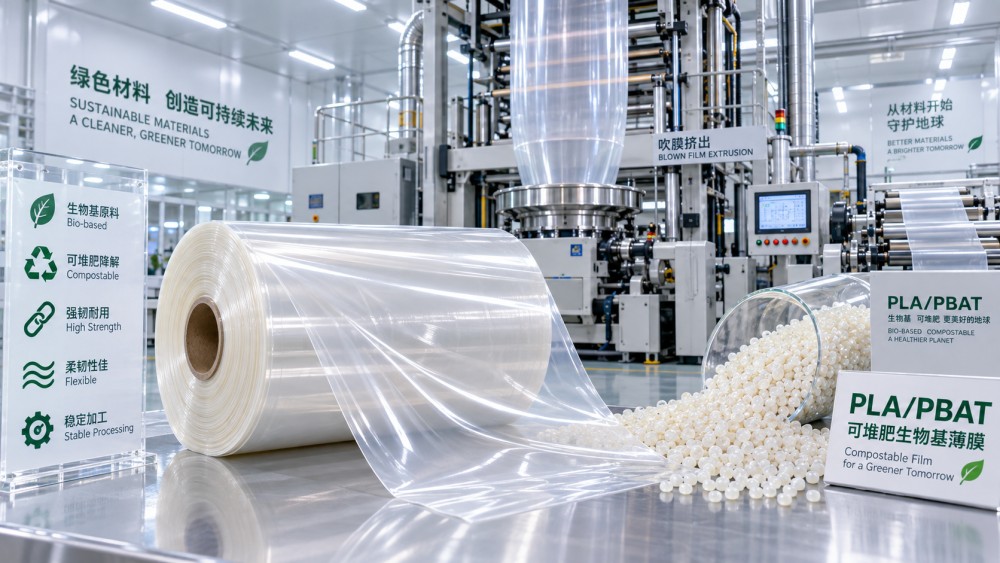
Technical evaluators usually need to determine whether a PLA/PBAT blend can satisfy a defined application window, including film gauge, load conditions, service temperature, sealing method, and disposal claims.
These blends are most commonly considered for compostable shopping bags, food-waste bags, produce bags, mulch films, overwraps, pouches, disposable articles, and coated paper structures.
Each application places different demands on tensile strength, puncture resistance, tear behavior, stiffness, transparency, slip, seal initiation temperature, and resistance to humidity during storage.
A bin liner may prioritize dart impact, elongation, and tear propagation resistance. A snack-packaging substrate may place greater emphasis on appearance, sealing reliability, stiffness, and barrier performance.
Material evaluation should also distinguish between industrial compostability, home compostability, biodegradability in soil, and biodegradation in unmanaged natural environments. These terms are not interchangeable.
Many commercial PLA/PBAT blends are designed for industrial composting systems, where elevated temperature, controlled humidity, oxygen availability, and microbial activity support disintegration and biodegradation.
Technical teams should request the applicable certification scope rather than relying on broad sustainability language. Common frameworks may include EN 13432, ASTM D6400, ISO 17088, or regional equivalents.
Certification applies to a specified product construction, thickness, pigment system, additive package, and intended disposal condition. A certified resin does not guarantee certification for every finished article.
Evaluators should identify the required product claim before formulation selection. A compostable film for a controlled collection system has different design constraints from a durable reusable packaging component.
Why PLA and PBAT Need Each Other
Polylactic acid, or PLA, is a polyester commonly produced from renewable feedstocks. It offers useful stiffness, gloss, printability, and tensile strength for many packaging applications.
However, unmodified PLA is relatively brittle and can show low impact resistance, limited tear resistance, and processing sensitivity when used in thin flexible film structures.
PLA also has a modest heat resistance unless crystallinity is increased or the polymer is modified. Standard amorphous PLA can soften under demanding thermal conditions.
Polybutylene adipate terephthalate, or PBAT, is a flexible biodegradable polyester. It is valued for softness, extensibility, toughness, and film-forming behavior resembling conventional flexible polyolefin materials.
PBAT can improve the ductility of PLA significantly, helping films survive handling, stretching, bag filling, transport, and consumer use without premature cracking or splitting.
Its limitations include lower stiffness and, depending on formulation and market conditions, a potentially less favorable cost position than conventional commodity polymers or some PLA grades.
When blended, PLA creates a structural backbone while PBAT provides a flexible phase. The resulting balance depends heavily on composition and how effectively both phases interact.
A PLA-rich blend often delivers better stiffness, gloss, and dimensional control, but may remain vulnerable to brittle failure. A PBAT-rich blend generally becomes tougher and more extensible.
The preferred balance is application-specific. A rigid thermoformed item, a blown film bag, and a cast-film laminate should not be expected to use identical PLA/PBAT ratios.
Blend Ratio Drives the Core Performance Trade-Off
PLA/PBAT ratio is usually the first formulation variable considered because it directly affects modulus, elongation at break, tensile response, melt strength, shrinkage, and conversion behavior.
Higher PLA content generally raises stiffness and can support improved web handling. It may also help preserve surface gloss and reduce the overly soft feel of flexible films.
Higher PBAT content generally improves elongation, impact resistance, flex-crack durability, and tear behavior. These benefits are especially valuable in bags and thin-gauge films.
Yet a simple ratio target is insufficient. Two 60/40 PLA/PBAT blends can perform differently when molecular weight, PBAT grade, branching, filler content, and compatibilizer selection differ.
For many blown-film applications, formulators use PBAT as the dominant toughening component while retaining sufficient PLA to support stiffness, renewable-content objectives, and targeted economics.
For stiffer packaging formats, PLA may be the larger component, supported by modifiers that reduce brittleness without causing excessive softness or loss of dimensional stability.
Technical evaluation should compare complete property profiles rather than one headline number. High elongation alone does not guarantee good tear resistance, and high tensile strength does not ensure puncture durability.
Relevant testing often includes tensile properties, Elmendorf tear, dart impact, puncture resistance, coefficient of friction, haze, gloss, heat seal strength, and aging performance.
Testing must use the intended film gauge and conversion route. Pellets may appear stable in laboratory testing but reveal draw resonance, gauge variation, or sealing inconsistency on production equipment.
Compatibilization Determines Whether the Blend Performs as Designed
PLA and PBAT are not fully compatible by nature. Without sufficient interfacial adhesion, the blend can develop dispersed domains that act as stress concentrators under mechanical loading.
This morphology may reduce tensile efficiency, create unstable elongation results, impair optical quality, and increase the likelihood of delamination-like failure within the polymer matrix.
Compatibilizers are used to improve interaction between PLA and PBAT phases. They can reduce interfacial tension, refine domain size, and improve stress transfer across the blend.
Common approaches include reactive chain extenders, multifunctional epoxy-based additives, grafting strategies, peroxide-assisted reactions, and carefully selected biodegradable copolyester modifiers.
Reactive compatibilization can also increase melt strength, which may benefit blown film, extrusion coating, foaming, and thermoforming. However, excessive reaction can raise viscosity beyond a practical window.
Over-compatibilization may increase torque, reduce throughput, complicate filtration, or produce gel particles. The target is controlled morphology, not the highest possible melt viscosity.
Evaluators should ask suppliers whether the blend contains reactive additives, how they affect food-contact compliance, and whether they change compostability documentation for the final article.
Microscopy, rheological analysis, and controlled compounding trials can clarify whether compatibility is adequate. In production, extrusion pressure stability and film consistency provide useful practical indicators.
Compatibilization should be judged alongside downstream requirements. A blend optimized for high melt strength may not automatically offer the best seal range, optical clarity, or machine-direction tear balance.
Processing Stability Is Often the Deciding Factor
PLA/PBAT blends can be processed through blown-film extrusion, cast-film extrusion, sheet extrusion, extrusion coating, compounding, injection molding, and thermoforming, depending on formulation design.
For flexible packaging, blown film remains a major focus because it tests the blend’s melt strength, bubble stability, drawability, cooling response, and thickness control simultaneously.
Moisture management is essential. PLA is susceptible to hydrolytic degradation at elevated processing temperatures, which can lower molecular weight and cause viscosity loss during extrusion.
Both incoming resin condition and plant handling matter. Drying requirements should be based on supplier guidance, measured moisture content, storage time, and humidity exposure before feeding.
Improper drying may produce brittle film, unstable output, excessive melt flow, odor, surface defects, reduced mechanical properties, or greater variation between production lots.
Temperature profiles should be high enough to achieve homogeneous melting and dispersion but controlled carefully to avoid thermal degradation, excessive residence time, or unwanted reactive side effects.
Because PLA/PBAT systems vary widely, processors should not apply one universal temperature profile. The optimum setting depends on grade design, screw configuration, throughput, and equipment condition.
Screw design influences distributive mixing, dispersive mixing, shear history, pressure generation, and residence-time distribution. A formulation that runs well on one line may require adjustment elsewhere.
Screen packs and melt filtration should be selected with awareness of additive dispersion and gel risk. Fine filtration may improve film appearance but can increase pressure and residence time.
During blown-film trials, operators should track bubble stability, frost-line position, die pressure, motor load, gauge variation, edge trim behavior, and roll appearance rather than only output rate.
Conversion performance must also be evaluated. Bag-making, printing, lamination, sealing, cutting, and winding can expose weaknesses that are not visible in basic extrusion trials.
Strength Means More Than Tensile Data
Technical teams frequently overemphasize tensile strength when reviewing PLA/PBAT blend data sheets. For flexible products, real-use performance depends on several failure mechanisms operating together.
Elongation at break helps indicate ductility, but it does not fully predict puncture resistance, notch sensitivity, tear propagation, repeated flex performance, or resistance to sharp contents.
A compostable grocery bag may require controlled stiffness for opening and loading, high elongation for handling, and balanced tear behavior to prevent failure from side seams.
Food-waste collection bags may also require resistance to moisture, organic acids, and prolonged contact with wet contents. A strong dry film may weaken under realistic service conditions.
Seal integrity requires separate attention. Seal strength, hot tack, seal-through contamination tolerance, and seal initiation temperature affect line speed and package reliability.
PLA-rich compositions may offer useful rigidity but can have narrower sealing windows. PBAT-rich systems can improve flexibility, although additives and surface treatments still affect sealing performance.
For multilayer structures, evaluate adhesion and layer interactions. A compostable PLA/PBAT layer may not deliver the desired result if another layer limits compostability or creates recycling incompatibility.
Accelerated aging should reflect the product’s actual distribution environment. Heat, humidity, ultraviolet exposure, and storage duration can change molecular structure and mechanical performance before end use.
Compostability Must Be Evaluated at the Finished-Product Level
Compostability is a system outcome, not simply a resin attribute. The final product includes inks, adhesives, pigments, coatings, labels, barrier layers, and sometimes reinforcing fillers.
Each component can affect disintegration, ecotoxicity testing, heavy-metal limits, and the ability of the finished article to meet recognized compostability standards.
Film thickness is especially important. Thicker articles may require longer disintegration periods, and certification limits can differ from those applicable to thin film specimens.
Technical evaluators should confirm the maximum approved thickness, product geometry, printing coverage, and additive levels covered by the supplier’s documentation or third-party certification.
Claims should match local collection and treatment infrastructure. A certified industrially compostable package may offer limited practical environmental benefit where organics collection does not accept compostable plastics.
This does not eliminate the material’s value, but it changes the evaluation. Material selection should align with disposal pathways, customer instructions, regulatory requirements, and brand commitments.
Teams should avoid describing PLA/PBAT blends as universally biodegradable in every environment. Accurate communication reduces regulatory risk and prevents end users from receiving misleading disposal guidance.
How to Build a Practical Evaluation Plan
A structured qualification plan reduces the chance that a promising laboratory compound fails during scale-up. Begin by defining the product’s non-negotiable functional requirements and disposal claim.
Document target gauge, basis weight, tensile range, tear performance, dart impact, seal requirements, printability, storage life, operating temperature, and acceptable appearance standards.
Next, compare candidate PLA/PBAT formulations under consistent conditions. Resin data sheets are useful screening tools, but pilot trials should replicate commercial equipment and production speeds.
Include material handling and drying controls in the trial plan. Record actual moisture content, residence time, melt temperature, pressure, torque, output, scrap rate, and downtime events.
Evaluate at least several process windows rather than a single successful run. Robust materials retain acceptable quality when normal plant variation occurs in temperature, throughput, or ambient humidity.
Finished samples should undergo application-specific testing after conversion. For example, bags should be loaded, dropped, flexed, sealed, exposed to expected contents, and aged under relevant conditions.
Procurement teams should assess batch consistency, regional availability, lead times, minimum order quantities, technical support, and documentation quality alongside resin price per kilogram.
Total cost should include drying energy, throughput, scrap, conversion speed, seal failures, rejected rolls, certification expenses, and potential changes to packaging equipment or quality controls.
Finally, confirm the commercial claim through the appropriate certification pathway. The qualified resin grade, additives, inks, and construction should remain controlled after launch.
Conclusion: Select PLA/PBAT Blends by Application Window
PLA/PBAT blends can provide a credible route to compostable flexible materials when they are engineered around the actual demands of the finished product and disposal system.
PLA contributes stiffness and tensile performance, while PBAT adds toughness and flexibility. Compatibilization and processing control determine whether those potential benefits become reliable production performance.
For technical evaluators, the strongest decision framework combines mechanical testing, extrusion trials, conversion testing, certification review, and total-cost analysis rather than relying on resin descriptions alone.
The right PLA/PBAT blend is not the one with the most aggressive sustainability claim. It is the formulation that meets defined functional requirements while supporting a defensible end-of-life pathway.
Have questions about this sector analysis, or seeking best practices specific to your niche? Drop us a line below and let the senior consultants at APIM assist you.
We respect your privacy. Your information is strictly confidential.
Related News
- 00
0000-00
Do polyolefin hot melt adhesives bond well to polyethylene? - 00
0000-00
Korean Study Finds PLA Barely Degrades in Landfill After 320 Days - 00
0000-00
How to assess batch consistency from a thermal potting compounds supplier - 00
0000-00
How much weight can carbon fiber reinforced plastics save in cars? - 00
0000-00
Switching from PS to ABS Sheet Extrusion: Equipment Checks