




Is PLA a Viable Alternative to PET in Food Packaging?
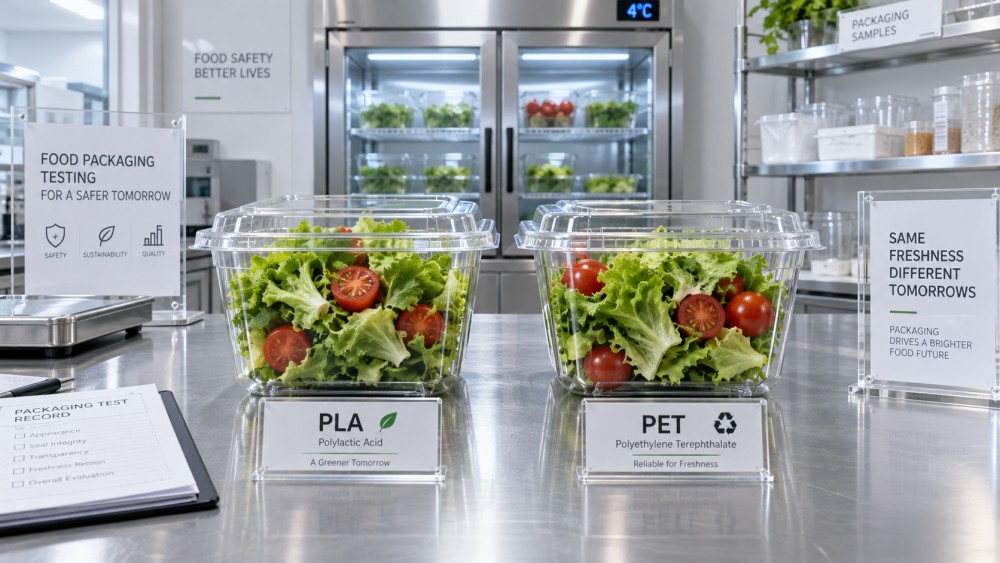
PLA can be a viable alternative to PET for selected food-packaging applications, particularly clear containers for cold foods with relatively short shelf lives. Its suitability becomes less certain when the package must withstand heat, preserve moisture-sensitive products, retain carbonation, or protect food through a demanding distribution cycle. Replacing PET successfully requires matching a specific PLA grade and package design to the food, filling process, storage conditions, and disposal route.
For manufacturers asking “is PLA really a viable alternative to PET in food packaging,” the answer is therefore conditional. A chilled takeaway salad container and a hot-filled beverage bottle present very different requirements. PLA deserves consideration where its performance is sufficient and its bio-based origin supports a defined objective. PET remains a stronger starting point for many applications requiring established barrier performance, processing consistency, or access to a functioning recycling system.
Which food-packaging applications are realistic candidates for PLA?
Clear cups for cold drinks, containers for chilled produce, and some short-life takeaway packs are reasonable applications to evaluate. PLA can provide the transparency and stiffness needed to display food and maintain package shape. These qualities make it relevant where visual presentation matters and the product does not depend on a particularly demanding barrier or temperature specification.
Even within those categories, the application needs a closer look. A salad sold and consumed on the same day has different requirements from a sealed salad expected to remain acceptable throughout refrigerated distribution. Dressings, oils, condensation, stacking loads, and the way consumers carry the container can all affect performance. “Suitable for cold food” is a useful screening description, but it is too broad to serve as a purchasing specification.
Produce packaging also requires attention to respiration. Some fruits and vegetables need a controlled exchange of gases to avoid undesirable conditions inside the pack. Perforations, vents, film permeability, and sealing design may matter more than the choice between two unmodified resins. A package that looks equivalent on a shelf may create a different internal atmosphere after several days.
PLA is a more difficult substitution candidate for carbonated beverages, extended-shelf-life foods, and products with demanding thermal requirements. These applications may be technically possible with specialized formulations or structures, but they require a separate development program. The commercial comparison then shifts from standard PLA versus standard PET to two complete packaging systems, including coatings, closures, processing steps, and waste-handling implications.
Does PLA offer enough heat resistance to replace PET?
Conventional clear PLA packaging has limited resistance to elevated temperatures. As it approaches its glass-transition region, it loses stiffness and can deform under load. The practical failure point depends on the grade, crystallinity, wall thickness, geometry, and duration of exposure. A resin property listed on a technical datasheet cannot by itself establish a safe filling or storage temperature for the finished container.
Heat exposure can occur beyond the filling line. Warm warehouses, delivery vehicles, direct sunlight, and food packed before it has cooled can challenge a container sold for cold-food use. A pack may remain visually acceptable while its rim distorts enough to weaken lid retention or sealing. Qualification should therefore include the package’s likely temperature history, including foreseeable distribution excursions.
Crystallization and formulation changes can improve PLA’s heat resistance. However, they can also affect transparency, impact behavior, processing time, and cost. A heat-resistant PLA article may have a different appearance and manufacturing route from the clear container that initially attracted the buyer. Any compostability or food-contact documentation must also cover the formulation being supplied.
PET requires a similarly precise assessment. Standard amorphous PET packaging should not automatically be treated as suitable for hot filling, ovens, or microwaves. Heat-set PET bottles and crystallized PET trays achieve thermal performance through specific material and processing choices. Comparing heat-resistant PLA with ordinary clear PET, or ordinary PLA with a specialized PET tray, can produce misleading conclusions.
Specify the actual thermal requirement: food temperature at filling, exposure time, loading during stacking, and acceptable dimensional change. That gives suppliers a testable target and prevents “heat resistant” from becoming an unsupported purchasing assumption.
How do barrier performance and shelf life compare?
PET generally provides a stronger baseline than unmodified PLA for oxygen and moisture barrier performance in comparable packaging structures. The size of that difference depends on material grade, orientation, crystallinity, thickness, temperature, and humidity. Published permeability values are useful for screening materials, but comparisons become unreliable when their test conditions or specimen structures differ.
The consequence for food depends on its deterioration mechanism. Oxygen exposure can contribute to oxidation, flavor changes, or discoloration. Moisture movement can soften dry foods or cause other quality losses. Beverage packaging may also need to retain carbon dioxide. A package acceptable for a freshly prepared meal may therefore be unsuitable for a snack or drink intended to remain on sale much longer.
The whole package determines protection. Closures, sealing surfaces, vents, pinholes, and variations in formed wall thickness can outweigh a favorable resin value. In thermoformed containers, the corners and sidewalls may be substantially thinner than the starting sheet. Comparing only sheet specifications can overlook the weakest barrier areas in the finished pack.
Barrier coatings, multilayer structures, and additives can extend PLA’s application range. Each modification introduces another question: does the finished structure still meet the intended food-contact, disposal, and commercial requirements? A coating that improves shelf life may complicate compostability certification or change the package’s behavior in a recovery process.
For a replacement decision, establish the required shelf life before selecting the resin. Test the filled package under the intended storage conditions and assess relevant safety and quality outcomes, such as microbial stability, sensory acceptance, moisture change, seal integrity, and appearance. A material change that shortens usable shelf life can increase food loss enough to undermine the intended environmental benefit.
Can existing PET equipment process PLA without major changes?
Some extrusion and thermoforming equipment can process both materials, but PLA should not be treated as a drop-in replacement. Drying, melt temperatures, residence time, cooling, and forming conditions require adjustment. Both polymers can suffer molecular-weight loss when moisture is present during melt processing, so material handling and drying control directly affect finished-package consistency.
Using a PET recipe for PLA can lead to degradation or unstable processing. Suppliers should provide grade-specific drying and processing guidance, while converters establish settings for their equipment and product geometry. Resin storage after drying, transfer to the machine, and exposure to ambient moisture deserve the same attention as the dryer itself.
Package design may need adjustment as well. PLA’s stiffness can be useful, while its impact behavior can create challenges around hinges, snap fits, trimmed edges, or stressed corners. Modified grades may improve toughness, but the formulation must still satisfy the application’s transparency, compliance, and disposal requirements. Matching nominal sheet thickness does not guarantee equivalent handling performance.
A useful conversion trial should evaluate output rate, thickness distribution, trimming quality, scrap generation, sealing, lid fit, and resistance to transport damage. It should also establish how start-up waste and production scrap will be handled. If a plant processes both PLA and PET, segregation matters because unintended mixing can affect processing and recovered-material quality.
The relevant cost is the cost of delivering an acceptable package. Resin price alone leaves out changes in cycle time, energy use, rejects, tooling, coatings, quality control, and package weight. A material that looks competitive per kilogram may become less attractive if the conversion process requires more material or produces more unusable output.
Does PLA automatically make food packaging more sustainable?
PLA’s bio-based origin can reduce reliance on fossil feedstocks, but it does not establish the overall environmental performance of a package. Feedstock production, resin manufacturing, package weight, conversion energy, transport, food protection, and waste treatment all influence the result. A fair comparison also needs to specify whether the PET alternative contains virgin resin, recycled content, or a mixture.
Compostability is particularly easy to misinterpret. Industrially compostable PLA packaging requires defined treatment conditions; it should not be assumed to break down quickly in home compost, soil, water, or litter. Certification applies to a specified product or formulation under a particular standard. A compostable base resin does not automatically establish that a thick container, printed label, adhesive, lid, and coating form a certified compostable package.
Access to a suitable disposal route is just as important as certification. A composting operator may decline compostable packaging because of processing times, contamination concerns, or its feedstock rules. Before making a composting claim central to material selection, confirm that the intended collection service and receiving facility accept the finished article.
A controlled setting, such as a catered venue with dedicated food-waste collection, can offer a more credible route than packaging distributed across many households. Even there, collection instructions, sorting behavior, and operator acceptance must align. If PLA enters mixed residual waste, its compostability may provide little practical benefit.
PET has established recycling routes in some markets and formats, especially bottles, but recycling access should also be assessed locally. Clear PET trays, colored packs, labels, and multilayer structures may face different acceptance conditions. Neither a resin identification code nor a general recyclability statement guarantees that a particular package will be collected and successfully processed.
What food-contact evidence is needed before switching?
Bio-based origin and compostability do not establish food-contact suitability. The selected PLA grade, additives, colorants, coatings, inks, adhesives, and other relevant components need appropriate documentation for the destination market and intended use. PET requires the same discipline, including suitable evidence where recycled material is used.
Ask whether the documentation covers the food type, contact time, and temperature involved. A statement supporting a short period of contact with chilled food may not support hot filling, prolonged storage, or contact with fatty foods. Migration assessment should reflect the finished package and relevant conditions of use, rather than relying on a general description of the polymer.
Supplier documentation also needs to match the delivered specification. A change in impact modifier, color masterbatch, coating, or material source may affect an earlier assessment. Procurement and quality teams should agree on traceability and change-notification requirements before approving the replacement. This is especially useful when multiple converters or component suppliers contribute to the final package.
What should determine the final go-or-no-go decision?
Start with one defined application and the existing package’s performance requirements. A replacement project becomes easier to judge when the team can distinguish essential requirements from preferences. Transparency may be commercially valuable, for example, while shelf life and seal integrity may be non-negotiable.
- Define the use conditions: food composition, filling temperature, storage duration, distribution exposure, and consumer handling.
- Qualify the finished package: confirm thermal stability, sealing, impact performance, stacking strength, and food protection.
- Establish production economics: compare acceptable output, scrap, package weight, and any additional processing steps.
- Verify the intended environmental route: obtain product-specific evidence and confirm collection and treatment acceptance.
PLA is a credible candidate when a cold-food package meets those requirements without excessive redesign and has a defensible reason for using a bio-based material. Where heat exposure, extended shelf life, or demanding barrier requirements dominate, PET often offers a more straightforward starting point. The decisive evidence is a qualified package that protects the food, runs consistently on the production line, and supports environmental claims that remain accurate after the consumer disposes of it.
Have questions about this sector analysis, or seeking best practices specific to your niche? Drop us a line below and let the senior consultants at APIM assist you.
We respect your privacy. Your information is strictly confidential.
Related News
- 00
0000-00
How does washing affect contamination in post-consumer recycled PP resins? - 00
0000-00
How does feedstock affect depolymerization equipment selection? - 00
0000-00
US Sets 213.44% Preliminary Antidumping Deposit on Chinese PTMEG - 00
0000-00
When should epoxy be used as a thermal interface material for semiconductors? - 00
0000-00
US Midterm Results Unlikely to Quickly Shift Recycled Plastics Market or Legislation