




How to Evaluate Biodegradable Resins for Mulch Film Performance
How to Evaluate Biodegradable Resins for Mulch Film Performance
Selecting biodegradable resins for mulch film requires more than checking compostability claims.
Technical evaluation starts with field performance, not with marketing language.
A mulch film must survive installation, resist early tearing, manage soil contact, and then break down at the right stage.
That timing is where many biodegradable resins for mulch film succeed or fail.
This guide explains how to compare resin options with a practical decision framework.
Start With the Real Performance Window
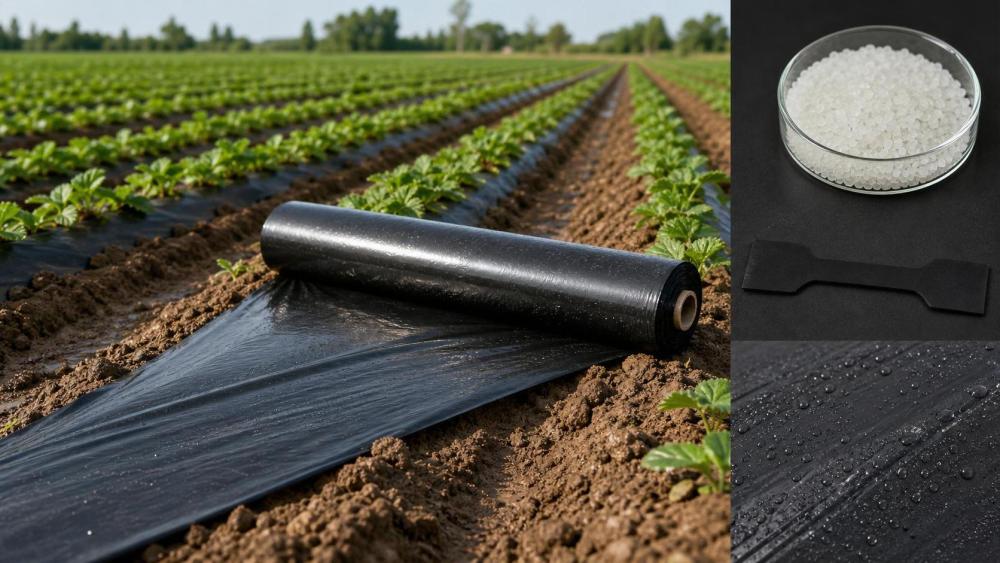
The first question is simple: how long must the film remain functional in the field?
Different crops, climates, and installation methods create different exposure profiles.
Some films need short service lives for fast-growing vegetables.
Others must hold together for a full season under stronger sunlight and wider temperature swings.
When evaluating biodegradable resins for mulch film, define the target performance window before reviewing grades.
That window should cover four stages:
- Film extrusion and winding stability
- Mechanical performance during laying
- Retention of function during crop growth
- Controlled breakdown after useful life ends
Without this timeline, resin selection quickly becomes vague and inconsistent.
Check Mechanical Properties Beyond the Datasheet Headline
Mechanical strength is still the first hard filter for biodegradable resins for mulch film.
Tensile strength matters, but it is not enough on its own.
Mulch film also needs elongation, puncture resistance, and tear behavior that match field handling.
A resin can test well in dry lab conditions and still split during installation.
Focus on these evaluation points:
- Tensile strength in machine and transverse directions
- Elongation at break under realistic film thickness
- Dart impact or puncture resistance
- Tear propagation after small defects appear
- Property retention after heat aging and moisture exposure
In practice, balanced toughness often matters more than peak strength.
That is especially true for thin-gauge films used on automated laying lines.
If the resin blend becomes brittle after storage or during cool mornings, field losses rise quickly.
Evaluate Weather Resistance and Soil Exposure Together
Many teams separate weathering and biodegradation, but mulch film performance links them tightly.
Sunlight, heat, rainfall, and soil microbes act at the same time.
That means biodegradable resins for mulch film should be tested under combined exposure conditions.
Key variables include UV dose, temperature cycling, humidity, soil pH, and microbial activity.
A useful evaluation sequence looks like this:
- Run accelerated weathering to track early embrittlement risk.
- Measure retained tensile and elongation after exposure.
- Expose samples to controlled soil burial or simulated soil contact.
- Compare fragmentation timing with actual crop-cycle requirements.
This is where resin families show real differences.
Some grades maintain flexibility well, yet degrade too slowly after harvest.
Others break down faster, but lose useful strength too early in warm and wet fields.
The right choice depends on matching degradation kinetics to the agricultural use window.
Review Processability as a Commercial Risk Factor
A technically promising resin can still fail at the extrusion line.
For that reason, processability should carry real weight in biodegradable resins for mulch film evaluation.
Look closely at melt strength, thermal stability, die build-up, bubble stability, and gauge consistency.
These factors affect output, scrap rate, and downstream film quality.
Important checkpoints include:
- Processing temperature window
- Sensitivity to moisture before extrusion
- Compatibility with existing blown film equipment
- Thickness control at target line speed
- Sealability and roll handling after production
From a decision standpoint, unstable processing usually creates hidden cost faster than resin price does.
A lower-cost grade is rarely attractive if it causes frequent breaks or inconsistent winding.
That is why converter trials should be part of the selection path, not an afterthought.
Verify End-of-Life Claims With Relevant Standards
Biodegradability claims need careful interpretation.
Industrial compostability alone does not guarantee strong field suitability.
For biodegradable resins for mulch film, the key issue is whether breakdown behavior matches agricultural soil conditions.
Ask suppliers for test scope, conditions, duration, and residual material criteria.
Useful references may include soil biodegradation standards, ecotoxicity data, and regional mulch film requirements.
Do not stop at certificate names.
Review whether the tested film structure, thickness, and formulation match your commercial design.
A certified base resin may behave differently once pigments, fillers, or processing aids are added.
Compare Supplier Capability, Not Only Resin Performance
Selection quality improves when supplier capability is reviewed alongside material data.
For biodegradable resins for mulch film, batch consistency can be as important as formulation design.
Ask about compounding control, moisture handling, quality documentation, and technical support during trials.
More importantly, confirm whether the supplier understands agricultural film applications, not just polymer sales.
A strong supplier discussion should cover:
- Recommended processing settings for mulch film extrusion
- Expected storage limits before conversion
- Field references in comparable climates
- Support for formulation adjustment if failure occurs
- Supply stability across planting seasons
This part often decides whether a project scales smoothly or stalls after pilot success.
Build a Practical Decision Matrix
A structured scorecard helps compare biodegradable resins for mulch film without overreacting to one strong claim.
Use weighted criteria tied to your application priorities.
For example, a warm-climate crop may weight weather resistance more heavily.
A thin downgauged film may give more weight to tear resistance and processing stability.
Typical scoring categories include mechanical performance, field durability, degradation control, processability, certification relevance, supplier support, and total cost.
Total cost should include scrap, line efficiency, returns, and field failure risk.
That broader view usually leads to better decisions than resin price comparison alone.
In actual business use, the best option is rarely the resin with the most aggressive sustainability headline.
It is the one that processes reliably, performs through the crop cycle, and degrades in a controlled and documented way.
Final Decision Guidance
Evaluating biodegradable resins for mulch film is really a timing and balance exercise.
The resin must stay intact long enough to deliver agronomic value.
Then it must break down in a way that fits soil conditions and compliance needs.
That balance can only be judged through combined review of mechanics, weathering, soil exposure, extrusion behavior, and end-of-life evidence.
A practical next step is to shortlist two or three materials and run parallel extrusion and field simulations.
That approach turns biodegradable resin selection from a claim-driven exercise into a performance-based decision.
Have questions about this sector analysis, or seeking best practices specific to your niche? Drop us a line below and let the senior consultants at APIM assist you.
We respect your privacy. Your information is strictly confidential.
Related News
- 00
0000-00
How does washing affect contamination in post-consumer recycled PP resins? - 00
0000-00
How does feedstock affect depolymerization equipment selection? - 00
0000-00
US Sets 213.44% Preliminary Antidumping Deposit on Chinese PTMEG - 00
0000-00
When should epoxy be used as a thermal interface material for semiconductors? - 00
0000-00
US Midterm Results Unlikely to Quickly Shift Recycled Plastics Market or Legislation