




How does the blend ratio affect PLA/PBAT resin cost per kilogram?
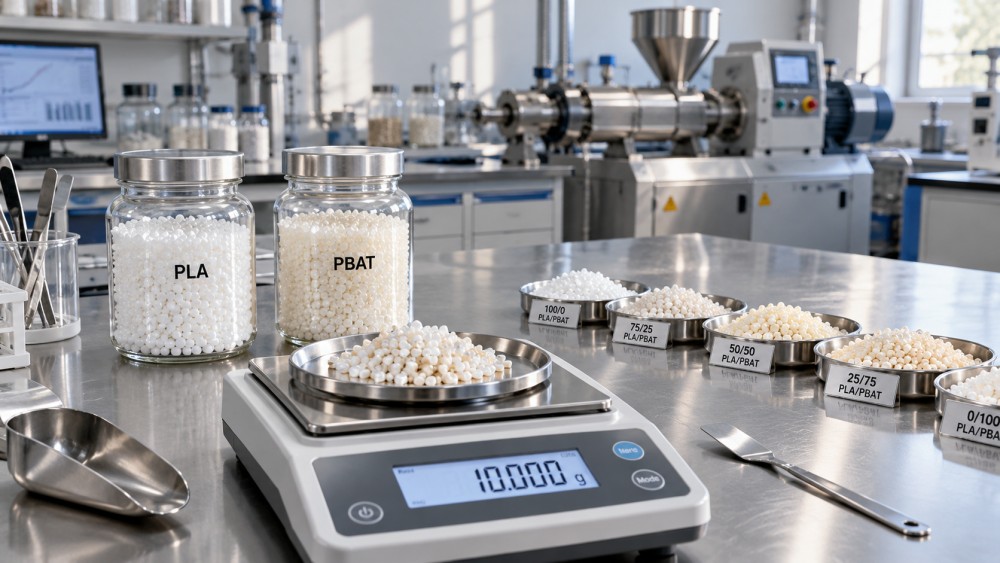
Increasing the share of the cheaper polymer lowers the raw material cost per kilogram of a PLA/PBAT blend, provided the grades and other ingredients remain unchanged. The size of that saving equals the change in polymer weight fraction multiplied by the price difference between the two resins. There is no universal rule that a higher PLA or PBAT content is cheaper: the direction depends on the actual delivered prices of the specified grades.
That calculation establishes a baseline. A ratio change can also alter additive demand, compounding throughput, drying requirements, and the amount of material lost during conversion. A lower pellet price therefore needs to be evaluated against the cost of producing material that meets the required flexibility, strength, thickness, and processing specifications.
The direct relationship between blend ratio and resin cost
For a blend containing only PLA and PBAT, the raw material calculation is a weighted average:
Blend resin cost per kilogram = (PLA weight fraction × PLA price per kilogram) + (PBAT weight fraction × PBAT price per kilogram).
The two weight fractions must add to one. Both prices must use the same currency, delivery basis, and treatment of taxes. Comparing a delivered PLA price with an ex-works PBAT price introduces a logistics difference into what appears to be a formulation comparison.
Let x represent the PLA weight fraction, PPLA the PLA price, and PPBAT the PBAT price. The equation becomes:
C = xPPLA + (1 − x)PPBAT.
This reveals the sensitivity of PLA PBAT resin cost to composition. For every percentage point shifted from PBAT to PLA, the raw material cost changes by (PPLA − PPBAT)/100 per kilogram. If PLA is cheaper, the result is a reduction. If PLA is more expensive, the same shift increases cost.
The price gap matters as much as the proposed ratio change. When the two resin prices are close, a substantial composition change produces only a small raw material saving. A wider price gap creates a stronger incentive, although the usable ratio remains constrained by product performance.
Establish what the quoted ratio actually describes
A stated PLA/PBAT ratio does not necessarily describe the entire pellet formulation. It may refer only to the relative amounts of the two polymers, with mineral filler, processing aids, pigments, and compatibilizers accounted for separately. It may also be an informal description of a commercial compound rather than a disclosed composition.
This distinction changes the calculation. If PLA and PBAT occupy only part of the finished compound, their relative ratio must first be converted into their weight fractions of the total formulation. Applying the polymer ratio directly to the full kilogram overstates the contribution of those two resins and omits the other ingredients.
Where composition is confidential, a controlled quotation comparison remains possible. Request prices for defined performance specifications and ask which formulation variables change between options. A complete recipe is not essential to establish whether two quoted materials offer equivalent usable performance.
Additives can absorb the saving from a cheaper polymer ratio
The complete formulation cost is the sum of each ingredient’s weight fraction multiplied by its purchase price. Changing the PLA/PBAT ratio while holding every other ingredient constant gives a useful sensitivity calculation. It does not establish that the revised material will perform adequately.
PLA and PBAT have different mechanical and rheological behavior. Their blends develop a morphology influenced by composition, grade selection, viscosity balance, and processing history. A ratio change can alter phase continuity and dispersion, so mechanical properties do not necessarily follow a simple weighted average.
If a lower-cost ratio requires additional compatibilizer, chain extender, or another modifier to retain the required properties, that ingredient belongs in the revised cost model. Its effect on processing also matters. A reactive additive can change melt viscosity, torque, and the operating window; its economic impact extends beyond its purchase price.
Mineral filler introduces a separate comparison problem. A filled blend can have a lower price per kilogram while its polymer ratio remains unchanged. Higher density means that a film of the same area and thickness contains more mass. The lower kilogram price may therefore produce a smaller saving per finished article than the quotation suggests.
Keep these effects identifiable. Otherwise, a price reduction attributed to “more PLA” or “more PBAT” could actually come from higher filler loading, a different additive package, or a changed resin grade.
The performance boundary determines how far the ratio can move
PLA generally contributes stiffness, while PBAT contributes flexibility and ductility. These tendencies explain why the cheaper resin cannot simply replace the more expensive one without qualification. Film applications must balance stiffness with elongation, tear behavior, puncture resistance, sealing performance, and reliable handling.
A formulation that meets a tensile-strength requirement can still fail during bag opening, sealing, or loading. Elongation alone also provides an incomplete picture: resistance to a propagating tear and resistance to a local puncture describe different failure modes. The relevant acceptance tests must reflect the finished article’s actual stresses.
Grade selection further limits comparisons based on ratio alone. Two blends with the same nominal PLA/PBAT composition can differ because of molecular characteristics, melt viscosity, additive chemistry, or processing conditions. A quotation for a different grade combination is a broader material substitution, even when the stated ratio matches.
For film, establish the comparison at the required finished thickness and usable width. If the revised blend needs a thicker gauge to meet mechanical requirements, the resulting increase in material consumption must be included. A cheaper kilogram has limited value when more kilograms are needed for the same quantity of acceptable product.
Translate pellet price into cost per acceptable kilogram
There are two useful cost boundaries: producing saleable compounded pellets and converting those pellets into acceptable finished goods. Keeping these boundaries explicit prevents compounding losses from being confused with downstream conversion losses.
For an internally compounded blend, the pellet cost includes formulation inputs, compounding energy, labor, equipment allocation, packaging, and unrecovered process losses. If finished pellets are purchased, those upstream activities are already reflected in the supplier’s price. Adding a separate compounding charge would count the same activity twice.
At the conversion stage, a practical relationship is:
Cost per acceptable kilogram = (delivered pellet cost + conversion cost per kilogram of input − recoverable scrap credit per kilogram of input) ÷ acceptable output yield.
Here, acceptable output yield means saleable output mass divided by input mass over the same accounting period. The conversion charge must use that same input basis. If internal regrind is included, use a consistent material balance so that recovered material is neither charged twice nor treated as new saleable output.
A changed blend ratio can affect film bubble stability, drawdown, blocking, or extrusion consistency. If those changes increase rejected material or reduce sustainable throughput, conversion cost can outweigh the raw material saving. Such effects need production evidence; they cannot be reliably inferred from the ratio printed on a quotation.
Drying and moisture control also belong in the comparison. Inadequate moisture control during melt processing can degrade polyester molecular weight, changing viscosity and mechanical behavior. A trial conducted with inconsistent drying conditions cannot clearly distinguish a formulation problem from a preparation problem.
Compare quotations on a common commercial and technical basis
The most useful quotation comparison separates the effects of composition, grade, and commercial terms. Request the current formulation and proposed alternatives against the same application specification, with the resin grade basis identified wherever disclosure permits.
The commercial comparison needs particular attention to:
- Delivered cost and order size. Freight, packaging, minimum order quantities, and shipment size can change the apparent saving between two formulations.
- Quotation validity. Prices obtained on different dates can reflect resin price movements as well as a ratio change. Contemporaneous alternatives provide a cleaner comparison.
- Included processing. A ready-to-process compound and separate resin components have different cost boundaries. Toll compounding, drying, blending, and handling charges must be assigned accordingly.
- Acceptance criteria and consistency. A low nominal price remains difficult to evaluate without agreed property limits and evidence that supplied batches meet them.
Quoted savings should also identify whether the alternative changes color, filler content, additive package, or approved processing conditions. These changes can be acceptable, but their effects should not be attributed solely to the PLA/PBAT ratio.
Set a break-even limit before approving the change
The raw material saving provides a budget for any additional cost created by the revised blend. Expressed on a common basis:
Net saving per acceptable kilogram = baseline total cost per acceptable kilogram − revised total cost per acceptable kilogram.
For an initial screening, the maximum affordable increase in additives and processing costs equals the raw material saving when yield and material consumption remain unchanged. Once either changes, recalculate the complete cost per acceptable output rather than subtracting isolated charges.
A useful trial therefore records more than whether the machine runs. It captures sustained throughput, acceptable output, scrap disposition, energy use where measurable, and finished-product properties at the intended gauge or geometry. Startup losses should be distinguished from steady production, particularly when short trials would otherwise exaggerate their contribution.
Define the acceptance boundary before testing: the required product properties, permitted processing adjustments, and maximum total cost per acceptable unit. This makes the result interpretable. A formulation that only succeeds after increasing thickness or substantially reducing output has changed the economics, even if its pellet price is lower.
Approve the ratio against the resin prices used in the calculation, and retain the price difference as a sensitivity variable. When that difference changes, the financial reason for choosing the blend can weaken or reverse, while its processing and performance characteristics remain the same.
Have questions about this sector analysis, or seeking best practices specific to your niche? Drop us a line below and let the senior consultants at APIM assist you.
We respect your privacy. Your information is strictly confidential.
Related News
- 00
0000-00
Do polyolefin hot melt adhesives bond well to polyethylene? - 00
0000-00
Korean Study Finds PLA Barely Degrades in Landfill After 320 Days - 00
0000-00
How to assess batch consistency from a thermal potting compounds supplier - 00
0000-00
How much weight can carbon fiber reinforced plastics save in cars? - 00
0000-00
Switching from PS to ABS Sheet Extrusion: Equipment Checks