




How PLA PBAT Resin Blend Ratio Affects Flexibility and Compostability
Why the PLA-PBAT Ratio Matters More Than the Label Suggests
In biodegradable flexible packaging, people often talk about a PLA PBAT resin blend as if it were a single material family with predictable behavior. It is not. The ratio between polylactic acid (PLA) and polybutylene adipate terephthalate (PBAT) changes the mechanical profile, processing window, seal performance, and compostability behavior enough that two blends sold under the same general description may perform very differently in production and at end of life.
That is the first point technical evaluators should keep in view. A blend with high PLA content is usually chosen for stiffness, higher biobased content, and a cleaner feel in film or molded articles. A blend with more PBAT is typically aiming to recover ductility, tear resistance, and handling toughness that neat PLA does not provide well on its own. The tradeoff is not only about “hard versus soft.” It reaches into compostability assessment, bag performance, extrusion stability, and whether the product is actually fit for the duty cycle it is meant to survive.
For buyers and R&D teams, the practical question is not whether a PLA PBAT resin blend is flexible or compostable in the abstract. The useful question is: flexible enough for what loading, at what thickness, under which storage conditions, and compostable under which standard or disposal route?
What the Ratio Is Really Controlling
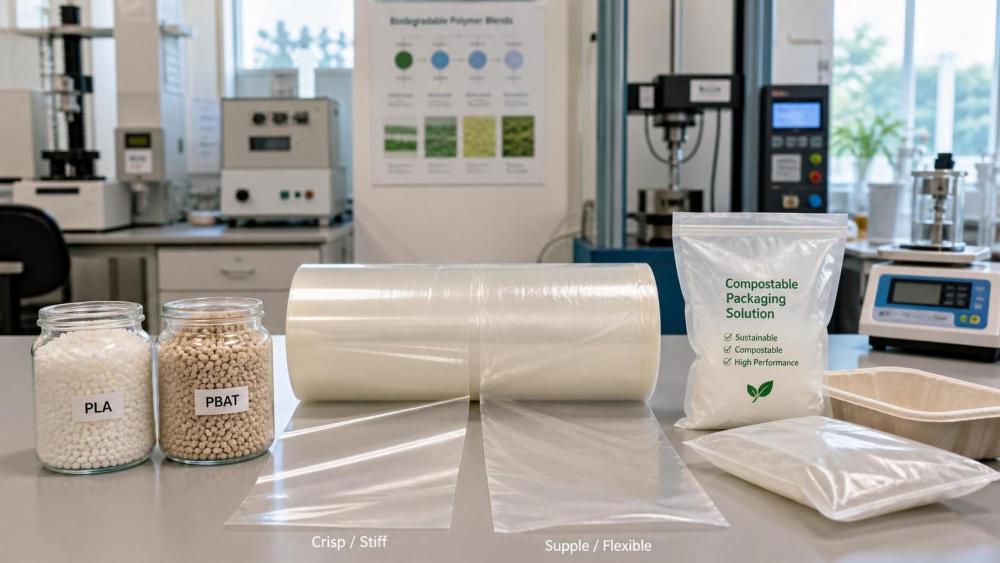
PLA is a relatively stiff and brittle polyester compared with PBAT. It can bring clarity, modulus, and a more paper-like crispness in some film structures, but it also tends to show lower elongation and weaker impact tolerance if used without modification. PBAT behaves very differently. It is more flexible, more forgiving under strain, and often introduced specifically to improve elongation at break, puncture resistance, and toughness in compostable film systems.
Once these two resins are blended, the ratio becomes a formulation lever that influences several properties at the same time:
- Stiffness and shape retention
- Elongation and film drape
- Impact and tear behavior
- Heat sealing response and processability
- Dimensional stability during converting
- Biobased content profile and end-of-life expectations
This is why ratio discussions cannot be separated from additives, compatibilizers, processing method, and final product geometry. A nominal 70/30 blend and a 60/40 blend may look close on paper, yet the performance difference can be very noticeable in blown film, shopping bags, compostable liners, or extrusion-coated layers.
In broad industry practice, increasing PLA tends to raise rigidity and lower flexibility. Increasing PBAT usually does the opposite. But technical evaluation should stop short of turning that into a simple linear rule. Blend morphology, dispersion quality, and interfacial compatibility can strongly affect the result. Poor compounding can leave a blend that is theoretically well designed but still underperforms in tear propagation or seal consistency.
Flexibility Is Not One Property
One recurring mistake in material selection is to treat flexibility as a single yes-or-no attribute. In conversion and product use, evaluators usually need to separate at least four different questions.
The first is whether the material can bend repeatedly without cracking. The second is whether it can stretch without failing. The third is whether it resists puncture and impact during handling. The fourth is whether it still seals and performs acceptably after storage, transport, or humidity exposure. A PLA-rich blend may appear adequate in basic lab handling but fail to deliver the expected toughness in a thin bag wall or in a downgauged film. A PBAT-rich blend may solve toughness problems but bring lower stiffness than the packaging line or end user wants.
This distinction matters in procurement discussions because application language is often vague. “Flexible packaging” covers produce bags, apparel mailers, organic waste liners, agricultural mulch films, and overwrap structures with very different stress patterns. The right blend ratio for one will not automatically transfer to another.
Compostability: Ratio Helps, but Standards Decide
The second area where confusion appears is compostability. A PLA PBAT resin blend is often assumed to be compostable simply because both polymers are commonly used in compostable formulations. In practice, compostability is not determined by naming the ingredients alone. It is determined by the finished article meeting the relevant standard, in the intended form, thickness, and application.
For many packaging discussions, the relevant references include industrial compostability frameworks such as EN 13432 in Europe and ASTM D6400 in the United States. Those standards address more than disintegration. They also consider biodegradation and other criteria tied to composting conditions. A blend ratio may support compliance, but it does not prove compliance on its own.
This is where technical evaluators need discipline. A higher PLA share may increase renewable content, but it does not automatically make a structure more suitable for every compostability claim. A higher PBAT share may improve bag function, yet the final article still needs to be evaluated within the applicable certification pathway. Additives, inks, fillers, processing aids, and multilayer combinations can all affect the outcome.
Another point often missed in commercial discussions: industrial compostability and home compostability are not interchangeable claims. Materials that are accepted under industrial composting conditions are not automatically validated for home composting environments, where temperature, moisture, and microbial conditions are much less controlled.
Typical Directional Effects of Blend Balance
The table is only directional. It should not be used as a substitute for compound-level data. Melt flow behavior, molecular weight, crystallization control, chain extension, and compatibilization strategy all influence what the converter actually sees on line.
Why Processing Behavior Can Change the Material Decision
Technical evaluations sometimes focus heavily on end properties and underweight processing stability. That is risky with compostable blends. PLA and PBAT do not behave identically in extrusion, and moisture management matters because polyester degradation can affect melt strength and finished performance. Drying discipline, thermal history, screw configuration, and residence time can all shift results enough to make a blend seem better or worse than it actually is.
In film applications, the ratio also affects drawability and bubble stability. In thermoforming or sheet extrusion, it may influence stiffness balance and post-process handling. For bags and liners, sealing behavior is often as important as tensile strength, because seal failure in use is a common commercial complaint. A blend chosen only for lab elongation may still disappoint if seal integrity is inconsistent at the customer’s line speed.
That is why experienced teams ask for data in context: processing method, thickness range, and target application. A generic statement that a PLA PBAT resin blend is “suitable for compostable packaging” says very little without that context.
Common Misreadings in Commercial Evaluation
Several misunderstandings come up repeatedly.
One is assuming that more PBAT always means a better film. It may mean a tougher film, but not necessarily a better one for print handling, stiffness expectations, or machine direction behavior. Another is assuming that more PLA is automatically the more sustainable choice. In some procurement frameworks, buyers look favorably on higher biobased content, but that should not override functional life, processing scrap rate, or disposal reality. A bag that tears too easily may satisfy no one, regardless of its resin profile.
There is also a tendency to confuse biodegradability language with recycling compatibility. PLA-PBAT blends are generally being specified for compostable routes, not as a drop-in answer for conventional mechanical recycling streams. That distinction matters in regions where waste collection infrastructure does not align with compostable packaging claims.
How Technical Evaluators Should Compare Formulations
A useful comparison process is less about chasing an ideal ratio and more about matching a formulation window to the application boundary. At minimum, evaluation should include:
- Target use case and failure mode: puncture, tear, crack, seal leak, deformation
- Processing route: blown film, cast film, sheet, injection molding, thermoforming
- Thickness and downgauging requirement
- Required compostability or certification pathway for the finished article
- Storage and use conditions, including temperature and humidity exposure
- Whether additives, fillers, inks, or multilayer structures are part of the final construction
When these factors are defined early, the ratio discussion becomes much more productive. Instead of arguing in general terms about whether PLA or PBAT is “better,” teams can test whether a given balance delivers the needed modulus, toughness, sealing reliability, and compliance pathway for that exact product format.
The Practical Reading of a PLA-PBAT Blend
In business terms, a PLA PBAT resin blend is best understood as a tunable compromise material. It exists because neat PLA alone is often too brittle for many flexible applications, while PBAT alone may not deliver the structural feel, biobased positioning, or balance of properties some converters want. The ratio is the center of that compromise, but not the whole story.
A competent evaluation does not stop at the blend label or a single datasheet value. It asks how the material behaves in a real converting process, whether its flexibility matches the actual stress profile of the product, and whether its compostability claim is tied to recognized standards for the finished article. That is the level where ratio choices stop being theoretical and start becoming commercially meaningful.
Have questions about this sector analysis, or seeking best practices specific to your niche? Drop us a line below and let the senior consultants at APIM assist you.
We respect your privacy. Your information is strictly confidential.
Related News
- 00
0000-00
How does washing affect contamination in post-consumer recycled PP resins? - 00
0000-00
How does feedstock affect depolymerization equipment selection? - 00
0000-00
US Sets 213.44% Preliminary Antidumping Deposit on Chinese PTMEG - 00
0000-00
When should epoxy be used as a thermal interface material for semiconductors? - 00
0000-00
US Midterm Results Unlikely to Quickly Shift Recycled Plastics Market or Legislation