




FDA Tightens Proof Rules for PLA/PBAT Packaging
On July 3, 2026, the U.S. FDA updated its Bio-based Food Contact Materials Guidance and introduced a new pre-market documentation requirement for PLA/PBAT compostable packaging entering the U.S. market. The change deserves close attention from importers, U.S. distributors, packaging manufacturers, material buyers, and downstream users because it shifts the compliance focus from product claims alone to lifecycle biodegradation verification across multiple environments, with the rule set to take effect on October 1, 2026.
What the FDA Update Formally Requires
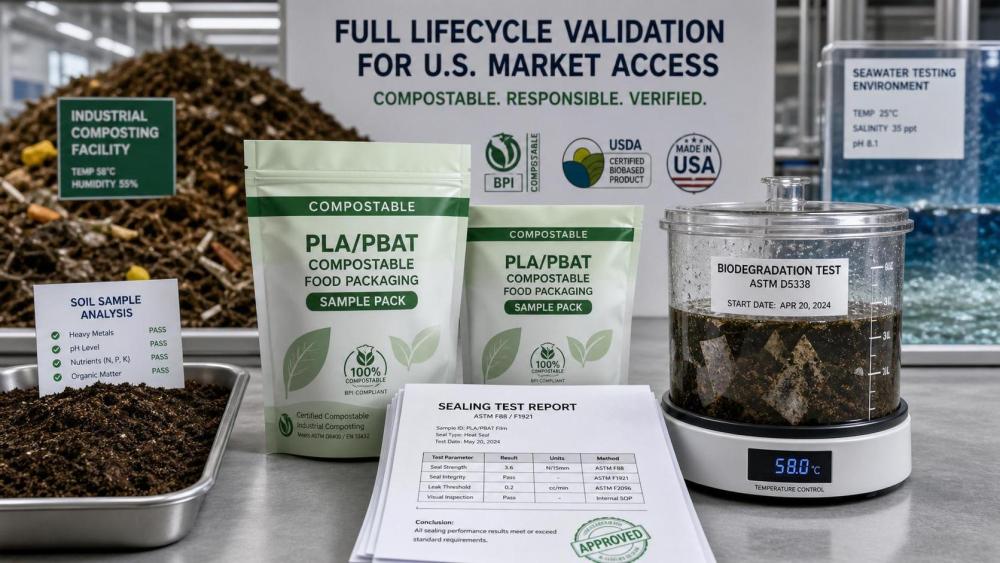
According to the information provided, the FDA updated its guidance on July 3, 2026. For PLA/PBAT compostable packaging materials, market entry into the United States will now require a full-lifecycle anaerobic and aerobic degradation verification report issued by an ISO 17065-accredited certification body.
The required verification must cover three environmental scenarios: soil, industrial composting, and marine environments. The new requirement will become effective on October 1, 2026.
The scope applies to all importers and distributors operating in the U.S. market.
Where the Pressure Will Be Felt Across the Supply Chain
Import and market-entry teams face a documentation threshold
From an industry perspective, importers and U.S. distributors are likely to feel the most immediate impact because the rule applies directly to market access. The practical issue is not only whether a product is described as compostable, but whether the required verification package is complete, valid, and issued by a qualifying ISO 17065 certification body before products enter the market.
Manufacturers may need to revisit compliance preparation
For converters and packaging manufacturers using PLA/PBAT materials, the impact is likely to appear in product qualification, technical file preparation, and customer-facing compliance support. What deserves closer attention is whether existing product documentation is sufficient for the FDA's updated expectation, especially where biodegradation claims have previously been supported by narrower testing or different certification pathways.
Material buyers and downstream users may see procurement conditions change
For procurement teams and end-use companies sourcing compostable packaging for the U.S. market, the likely effect is upstream: supplier approval, contract documentation, and delivery planning may all become more dependent on the availability of the required verification report. Observably, this is not only a regulatory issue for factories; it can also affect sourcing decisions and launch timing for packaged products intended for U.S. distribution.
Supply chain service providers may need tighter document coordination
Supply chain and compliance service providers may be affected where they support customs, distribution, or cross-border documentation flows. The immediate concern is whether product files, certification records, and transaction documents remain aligned once the new requirement becomes effective.
What Companies Should Watch Before October 1
Check whether the affected product scope is clearly mapped
Companies dealing in PLA/PBAT packaging should first identify which SKUs, customer programs, or U.S.-bound shipments fall within the updated guidance. This matters because the new requirement is tied to market entry, making product scope confirmation a practical first step rather than a legal formality.
Verify the status of certification bodies and report completeness
The information provided specifically mentions reports issued by ISO 17065-accredited certification bodies. In practice, companies should pay close attention to whether their existing or planned reports match that requirement and whether the verification package covers the three listed scenarios: soil, industrial composting, and marine environments.
Separate policy language from operational readiness
Analysis shows that the core business question is not simply how the rule is worded, but whether suppliers, importers, and distributors can assemble compliant documentation within commercial timelines. A policy requirement can be clear on paper while still creating delays in procurement, shipment release, or customer acceptance if supporting files are incomplete.
Prepare for customer and partner communication
Because the rule applies to all importers and U.S. distributors, companies should be ready for more requests around certificates, verification reports, and supporting materials in commercial communication. This is especially relevant where multiple parties share responsibility for sourcing, packaging specification, and U.S. distribution.
Why This Looks Like More Than a Short-Term Notice
As an editorial observation, this update is more appropriate to understand as a concrete compliance signal rather than a passing procedural change. The requirement is specific, time-bound, and tied to market entry, which gives it immediate operational relevance.
At the same time, it should not yet be overstated beyond the facts provided. The confirmed information shows a stricter documentation requirement for PLA/PBAT packaging under the FDA guidance, but broader market effects, cost implications, or changes in supplier structure would still require continued observation rather than firm conclusions.
How the Industry May Need to Read This Update
The practical significance of this development lies in how it connects biodegradation claims with formal lifecycle verification across multiple environments. For companies active in U.S.-related packaging trade, the update is best understood as an actionable compliance change with near-term effects on documentation, supplier coordination, and market-entry planning.
From a broader industry perspective, it is also a policy signal worth monitoring over time. The immediate result is clear: PLA/PBAT products entering the U.S. market will face a more explicit verification threshold starting October 1, 2026. Beyond that, the full commercial impact still needs to be tracked through implementation.
Basis of This Article and What Still Needs Verification
This article is based on the user-provided news title, event date, and summary concerning the FDA update issued on July 3, 2026. It has been written as an industry analysis piece rather than a reproduction of a formal notice.
For this type of development, relevant source categories typically include official regulatory notices, company disclosures, industry association updates, authoritative media reporting, and standards-related documents. A specific official source link was not provided in the input, so the exact text and any subsequent clarification should continue to be verified.
Further attention should remain on whether the FDA issues additional implementation language, whether market participants publish follow-up compliance interpretations, and how affected importers and distributors operationalize the new documentation requirement ahead of the October 1, 2026 effective date.
Have questions about this sector analysis, or seeking best practices specific to your niche? Drop us a line below and let the senior consultants at APIM assist you.
We respect your privacy. Your information is strictly confidential.
Related News
- 00
0000-00
How does washing affect contamination in post-consumer recycled PP resins? - 00
0000-00
How does feedstock affect depolymerization equipment selection? - 00
0000-00
US Sets 213.44% Preliminary Antidumping Deposit on Chinese PTMEG - 00
0000-00
When should epoxy be used as a thermal interface material for semiconductors? - 00
0000-00
US Midterm Results Unlikely to Quickly Shift Recycled Plastics Market or Legislation