




FDA Tightens Proof Requirements for PLA/PBAT Food Packaging
On July 2, 2026, the U.S. FDA updated its Bio-based Food Contact Substances Guidance, adding a more specific documentation requirement for import filings involving PLA/PBAT biodegradable resins used in food-contact packaging. For packaging suppliers, importers, testing partners, and procurement teams, the change is worth close attention because it shifts biodegradability claims from general material positioning toward document-backed compliance review ahead of the October 1, 2026 effective date.
What the updated guidance now requires
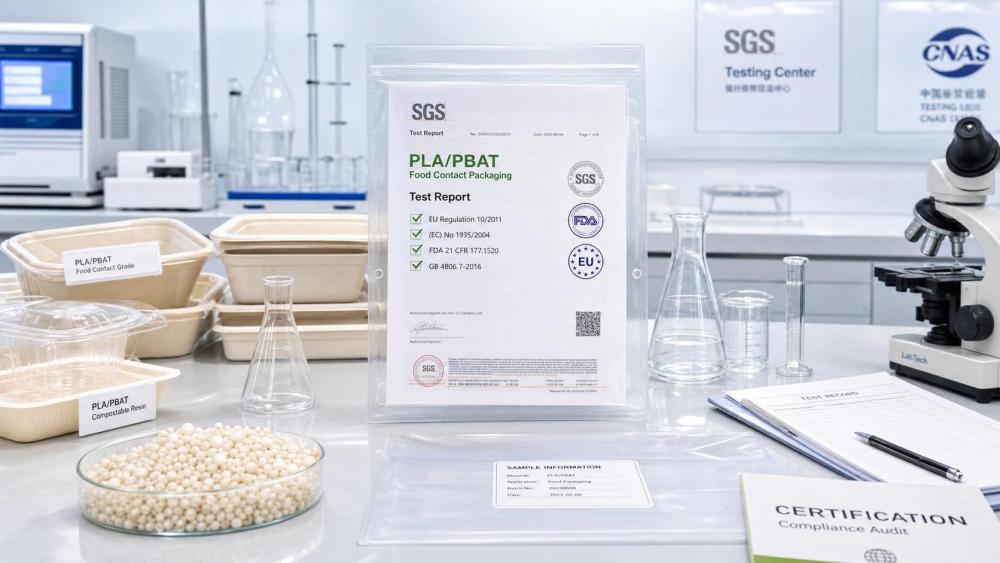
According to the information provided, the FDA updated its Bio-based Food Contact Substances Guidance on July 2, 2026. Under the update, importers filing PLA/PBAT biodegradable resins for use in food-contact packaging must submit full-cycle degradation verification reports issued by third-party laboratories under ASTM D6400/D6868. The submission must also state the composting condition involved, whether industrial or home composting, and include results for heavy metal migration and microbial toxicity testing. The new requirement takes effect on October 1, 2026.
Where the operational pressure is likely to appear
Import filings may face a higher document threshold
From an industry perspective, importers are the first group directly exposed to the rule change because the requirement is tied to filing PLA/PBAT biodegradable resins for food-contact packaging. The practical impact is likely to center on whether supporting reports are complete, whether the composting condition is clearly identified, and whether heavy metal migration and microbial toxicity results are available in a form that can be presented during compliance review.
Material suppliers and converters may need earlier test coordination
Analysis shows that upstream resin suppliers and packaging converters could be affected even when the formal submission duty sits with the importer. Buyers and filing parties are likely to ask suppliers for third-party ASTM D6400/D6868 degradation verification, together with the related test details named in the guidance. That means technical files, declarations, and product documentation may need to be aligned earlier in the supply process.
Procurement and delivery planning may become more documentation-driven
What deserves closer attention is the effect on procurement and delivery workflows. Where PLA/PBAT materials are specified for food-contact packaging, purchasing teams may need to check whether the required reports already exist, whether they match the intended composting condition, and whether supporting compliance files can move with the shipment. In practice, documentation readiness may become as important as material availability for order confirmation and delivery timing.
Testing and certification service providers may see a more defined role
Observably, third-party laboratories and compliance service providers are also implicated because the update expressly refers to third-party verification reports and named testing outputs. For businesses relying on external testing capacity, the immediate issue is less about market expansion and more about whether report scope, format, and timing will match importer needs before the effective date.
What companies should review before October 1
Check whether existing files match the new submission expectation
Analysis shows that companies dealing in PLA/PBAT food-contact packaging materials should first review whether current technical dossiers already include third-party ASTM D6400/D6868 full-cycle degradation verification. If not, the compliance gap is not only a testing issue but also a filing-readiness issue.
Separate composting claims with greater precision
The guidance summary specifically requires the composting condition to be identified as industrial or home composting. That means businesses should pay closer attention to how product claims, specifications, and supporting reports describe end-of-life performance. Where product literature uses broad biodegradable language, the underlying compliance file may now need more precise alignment.
Prepare supporting test results as part of transaction documents
What deserves closer attention is whether heavy metal migration and microbial toxicity results are available in a traceable and usable form for trade and compliance purposes. Companies may need to review how these records are retained, referenced, and shared across sales, import, quality, and customer-facing teams, especially where shipment approval depends on complete paperwork.
Continue tracking implementation language and review practice
The input does not provide detailed enforcement procedure or review format beyond the updated guidance summary and effective date. It is therefore more appropriate to understand near-term preparation as a monitoring task as well as a document task. Businesses should keep watching for any clearer execution language, filing interpretation, or downstream specification updates tied to this requirement.
Why this reads as an execution signal rather than a broad policy slogan
Observably, this update is not merely a general endorsement of bio-based packaging. It points to a narrower compliance direction: biodegradability claims for PLA/PBAT food-contact materials are being tied to named standards, third-party verification, and additional test disclosure. Analysis shows that the significance lies in the conversion of a material attribute into a documentary requirement that can affect trade handling, supplier qualification, and submission completeness.
At the same time, this should not be overstated as a fully mapped enforcement outcome. The information provided confirms the new requirement and effective date, but it does not describe how review intensity, document format preferences, or market responses will develop after implementation. That remains an area for continued observation.
How the market may best interpret this update now
At this stage, it is more appropriate to understand the FDA update as a concrete compliance signal with near-term operational consequences for PLA/PBAT food-contact packaging, especially where import filings depend on third-party degradation evidence and related test records. The change does not by itself establish a full market outcome, but it does clearly indicate that documentation quality, testing scope, and claim precision will matter more in execution after October 1, 2026.
Basis of this article and what still needs verification
This article is based on the user-provided news title, event date, and event summary. For developments of this kind, relevant source categories commonly include official regulatory releases, notices from supervisory agencies, customs or trade administration updates, industry association communications, standards organization documents, and reporting by authoritative trade media. No specific official source link was provided in the input, so the exact original publication link still needs to be verified. Observably, further follow-up should focus on any detailed implementation language, certification and testing interpretation, procurement specification changes, tender document updates, industry feedback, and how companies execute the requirement in practice.
Have questions about this sector analysis, or seeking best practices specific to your niche? Drop us a line below and let the senior consultants at APIM assist you.
We respect your privacy. Your information is strictly confidential.
Related News
- 00
0000-00
Do polyolefin hot melt adhesives bond well to polyethylene? - 00
0000-00
Korean Study Finds PLA Barely Degrades in Landfill After 320 Days - 00
0000-00
How to assess batch consistency from a thermal potting compounds supplier - 00
0000-00
How much weight can carbon fiber reinforced plastics save in cars? - 00
0000-00
Switching from PS to ABS Sheet Extrusion: Equipment Checks