




FDA Tightens PLA/PBAT Packaging Proof for Q3
On July 9, 2026, the U.S. FDA introduced a new compliance alert that changes how PLA/PBAT composite food-contact packaging is documented for access to the U.S. market. For exporters, packaging manufacturers, registration teams, buyers, and testing partners, the key issue is no longer only material performance but whether degradation verification can be submitted in the required form and on the required timeline. This matters because the change directly affects product registration readiness, third-party testing arrangements, and delivery planning for packaging sold into the United States.
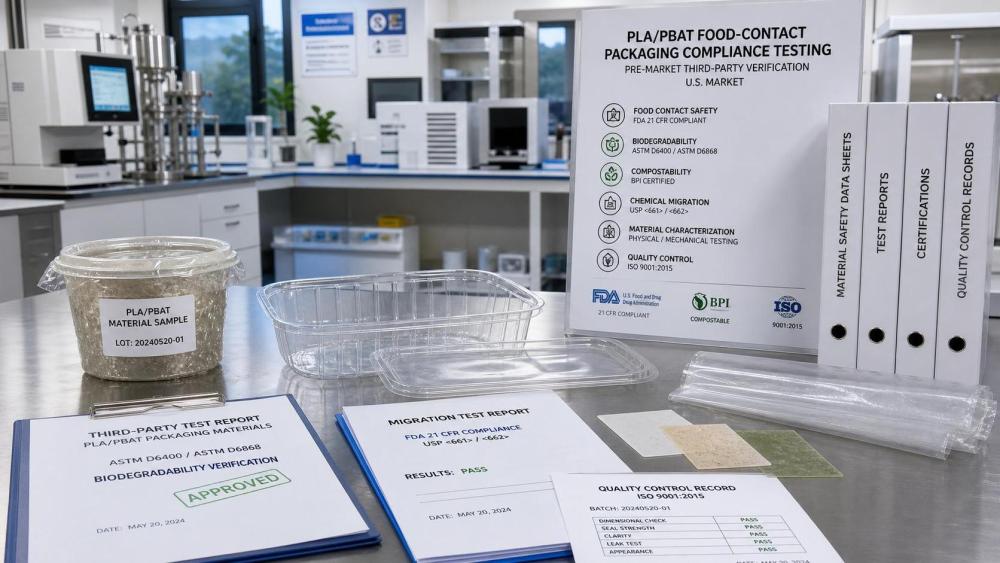
What the FDA now requires for affected packaging
According to the information provided, the FDA released Bio-based Packaging Compliance Alert No. 2026-07 on July 9, 2026. The alert applies to PLA/PBAT composite food-contact packaging sold to the U.S. market, including trays, cup lids, and films.
Beginning in the third quarter of 2026, the product registration process must be accompanied by an end-of-life degradation verification report under ISO 14855-2, issued by an ISO 17025 accredited laboratory. The report must include results covering CO₂ release rate under 60-day composting conditions, heavy metal residue, and ecotoxicity testing.
The information provided also states that the new requirement materially raises third-party testing cost and timing thresholds for Chinese bio-based material exporters, while also creating a differentiated market-entry advantage for companies that can meet the compliance expectation.
Where the immediate pressure will show up in the supply chain
Export registration and market access preparation
From an industry perspective, exporters selling affected packaging into the United States are likely to face the most direct impact because the report is tied to product registration. The practical effect is concentrated in document readiness, laboratory coordination, and the ability to align compliance evidence with shipment and registration timing. What deserves closer attention is whether existing registration files, internal technical dossiers, and customer-facing compliance packs are complete enough to support this new submission requirement.
Manufacturing and product management workflows
For processors and packaging manufacturers, the rule change may affect how product variants are managed before sale to the U.S. market. Trays, cup lids, and films are explicitly named in the provided information, so manufacturers handling these product categories should pay attention to whether product specifications, material combinations, and supporting test records are organized in a way that can support registration-linked reporting. The impact is less about production theory and more about whether compliance evidence can move in step with commercial orders and delivery commitments.
Procurement and buyer qualification decisions
Procurement teams and downstream buyers may also be affected because supplier qualification is likely to depend more heavily on the availability and credibility of third-party degradation verification. Analysis shows that purchasing decisions may shift toward suppliers that can present ISO 17025 laboratory documentation in the format required for registration support. In practice, this can influence tender documentation, supplier screening, and order confirmation timelines.
Testing and compliance service demand
Testing service providers and compliance support firms may see added demand because the requirement is not limited to a self-declared claim; it specifies both the laboratory qualification and the testing framework to be used. Observably, the pressure point is not only laboratory capacity but also the sequencing of report issuance against registration schedules. Even where business demand exists, companies will need to watch turnaround expectations closely because the provided information already points to higher cost and time barriers.
What companies should monitor now
Check whether current files match the registration-linked requirement
Analysis shows that companies should first review whether their existing compliance files for PLA/PBAT composite food-contact packaging already contain a report structure that matches the new FDA requirement. The issue is not simply having test materials on hand, but whether the required ISO 14855-2 end-of-life degradation verification can be submitted together with product registration.
Reassess laboratory arrangements and report timing
What deserves closer attention is the dependence on reports issued by ISO 17025 accredited laboratories. Companies involved in export planning, registration support, or customer delivery scheduling should monitor whether current laboratory arrangements can support the required testing scope, including CO₂ release rate under 60-day composting conditions, heavy metal residue, and ecotoxicity results.
Review sales, purchasing, and delivery documents for U.S.-bound products
For teams handling quotations, supply contracts, tenders, and delivery planning, this change may need to be reflected in technical annexes, supplier qualification records, and document checklists tied to U.S.-bound business. Because the provided information does not include detailed enforcement procedures, it would be premature to assume a uniform market practice, but document alignment is already a practical area to watch.
Follow official wording and execution signals after Q3 begins
It is more appropriate to understand this as a rule change with immediate compliance consequences, while still recognizing that execution details may continue to evolve. Companies should therefore keep watching for later official wording, registration interpretation, customer document requests, and any changes in how market participants translate the requirement into purchasing and delivery conditions.
Why this looks like an execution signal, not just a policy headline
Analysis shows that this update is more than a general sustainability statement because it links a named testing standard, a laboratory qualification requirement, and a registration submission timing point. That combination usually matters operationally: it affects whether a product can move through market-access processes without documentation gaps. At the same time, the information provided does not describe detailed enforcement mechanics, so some aspects of implementation still require observation rather than assumption.
Observably, the market significance lies in two parallel effects already stated in the source material: higher compliance cost and timing pressure for Chinese exporters, and a clearer entry advantage for firms that are ready with acceptable third-party verification. The near-term industry response is therefore likely to focus less on public positioning and more on documentation discipline, test scheduling, and supplier qualification.
How this update is best understood at this stage
At this stage, the FDA alert is best read as a concrete compliance change affecting U.S.-bound PLA/PBAT composite food-contact packaging, rather than as a distant policy direction. The most rational reading is that companies exposed to registration, testing, procurement, and export delivery should treat the reporting requirement as an operational issue now, while continuing to watch for how the rule is applied in practice after the third quarter of 2026 begins.
Basis of this article and points still requiring verification
This article is generated from the user-provided news title, event date, and event summary. For developments of this kind, relevant source categories commonly include official regulatory notices, publications issued by supervisory authorities, customs or trade administration updates, industry association materials, standards organization documents, and reporting by authoritative trade media.
No specific official source link was provided in the input, so the exact official link remains to be verified on an ongoing basis. Observably, the areas that still merit continued monitoring include detailed implementation language, certification and testing interpretation, changes in tender and procurement documents, market feedback, and how companies execute against the new requirement in practice.
Have questions about this sector analysis, or seeking best practices specific to your niche? Drop us a line below and let the senior consultants at APIM assist you.
We respect your privacy. Your information is strictly confidential.
Related News
- 00
0000-00
Do polyolefin hot melt adhesives bond well to polyethylene? - 00
0000-00
Korean Study Finds PLA Barely Degrades in Landfill After 320 Days - 00
0000-00
How to assess batch consistency from a thermal potting compounds supplier - 00
0000-00
How much weight can carbon fiber reinforced plastics save in cars? - 00
0000-00
Switching from PS to ABS Sheet Extrusion: Equipment Checks
Tag