




FDA Tightens Migration Data for PLA/PBAT Food Packaging
On August 6, 2026, the U.S. FDA revised its guidance on bio-based polymer packaging for food contact, introducing a more specific data requirement for PLA/PBAT blended and multilayer materials. From October 1, 2026, companies supplying these packaging formats to the U.S. market will need migration test reports generated under actual processing conditions such as heat sealing, boiling, and microwave use, with quantitative analysis of low-molecular-weight degradation by-products. For resin suppliers, compounders, and export-oriented film manufacturers, this is not a routine wording update; it directly affects how compliance files are prepared and how supply to the U.S. market is supported.
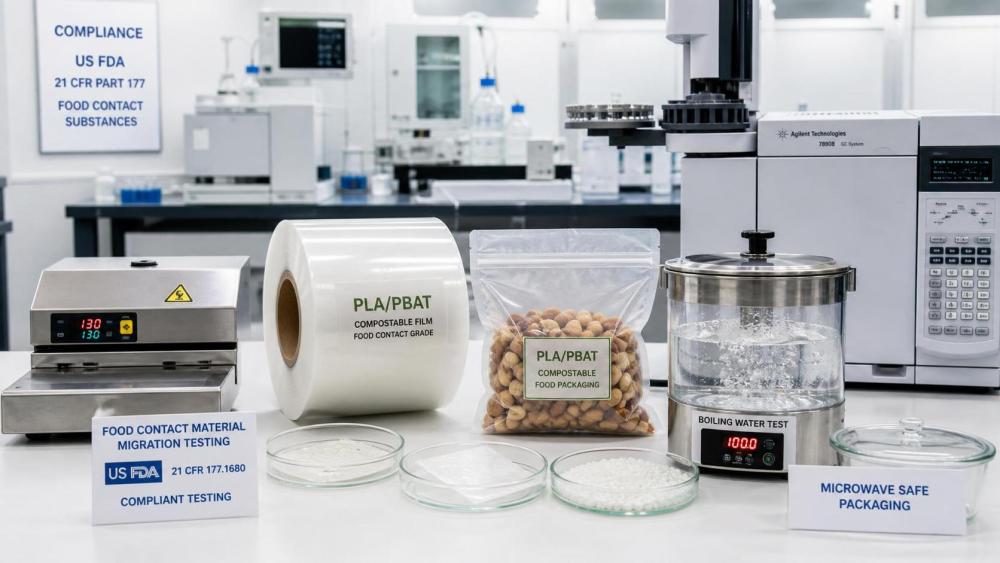
What the revised FDA guidance now requires
The confirmed change is tied to the revised Guidance for Industry: Bio-based Polymer Packaging for Food Contact issued by the U.S. FDA on August 6, 2026. Under the revised guidance, all food-contact packaging materials containing PLA/PBAT blends or multilayer structures must, from October 1, 2026, submit comprehensive chemical migration test reports based on actual processing conditions.
The processing conditions specifically referenced in the event summary include heat sealing, boiling, and microwave use. The required testing scope also includes quantitative analysis of low-molecular-weight degradation by-products, with examples including lactic acid, adipic acid, and terephthalic acid monomers.
The event summary further confirms that this requirement directly affects the compliance pathway for Chinese PLA/PBAT resin suppliers, modification plants, and export-oriented composite film manufacturers serving the U.S. market.
Where the compliance burden is likely to shift
Material suppliers may face new documentation expectations
From an industry perspective, PLA/PBAT resin suppliers and modification plants may be affected because downstream customers exporting to the United States will need testing evidence linked to actual processing conditions rather than only material-level descriptions. The practical impact is likely to appear in technical documentation, supporting test data, and the way material information is handed over to film converters or brand-side buyers.
What deserves closer attention is whether existing data packages are sufficient for customer review once the new requirement takes effect. Even where the final report is submitted by a packaging manufacturer, upstream material suppliers may be asked for more detailed composition, processing, or degradation-related support documents.
Film converters will feel the requirement at the shipment approval stage
For export-oriented composite film manufacturers, the rule change is closely connected to market access and delivery readiness. Because the revised guidance points to testing under heat sealing, boiling, and microwave conditions, the relevant compliance work is tied not only to the resin itself but also to the finished packaging structure and its intended use conditions.
Observably, this can affect pre-shipment compliance review, customer acceptance, and the completeness of files accompanying U.S.-bound orders. Manufacturers will need to pay closer attention to whether test reports, technical files, and product declarations align with the actual converting and use scenarios of the packaging being supplied.
Buyers and supply chain coordinators may need earlier qualification checks
Procurement teams, import-facing trading companies, and supply chain service providers may also be affected because the revised requirement changes what may be treated as acceptable compliance support for PLA/PBAT-related food-contact packaging. The impact is likely to show up in supplier qualification, purchase specifications, document collection, and delivery coordination.
Analysis shows that buyers handling U.S.-market supply will need to review whether suppliers can provide the required migration data in time for orders shipping after the effective date. Where packaging is used in applications involving thermal processing, the link between intended use and submitted test materials becomes especially important.
Practical points companies should watch now
Review whether current test files match real processing conditions
Analysis shows that one immediate task is to check whether existing migration reports for PLA/PBAT blended or multilayer food-contact packaging were generated under conditions that correspond to actual use and processing. If reports are based on narrower assumptions, they may not fully match the revised FDA expectation described in the event summary.
Check how low-molecular-weight by-product data is presented
What deserves closer attention is the requirement to quantify low-molecular-weight degradation by-products, including examples such as lactic acid, adipic acid, and terephthalic acid monomers. Companies involved in export documentation should review whether current test packages and technical files present these substances in a way that can support customer or compliance review.
Prepare for changes in customer document requests and lead times
Observably, the revised guidance may influence what buyers, importers, or downstream users ask for before approving supply. Companies should watch for changes in specification sheets, testing checklists, supplier onboarding requirements, and shipment document requests tied to U.S.-bound business. Because the input does not provide execution details beyond the effective date and the testing requirement itself, this should be treated as a point for active monitoring rather than a settled outcome.
Track how the requirement is reflected in market-facing paperwork
From an industry perspective, it is also necessary to watch whether the revised expectation begins to appear in tender documents, compliance questionnaires, purchase contracts, or customer audit requests. The event summary confirms a rule change and an effective date, but it does not define a detailed implementation pathway for every transaction scenario, so companies should avoid assuming that one format of supporting file will satisfy all counterparties.
Why this reads as an execution signal rather than a distant policy trend
Analysis shows that this update is more than a broad policy direction because it identifies a concrete effective date, a defined material scope, and a specific testing expectation tied to actual processing conditions. That gives the change the character of an execution signal for companies already supplying or preparing to supply PLA/PBAT-related food-contact packaging to the U.S. market.
At the same time, it is more appropriate to understand this as a rule development that still requires observation in practice. The event summary does not provide fuller detail on review procedures, documentation formats, or how market participants will standardize compliance evidence across different packaging applications. For that reason, continued attention to implementation language and market feedback remains necessary.
How the market should read the change at this stage
In practical terms, this FDA guidance revision should be read as a compliance requirement with near-term operational consequences for PLA/PBAT food-contact packaging linked to the U.S. market. It is not simply a background policy update, because it directly affects the data expected in support of supply after October 1, 2026.
That said, the current stage still calls for measured interpretation. The confirmed facts establish the new requirement and the affected product scope, while many execution details still need to be watched through customer practice, compliance review behavior, and later market implementation. A rational reading today is that companies should treat the change as actionable now, while continuing to monitor how it is applied in real transactions.
Basis of this article and what still needs verification
This article is generated based on the user-provided news title, event date, and event summary. For events of this type, commonly relevant source categories may include official regulatory releases, government agency publications, customs or trade authority updates, industry association notices, standards organization documents, and reporting by established trade media.
No specific official source link was provided in the input, so the exact official publication path still needs to be verified on an ongoing basis. Observably, the points that still merit follow-up include any additional policy detail, the compliance interpretation used in practice, changes in tender or procurement documents, industry feedback, and how companies implement the requirement in export operations.
Have questions about this sector analysis, or seeking best practices specific to your niche? Drop us a line below and let the senior consultants at APIM assist you.
We respect your privacy. Your information is strictly confidential.
Related News
- 00
0000-00
Do polyolefin hot melt adhesives bond well to polyethylene? - 00
0000-00
Korean Study Finds PLA Barely Degrades in Landfill After 320 Days - 00
0000-00
How to assess batch consistency from a thermal potting compounds supplier - 00
0000-00
How much weight can carbon fiber reinforced plastics save in cars? - 00
0000-00
Switching from PS to ABS Sheet Extrusion: Equipment Checks
Tag