




FDA Tightens Import Checks on PLA/PBAT Resins
On July 2, 2026, the U.S. FDA updated its Bio-based Packaging Materials Import Guidance and introduced a stricter documentation requirement for imported PLA and PBAT biodegradable resins. Importers must now provide biodegradation verification reports issued by ISO/IEC 17025 accredited laboratories under ASTM D6400 or ASTM D6868, with a threshold of at least 90% degradation under 180-day composting conditions. Because the rule took effect immediately and applies to both food-contact and non-food-contact materials from all countries of origin, it deserves close attention from resin exporters, importers, testing partners, processors, and downstream packaging buyers.
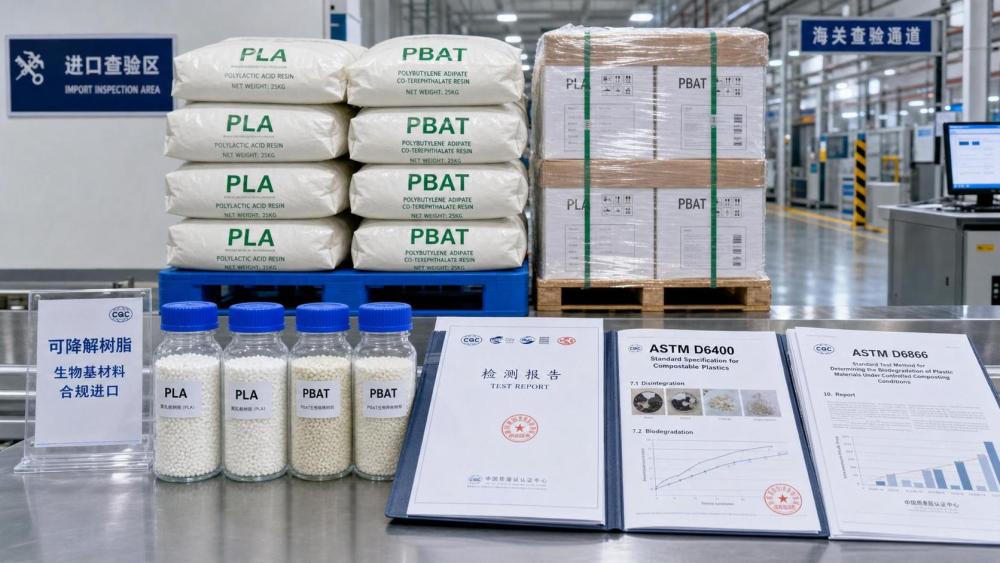
What the updated guidance now requires
The confirmed change is that the FDA updated its Bio-based Packaging Materials Import Guidance on July 2, 2026. Under the updated requirement, all importers of PLA/PBAT biodegradable resins must submit biodegradation verification reports issued by laboratories accredited to ISO/IEC 17025. The reports must be based on ASTM D6400 or ASTM D6868 testing, and the biodegradation result must reach at least 90% under 180-day composting conditions. According to the provided information, shipments that do not provide the required documentation will not be released. The rule is effective immediately, covers both food-contact and non-food-contact biodegradable resins, and applies regardless of country of origin.
Where the pressure will likely appear first in the value chain
Import execution and customs-facing documentation
From an industry perspective, direct trading companies and importers are likely to feel the impact first because the new requirement is tied to release of goods. The practical issue is no longer only product specification or contract terms, but whether the shipment file includes a compliant third-party verification report. What deserves closer attention is the completeness of shipment documents, the matching of test reports to imported material, and the timing risk created by a rule that took effect immediately.
Export supply arrangements for resin producers
For PLA and PBAT resin exporters, especially those supplying the U.S. market, the change may affect how export batches are prepared and supported with testing documentation. Analysis shows that the requirement shifts part of the compliance burden upstream: suppliers may now need to align more closely with accredited laboratories and with customers on which ASTM standard is being used in the submitted report. For Chinese exporters specifically, the supplied information indicates a need to upgrade testing cooperation mechanisms in step with the new FDA requirement.
Converters and downstream packaging users
Processors and end-use packaging companies may not be the party submitting import documentation, but they can still be affected through supply continuity and material qualification schedules. Observably, if upstream resin imports are delayed or not released, converting operations and procurement planning may face disruption. Buyers using biodegradable resin inputs should therefore pay attention to whether suppliers can maintain compliant documentation for ongoing orders, not only whether the material claim itself appears in commercial communications.
Testing and compliance service partners
Service providers involved in testing, certification support, and trade documentation may see increased operational importance under the new rule. The main issue is not market expansion as a fact, but the immediate need for importers and exporters to work with laboratories holding ISO/IEC 17025 accreditation and to ensure the reports are suitable for submission under the updated guidance. The quality, format, and timing of test evidence now become part of transaction execution.
What companies should review now
Check whether current reports meet the stated FDA threshold
Companies involved in U.S.-bound PLA/PBAT shipments should first verify whether existing biodegradation documents actually meet the stated requirement: ISO/IEC 17025 accredited laboratory issuance, ASTM D6400 or ASTM D6868 basis, and at least 90% degradation under 180-day composting conditions. This is a document-control question as much as a technical one.
Separate policy wording from shipment readiness
Analysis shows that one of the main practical risks is assuming that a general biodegradable claim or prior testing history is enough for customs release. The updated guidance, as provided, points to a specific third-party verification threshold. Companies should therefore distinguish between broad product positioning and the exact paperwork needed for import clearance.
Reconfirm supplier and laboratory coordination
For exporters, importers, and procurement teams, a near-term priority is to reconfirm who is responsible for arranging testing, obtaining the accredited report, and attaching the document to the shipment process. For Chinese exporters in particular, the provided information highlights the need to upgrade coordination with testing partners. The key issue is not only whether testing can be done, but whether the cooperation model supports repeated and timely submission for live orders.
Prepare for customer communication and delivery adjustments
Because the rule is already in effect, companies may need to revisit delivery commitments, shipment scheduling, and customer communication for U.S.-bound business involving PLA/PBAT biodegradable resins. What deserves closer attention is whether existing orders require supplemental documents and whether downstream customers need early notice about possible processing or clearance delays.
Why this looks like more than a routine paperwork update
This section is an editorial observation. It is more appropriate to understand this development as an operational compliance signal with immediate effect rather than as a distant policy direction. The reason is straightforward: the consequence described in the provided information is non-release of goods when the required report is missing. At the same time, it is still too early to treat the update as a fully settled long-term market outcome. Observably, the stronger takeaway for now is that documentation standards around biodegradable resin imports are becoming more explicit, and the industry should continue watching how this is applied in day-to-day trade practice.
How this update should be read at this stage
At this stage, the FDA update matters less as a headline about biodegradable materials in general and more as a concrete import-control change for PLA/PBAT resin trade. The immediate business relevance lies in accredited third-party testing, shipment documentation, and release risk. A neutral reading is that this is already a short-term operational change, while its longer-term influence on sourcing patterns, customer requirements, and compliance workflows still needs continued observation.
Basis of this article and what still needs verification
This article is based on the user-provided news title, event date, and event summary. For this type of industry update, common source categories would normally include official notices, corporate statements, industry association updates, authoritative media coverage, and standards-related documents. A specific official source link was not provided in the input, so the exact published document and any later clarifications still require continued verification. Follow-up attention should remain on any additional FDA wording, implementation details in trade practice, and whether supporting compliance expectations evolve further after the immediate effective date.
Have questions about this sector analysis, or seeking best practices specific to your niche? Drop us a line below and let the senior consultants at APIM assist you.
We respect your privacy. Your information is strictly confidential.
Related News
- 00
0000-00
Do polyolefin hot melt adhesives bond well to polyethylene? - 00
0000-00
Korean Study Finds PLA Barely Degrades in Landfill After 320 Days - 00
0000-00
How to assess batch consistency from a thermal potting compounds supplier - 00
0000-00
How much weight can carbon fiber reinforced plastics save in cars? - 00
0000-00
Switching from PS to ABS Sheet Extrusion: Equipment Checks