




FDA Sets Q3 PLA/PBAT Packaging Report Rule
On July 7, 2026, the U.S. Food and Drug Administration (FDA) issued a new compliance alert for bio-based packaging that directly affects PLA/PBAT blended food-contact packaging entering the U.S. market. The update matters not only to exporters of bio-based materials, but also to manufacturers, procurement teams, compliance staff, and supply chain partners, because it shifts attention toward verified biodegradation end results and could change how testing, documentation, timing, and certification costs are managed in actual export business.
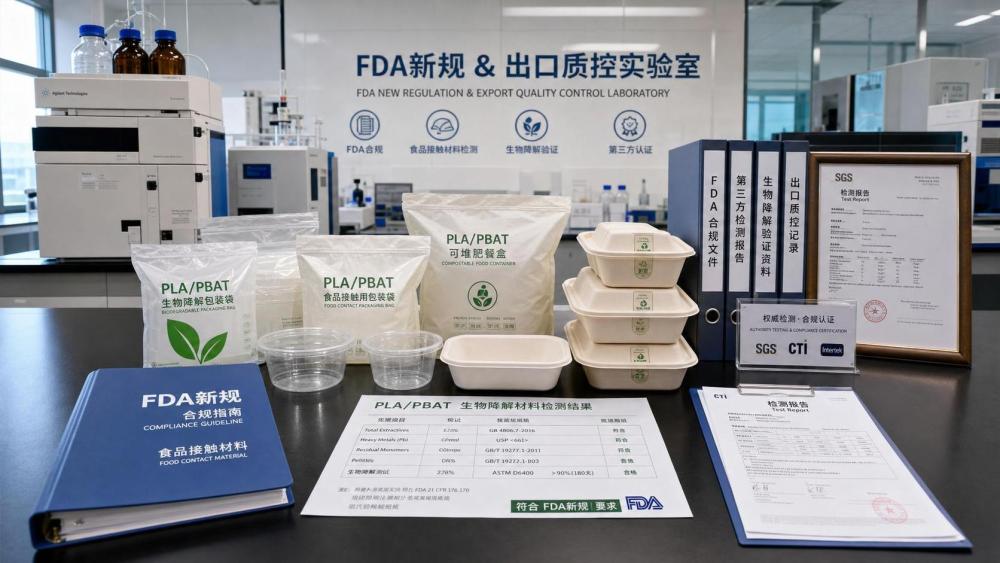
What the FDA update formally requires
According to the provided information, the FDA released Bio-based Packaging Compliance Alert No. 26-07 on July 7, 2026. The alert states that from the third quarter of 2026, all PLA/PBAT blended food-contact packaging entering the U.S. market must be accompanied by a third-party verification report issued by an ISO/IEC 17025 accredited laboratory.
The required report must be based on ISO 14855-2 and show a final anaerobic biodegradation rate of at least 90%. Based on the provided summary, the regulatory emphasis is being placed on the biodegradation endpoint rather than on process-oriented indicators.
Where the pressure is likely to appear in the supply chain
Export-facing material and packaging suppliers
From an industry perspective, suppliers shipping PLA/PBAT blended food-contact packaging to the United States are the most directly affected group. The impact is likely to show up first in testing arrangements, export documentation, and customer-facing compliance files, because products entering the U.S. market will need the specified third-party endpoint report.
Manufacturing and formulation teams
For processors and manufacturers, the key issue is not only product output but whether the specific PLA/PBAT blend can support the required verification result under ISO 14855-2. Analysis shows that the effect may be felt in formulation review, production planning, and internal coordination between technical and regulatory functions.
Procurement and customer compliance functions
Buyers, sourcing teams, and compliance managers may also face a more documentation-driven review process. What deserves closer attention is whether existing supplier packages already include reports from ISO/IEC 17025 accredited laboratories and whether those reports match the FDA-stated endpoint requirement, rather than relying on broader biodegradability claims.
Testing and supply chain service providers
Observably, laboratories, certification support providers, and export service partners may see rising demand for report readiness, qualification checks, and document coordination. The practical impact is likely to center on turnaround time, report completeness, and shipment readiness for U.S.-bound orders.
What companies should focus on now
Check whether current reports match the new endpoint requirement
Companies involved in U.S.-bound PLA/PBAT food-contact packaging should first verify whether their existing test files actually meet the FDA-stated requirement: a third-party ISO 14855-2 report from an ISO/IEC 17025 accredited laboratory showing final anaerobic biodegradation of at least 90%.
Separate marketing claims from entry documentation
Analysis shows that this update should not be treated as a general sustainability message alone. The more immediate issue is document sufficiency for market entry. Businesses should distinguish between broad biodegradability positioning and the specific compliance evidence now referenced in the FDA alert.
Review supplier qualifications and delivery timing
What deserves closer attention is whether upstream suppliers and external testing partners can support the required documents within commercial delivery schedules. This matters for contract execution, shipment preparation, and customer communication, especially where orders depend on complete compliance files before dispatch or customs-related review.
Watch for further official wording and practical interpretation
Observably, the current alert gives a clear directional requirement, but companies should continue monitoring whether any subsequent official clarification affects scope, documentation expectations, or implementation practice. In operational terms, businesses may need contingency planning for certification timing and customer inquiries during the transition into Q3 2026.
How this update should be understood at this stage
Analysis shows that this is more than a routine wording change because the stated requirement centers on a third-party verified biodegradation endpoint. At the same time, it is more appropriate to understand the development as a concrete compliance signal rather than a complete picture of every downstream consequence. The practical importance lies in how quickly market participants align testing strategy and document preparation with the new requirement.
From an industry perspective, the update is especially relevant for Chinese exporters of bio-based materials and packaging, because the provided information already points to likely effects on testing strategy and certification cost. That does not by itself establish the full scale of impact, but it does indicate that compliance preparation may become a more active part of export execution.
Why the market will keep watching this change
At present, this development is best understood as a near-term compliance change with longer-term signaling value. In the short term, it affects report readiness for PLA/PBAT blended food-contact packaging entering the U.S. market from Q3 2026 onward. In a broader sense, it suggests that endpoint-based verification is receiving closer regulatory attention. The industry should therefore read this as both an immediate operational issue and a policy signal that still requires continued observation.
Basis of this article
This article is based on the user-provided news title, event date, and event summary. For this type of industry update, commonly relevant source categories may include official notices, company disclosures, industry association materials, authoritative media coverage, and standards-related documents.
The specific official source link was not provided in the input, so further verification remains necessary. Any follow-up interpretation should continue to monitor later official FDA wording, implementation-related clarification, and practical documentation requirements tied to U.S. market entry.
Have questions about this sector analysis, or seeking best practices specific to your niche? Drop us a line below and let the senior consultants at APIM assist you.
We respect your privacy. Your information is strictly confidential.
Related News
- 00
0000-00
Do polyolefin hot melt adhesives bond well to polyethylene? - 00
0000-00
Korean Study Finds PLA Barely Degrades in Landfill After 320 Days - 00
0000-00
How to assess batch consistency from a thermal potting compounds supplier - 00
0000-00
How much weight can carbon fiber reinforced plastics save in cars? - 00
0000-00
Switching from PS to ABS Sheet Extrusion: Equipment Checks