




FDA Clears PLA/PBAT Resin for Frozen Food Trays
On June 30, 2026, the U.S. Food and Drug Administration (FDA) issued industry notice Docket No. FDA-2026-D-0872, approving a specified PLA/PBAT biodegradable resin blend for frozen ready-to-eat food trays within a temperature range of -20°C to 40°C. The practical change drawing industry attention is that, where ASTM D6400 is met, the material can move forward without the prior single-batch GRAS clearance step. For packaging buyers, converters, exporters, certification-related service providers, and suppliers serving North American food packaging programs, this points to a concrete shift in how compliance timing and packaging introduction workflows may be handled.
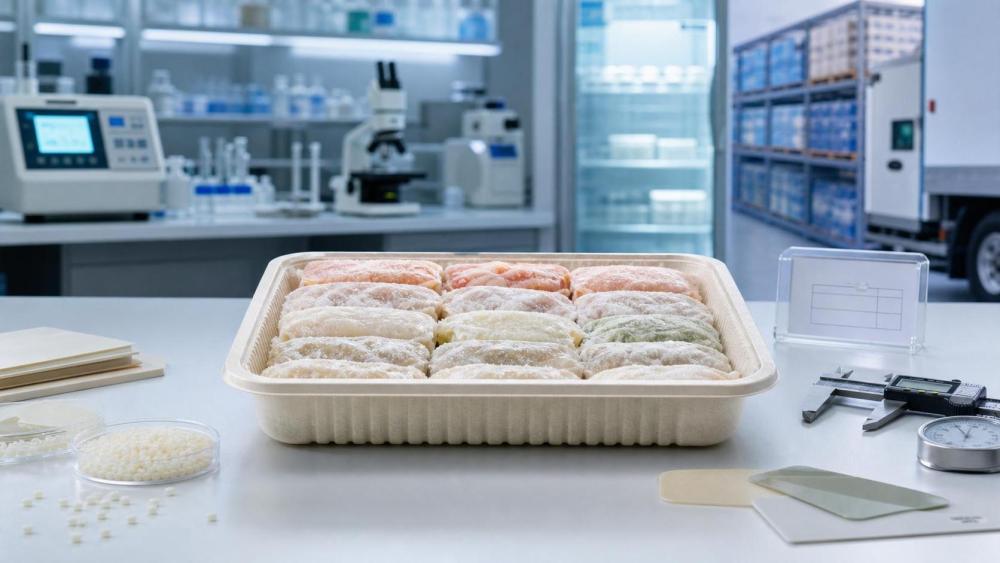
What the FDA Notice Confirms
The confirmed facts are limited but commercially relevant. According to the provided event summary, the FDA formally approved a specific-ratio PLA/PBAT biodegradable resin blend for use in frozen ready-to-eat food trays. The approved application covers use conditions between -20°C and 40°C. The same notice states that, for materials meeting ASTM D6400, the prior single-batch GRAS certification process can be waived. The event date provided is June 30, 2026, and the notice is identified as Docket No. FDA-2026-D-0872.
The provided summary also states that this change shortens new packaging introduction cycles for North American brand owners and is favorable to export cooperation involving Chinese PCR compounders that already hold ISO 13485 and BPI certifications.
Where the Operational Impact May Appear First
Packaging buyers may adjust qualification timing
From an industry perspective, buyers and brand-side packaging teams are among the first groups likely to feel the change because the waiver affects a front-end compliance step tied to material introduction. The immediate business impact is likely to center on supplier screening, packaging project scheduling, and internal approval sequencing. What deserves closer attention is whether procurement teams begin requesting clearer proof of ASTM D6400 compliance and more complete technical documentation at an earlier stage, since the waived GRAS precondition does not remove the need to substantiate material suitability within the stated application scope.
Converters and manufacturers may face tighter document expectations
Processors and tray manufacturers may benefit from a shorter path to introducing approved material combinations into frozen food tray programs, but they may also face more detailed scrutiny over formulation consistency, use conditions, and supporting records. The business effect is likely to show up in technical file preparation, customer submissions, product specification alignment, and delivery commitments. Analysis shows that manufacturers will need to pay closer attention to how the approved resin ratio, the defined temperature range, and ASTM D6400 evidence are presented in customer-facing documentation.
Export-oriented resin suppliers may see a compliance-based opening
For export suppliers, especially Chinese PCR compounders referenced in the event summary, the notice matters because it may improve the commercial usability of qualified material in North American packaging projects. The likely impact is less about volume in the immediate term and more about supplier eligibility in quotation, sampling, and program entry discussions. Observably, suppliers with ISO 13485 and BPI certifications may be in a stronger position when buyers compare documentation readiness, certification status, and response speed, even though the event summary does not confirm how individual purchasers will update their vendor requirements.
Certification and testing service providers may need to track new client demand
Certification-related firms and testing service providers may also be affected because the change shifts attention toward standards evidence and dossier quality rather than a prior single-batch GRAS gate. Their role may become more prominent in test reporting, certification review, and supporting materials for procurement or tender files. What deserves closer attention is whether customers begin asking for more explicit alignment between ASTM D6400 proof, application boundaries, and export documentation used in buyer qualification.
Practical Issues Companies Should Watch Now
Check whether internal material files match the approved use boundary
Analysis shows that companies should first verify whether their existing technical files clearly correspond to the approved application described in the notice: a specified PLA/PBAT blend, frozen ready-to-eat food trays, and a use range of -20°C to 40°C. Where product documents are broader or imprecise, commercial teams may face delays during customer review even if the underlying material appears relevant.
Prepare compliance evidence around ASTM D6400 with more discipline
The waiver described in the event summary is conditional on meeting ASTM D6400. It is therefore more appropriate to understand documentation discipline, not just certification possession, as a current priority. Companies involved in supply, conversion, or export should pay attention to how test reports, declarations, specifications, and customer submission packs are organized, because purchasers may rely more heavily on those materials when the prior single-batch GRAS step is no longer the initial gating item.
Watch for changes in customer procurement language and tender documents
The provided information does not include downstream execution details, so it should not be assumed that all buyers will immediately align their procurement language. Observably, one area worth tracking is whether frozen food tray tenders, supplier manuals, or packaging specifications begin to reflect the new approval path and the GRAS-related waiver condition. That would be an important signal of how quickly the rule change is being operationalized in the market.
Keep traceability and after-delivery support in view
Even where packaging introduction becomes faster, exporters and manufacturers still need to pay attention to batch traceability, formulation consistency, and issue-response records. From an industry perspective, shorter onboarding windows can increase the need for well-prepared follow-up support if buyers ask for clarification during qualification or after delivery. The event summary supports attention to export cooperation, but it does not confirm any uniform market practice, so traceability readiness remains a prudent operational focus.
How This Change Should Be Read at This Stage
Analysis shows that this development is better understood as a concrete execution signal rather than a broad policy narrative. The notice points to an actionable change in how an approved biodegradable resin blend may enter a defined frozen food tray application in the U.S. market. At the same time, it is not yet enough to treat every commercial implication as settled. Observably, the most important follow-up questions are likely to come from execution: how buyers interpret the waiver in procurement workflows, how documentation thresholds are applied in practice, and how certification and testing evidence are weighed during supplier selection.
It is also more appropriate to view this as a targeted rule change with application-specific relevance, not as a blanket simplification across all food-contact packaging scenarios. That distinction matters for companies deciding whether to revise sales claims, compliance statements, or product positioning.
What the Notice Means for the Market Right Now
The immediate significance of this event lies in a narrower but meaningful compliance shift: a specified PLA/PBAT biodegradable resin blend has been approved for a defined frozen food tray use case, and the prior single-batch GRAS step can be waived where ASTM D6400 is satisfied. For the industry, this is best read as an implemented change with real workflow implications, while the pace and consistency of downstream market adoption still require observation. A careful reading today is that the rule change can shorten packaging introduction processes, but companies should continue to track customer requirements, document expectations, and execution feedback before treating the new pathway as fully standardized across transactions.
Basis of This Article and What Still Needs Verification
This article is based on the user-provided news title, event date, and event summary. For developments of this kind, relevant source categories typically include official regulatory notices, regulator-issued updates, trade or customs authority information, industry association releases, standards organization documents, and reporting by established professional media. A specific official source link was not provided in the input, so the exact source document and any subsequent clarifications still need to be verified on an ongoing basis.
Further observation is still needed on possible implementing detail, certification interpretation, buyer-side tender language, technical document requirements, industry feedback, and how companies apply the change in actual export and packaging qualification workflows.
Have questions about this sector analysis, or seeking best practices specific to your niche? Drop us a line below and let the senior consultants at APIM assist you.
We respect your privacy. Your information is strictly confidential.
Related News
- 00
0000-00
Do polyolefin hot melt adhesives bond well to polyethylene? - 00
0000-00
Korean Study Finds PLA Barely Degrades in Landfill After 320 Days - 00
0000-00
How to assess batch consistency from a thermal potting compounds supplier - 00
0000-00
How much weight can carbon fiber reinforced plastics save in cars? - 00
0000-00
Switching from PS to ABS Sheet Extrusion: Equipment Checks
Tag