




ECHA Tightens Phthalate Migration Limits for PBAT/PLA Blends
On June 27, 2026, the European Chemicals Agency (ECHA) issued an emergency revision to REACH Annex XVII that lowers the migration limit for DEHP, BBP, and DBP in PBAT/PLA blended biodegradable plastic products from 0.1% to 0.01%. The change applies to imported products used in direct food contact, children's toys, and medical packaging, making it immediately relevant to exporters, importers, testing providers, procurement teams, and manufacturers that rely on these materials for EU-bound shipments.
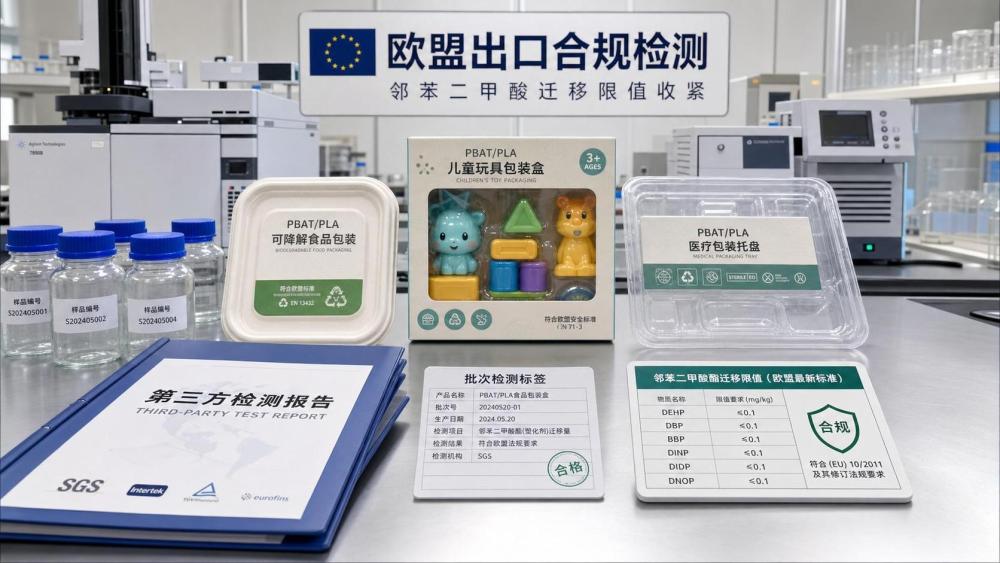
What the revision changes
According to the information provided, ECHA released the emergency revision notice on June 27, 2026. The revision adds a stricter migration threshold for three phthalates, DEHP, BBP, and DBP, in PBAT/PLA blended biodegradable plastic products covered by REACH Annex XVII.
The limit is reduced from the current 0.1% to 0.01%. The scope covers all imported products in this material category that come into direct contact with food, are intended for children's toys, or are used in medical packaging.
The new rule becomes mandatory on October 1, 2026. Importers will be required to provide batch-level migration test reports issued by third-party laboratories.
Where the immediate pressure is likely to appear
Formulation and material sourcing will face closer scrutiny
From an industry perspective, manufacturers and exporters using PBAT/PLA blends may be affected because the lower limit directly touches formulation compliance. The practical pressure point is not only the finished product, but also how raw materials and additives are selected, verified, and documented before production for EU-bound orders.
What deserves closer attention is whether existing procurement specifications, supplier declarations, and incoming material checks are sufficient for a 0.01% migration threshold, especially for applications already named in the rule.
Import-side documentation becomes part of shipment readiness
Direct trade companies and EU importers may be affected because the rule explicitly requires batch-level migration test reports from third-party laboratories. This means compliance is tied not just to product design, but also to the completeness and timing of shipment documents.
In business terms, the impact is likely to appear in pre-shipment review, customs-facing documentation chains, contract allocation of testing responsibility, and acceptance conditions between suppliers and buyers.
Testing and certification workflows may become a bottleneck
Testing service providers and compliance-related firms may see increased demand because the rule requires third-party laboratory evidence at batch level. For exporters and buyers, the business impact may appear in test scheduling, report issuance timing, document consistency, and the need to align lot identification with shipment batches.
Analysis shows that this is less about a broad policy statement and more about whether evidence can be produced in a form that supports delivery and import compliance.
Practical points companies should review now
Check whether current formulations can still support the new threshold
Analysis shows that companies producing PBAT/PLA blended products for the covered uses should first review whether existing formulations, additive systems, and internal compliance files are still suitable under the lower migration limit. The key issue is not to assume prior compliance at 0.1% automatically translates into readiness at 0.01%.
Prepare batch-level testing into delivery planning
Observably, the requirement for batch-level third-party migration reports may affect shipment timing and document preparation. Companies involved in export, procurement, and order fulfillment should pay close attention to how batch definitions, sampling arrangements, and report issuance fit into the delivery calendar ahead of the October 1, 2026 enforcement date.
Revisit supplier qualification and technical documents
What deserves closer attention is whether supplier files, technical specifications, product declarations, and customer-facing compliance documents clearly support the covered applications of food contact, children's toys, and medical packaging. Where documentation remains generic, the new rule may expose gaps during buyer review or import-side checks.
Watch for execution details beyond the headline requirement
The information provided confirms the new threshold and the testing obligation, but it does not provide fuller execution details. It is therefore appropriate for companies to keep watching for further official wording, enforcement interpretation, and any changes in customer technical files or tender documentation before treating all compliance steps as fully settled.
Why this reads as an execution signal
From an industry perspective, this development is more appropriate to understand as a concrete compliance signal rather than a distant policy discussion. The presence of a mandatory date and a batch-level third-party testing requirement indicates that the rule change is linked to market access and shipment documentation, not only to general regulatory direction.
At the same time, observably, the market still needs to watch how the requirement is applied in practice across purchasing, import review, and technical acceptance. That means industry attention should remain on the implementation path, not only on the headline limit reduction.
How the market may best interpret this update
In practical terms, this update points to a narrower compliance margin for PBAT/PLA blended biodegradable plastic products entering the specified EU-use scenarios. The immediate significance lies in formulation review, test evidence, and document readiness across export and import workflows.
Analysis shows that the event is best understood as a rule change with direct operational consequences, while some execution details still warrant continued observation. For affected companies, the priority is to treat it as a near-term compliance and delivery issue rather than a background regulatory development.
Basis of this article and what still needs verification
This article is generated based on the user-provided news title, event date, and event summary. For events of this type, relevant source categories usually include official notices, regulatory authority releases, customs or trade administration updates, industry association communications, standards organization documents, and reporting by authoritative media.
No specific official source link was provided in the input, so the exact official link remains to be verified on an ongoing basis. Further observation is still needed regarding detailed implementation language, certification and testing practice, buyer documentation requirements, tender file changes, industry feedback, and how companies execute compliance before and after the October 1, 2026 enforcement date.
Have questions about this sector analysis, or seeking best practices specific to your niche? Drop us a line below and let the senior consultants at APIM assist you.
We respect your privacy. Your information is strictly confidential.
Related News
- 00
0000-00
Do polyolefin hot melt adhesives bond well to polyethylene? - 00
0000-00
Korean Study Finds PLA Barely Degrades in Landfill After 320 Days - 00
0000-00
How to assess batch consistency from a thermal potting compounds supplier - 00
0000-00
How much weight can carbon fiber reinforced plastics save in cars? - 00
0000-00
Switching from PS to ABS Sheet Extrusion: Equipment Checks
Tag