




Do Biopolymer Materials Degrade Faster Than Expected Outdoors?
The short answer is: some biopolymer materials can degrade outdoors faster than expected, but the outcome is governed by the exposure environment and the formulation—not by the words “bio-based” or “biodegradable” on a data sheet. A material designed to biodegrade under controlled industrial composting conditions may remain largely unchanged in a dry outdoor setting for a long period. Conversely, a bio-based polymer intended for durable use may crack, fade, embrittle, or lose strength outdoors if its UV-stabilization package, processing history, or product geometry is not appropriate.
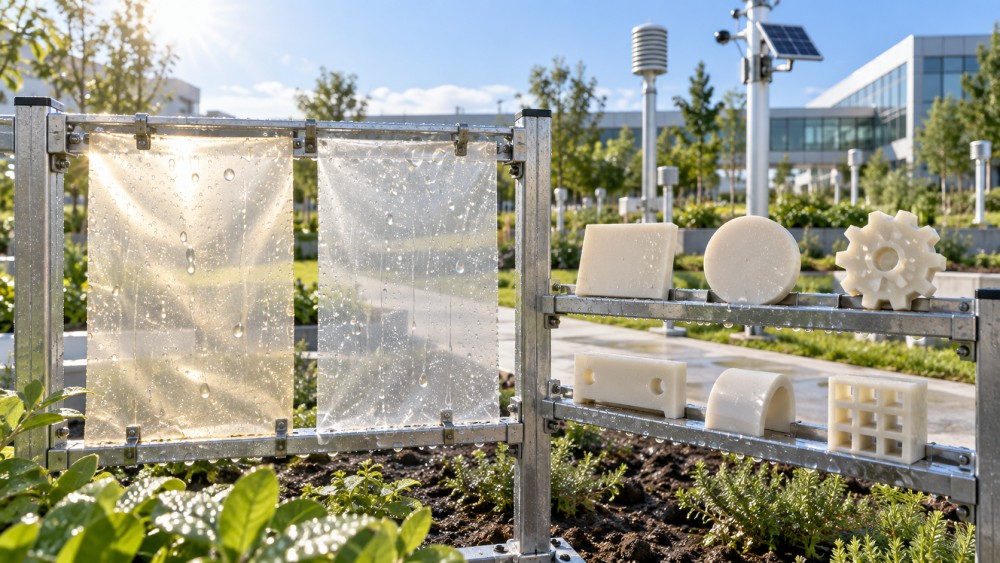
The central mistake is treating outdoor degradation as a single process. In service, a polymer may be affected by solar radiation, heat, moisture, oxygen, freeze-thaw cycles, abrasion, chemicals, and microorganisms at the same time. These mechanisms do not act equally on every material, and they do not necessarily produce visible breakdown at the same rate as loss of functional performance. A part can still look intact while its tensile strength, elongation, impact resistance, or dimensional stability has already changed beyond an acceptable limit.
Does “biopolymer” mean a material will break down outdoors?
No. “Biopolymer” is not a durability classification. It can refer to polymers made partly or fully from renewable feedstocks, polymers designed to biodegrade, or materials meeting both descriptions. These are different properties.
Bio-based polyethylene, bio-based PET, and certain bio-based polyamides can be selected for long-life applications and are not expected to biodegrade simply because they are derived partly from biomass. Their outdoor durability challenges are broadly similar to those of fossil-derived counterparts: UV oxidation, thermal exposure, stress cracking, moisture uptake, pigment stability, and additive depletion.
Other materials, including PLA, PHA-based materials, starch-containing blends, and some biodegradable polyester blends, may be more sensitive to the conditions that commonly occur outdoors. That does not mean each will degrade rapidly in every outdoor location. Their behavior depends on whether the specific environment supplies the temperature, water availability, microbial activity, and exposure duration needed to activate the relevant degradation pathways.
A compostability claim should therefore not be read as a prediction of performance in soil, freshwater, seawater, roadside exposure, agricultural fields, or open-air storage. Industrial composting is a managed system with controlled temperature, aeration, moisture, and biological activity. Outdoor environments are variable and frequently less favorable to the biological conversion assumed by compostability testing.
Why outdoor performance is often different from laboratory expectations
Laboratory testing is essential, but every test represents a defined set of conditions. An accelerated weathering result, a composting result, and a soil biodegradation result answer different questions. Problems arise when a result from one test is used as evidence for another exposure scenario.
For example, a resin may show satisfactory performance during short-duration UV exposure but fail after repeated wet-dry cycling. Another may hydrolyze when heat and moisture are present together, even though neither factor alone appears severe. A thin film may lose integrity quickly because its high surface-area-to-thickness ratio allows moisture and oxygen to affect much of the structure, while a thick molded component of the same resin may retain its core properties for far longer.
Outdoor conditions also vary sharply by location. A dark product in high solar exposure can reach a surface temperature substantially above ambient air temperature. In humid climates, hydrolysis and moisture-related dimensional changes can become important. In cold regions, freeze-thaw cycling can enlarge existing microcracks. In agricultural use, contact with fertilizer residues, soil moisture, mechanical damage, and microorganisms may create an exposure profile that is unlike standard outdoor weathering.
Which mechanisms cause premature failure?
UV-driven photo-oxidation is often the first concern for exposed polymer articles. Ultraviolet radiation can initiate chain scission or oxidation reactions, particularly when the formulation lacks an effective stabilizer system. The visible signs may include chalking, yellowing, surface cracking, loss of gloss, and color shift. More critical than appearance is the potential reduction in elongation at break and impact resistance. A brittle part can fail under loads that were acceptable when it was newly manufactured.
Hydrolysis matters for polymers with hydrolysis-sensitive chemical structures, especially when elevated temperature and moisture occur together. PLA is a commonly discussed example because water can contribute to molecular-weight reduction under suitable conditions. The practical effect depends on resin grade, crystallinity, part thickness, residual moisture, processing damage, and thermal history. A product that is dry in use may behave very differently from one exposed to rainwater, condensation, or repeated wash-down.
Microbial action is frequently misunderstood. Microorganisms do not automatically consume any material described as biodegradable. Biological degradation generally follows or accompanies physical and chemical changes that make polymer chains accessible. Soil composition, oxygen level, microbial population, temperature, and moisture all influence the process. A dry, cool, nutrient-poor soil is not equivalent to a warm, aerated composting environment.
Mechanical stress and design effects can turn moderate chemical aging into early product failure. Sharp corners, weld lines, thin sections, mounting holes, flex points, and residual molding stress create localized weak points. If UV exposure or hydrolysis lowers ductility, cracks often begin in these stressed regions rather than uniformly across the product. For outdoor components, material selection cannot be separated from geometry, joining method, and expected loading.
Formulation interactions also matter. Fillers, natural fibers, pigments, plasticizers, compatibilizers, flame retardants, and recycled content can alter weathering behavior. Natural-fiber reinforcement may improve stiffness but can introduce moisture sensitivity if interfacial adhesion and surface protection are not controlled. Dark pigments can raise surface temperature under sunlight. Some additive packages protect one property while changing another, such as transparency, color, food-contact compliance, or end-of-life behavior.
Can a material be too durable for its intended end-of-life route?
Yes. This is a genuine design trade-off rather than a simple material defect. A product intended for a short, controlled service period may need enough stabilization to survive distribution, storage, and use without becoming so resistant that it no longer behaves as intended in the designated recovery or treatment system.
That balance is particularly important for agricultural films, temporary protective products, outdoor packaging elements, horticultural items, and event-use articles. A material that fragments prematurely can create operational and environmental problems. Yet a highly stabilized material may not meet the intended biodegradation profile under the relevant disposal conditions. The correct target is not “fastest degradation”; it is predictable performance through the required service life, followed by behavior consistent with the actual end-of-life pathway.
This is also why generic claims about degradation periods are unreliable. A time-to-breakdown estimate without a defined exposure environment, thickness, color, product design, and performance criterion has little procurement or engineering value.
What should be measured besides visible disintegration?
Visible cracking or fragmentation is only one indicator. For functional outdoor products, the more useful question is whether the part continues to meet its required service properties. Depending on the application, that may include:
- tensile strength, elongation, tear resistance, or puncture resistance for films and flexible products;
- impact strength, flexural properties, creep resistance, and crack growth for molded parts;
- color change, gloss retention, haze, and surface chalking for visible components;
- water uptake, dimensional change, warpage, and seal integrity;
- barrier performance for packaging or protective layers;
- retained adhesion where coatings, labels, laminates, or bonded assemblies are involved.
For products expected to biodegrade, disintegration and biodegradation should also be distinguished. A material can fragment into smaller pieces without having undergone full biological conversion. Conversely, a product may lose mass or molecular weight before it visibly disappears. The relevant test method must match the claim being assessed.
How should outdoor durability be tested before commercial release?
A credible evaluation usually combines controlled aging with exposure conditions that resemble actual use. Accelerated weathering methods, such as those based on ASTM G154, ASTM G155, or ISO 4892 series procedures, can help compare formulations and identify UV-related sensitivity. They should not be used alone to declare an exact outdoor lifetime. Acceleration factors vary with material chemistry, specimen geometry, exposure cycle, and climate.
Where moisture sensitivity is relevant, testing should include humidity, immersion, condensation, or wet-dry cycling that reflects the product’s service condition. Thermal cycling is important when outdoor temperature swings are expected. Mechanical testing should be performed after aging rather than only before exposure, because the purpose is to identify retained functional performance.
For biodegradation claims, the test environment should be explicitly stated. Industrial composting standards and specifications, including ISO 14855 and ASTM D6400-related frameworks, address conditions that are not interchangeable with open-environment degradation. Soil-related methods, such as ISO 17556 or ASTM D5988, address different biological systems and still require careful interpretation. A supplier certificate is useful only when the tested article, thickness, formulation, pigment package, and intended disposal environment are relevant to the finished product.
Field exposure remains valuable when the application has a distinct environment that laboratory cycles cannot fully reproduce. It is especially useful for products exposed to soil contact, agricultural chemicals, standing water, high-altitude sunlight, coastal humidity, or repeated handling. Field trials should define pass/fail criteria before testing begins; otherwise, observations may become subjective after the fact.
What information should be requested from a material supplier?
A resin data sheet alone rarely answers the outdoor-use question. The commercial specification should identify the exact grade, intended processing route, recommended drying conditions, stabilization package where disclosure is possible, and any restrictions on colorants, fillers, regrind, or additive masterbatches. If outdoor performance is claimed, the relevant exposure method, duration, and property-retention criteria should be requested rather than a general statement that the material is “UV resistant” or “weatherable.”
For compounds and converted products, formulation control matters as much as base polymer selection. Changing pigment, filler level, recycled content, fiber source, film thickness, or extrusion temperature can alter performance. Material substitution should therefore be governed by a change-control process, particularly when the finished product has a defined service-life commitment or environmental claim.
Traceability is also important. Outdoor durability can be affected by batch variation in moisture content, molecular weight, additive dispersion, residual catalyst levels, or contamination. For biodegradable materials, uncontrolled process degradation during drying, extrusion, molding, or recycling can reduce molecular weight before the product ever reaches outdoor service.
When is a biopolymer a reasonable choice for outdoor use?
A biopolymer can be suitable when the required lifetime, exposure profile, product design, and end-of-life route have been defined together. Durable bio-based polymers are appropriate where renewable feedstock content is a priority but long service life is still required. Biodegradable polymers may be appropriate where a product has a short and clearly bounded use phase, where collection is impractical, and where the relevant end-of-life environment has been evaluated rather than assumed.
The key decision is not whether biopolymer materials degrade faster than expected in outdoor use in the abstract. It is whether a specific formulation will retain the necessary properties for a specific period under a defined exposure condition. A material label cannot answer that question. Exposure-relevant testing, controlled formulation, realistic product design, and precise claims can.
Have questions about this sector analysis, or seeking best practices specific to your niche? Drop us a line below and let the senior consultants at APIM assist you.
We respect your privacy. Your information is strictly confidential.
Related News
- 00
0000-00
How does washing affect contamination in post-consumer recycled PP resins? - 00
0000-00
How does feedstock affect depolymerization equipment selection? - 00
0000-00
US Sets 213.44% Preliminary Antidumping Deposit on Chinese PTMEG - 00
0000-00
When should epoxy be used as a thermal interface material for semiconductors? - 00
0000-00
US Midterm Results Unlikely to Quickly Shift Recycled Plastics Market or Legislation