




Are Biopolymer Materials Suitable for High-Temperature Sterilization?
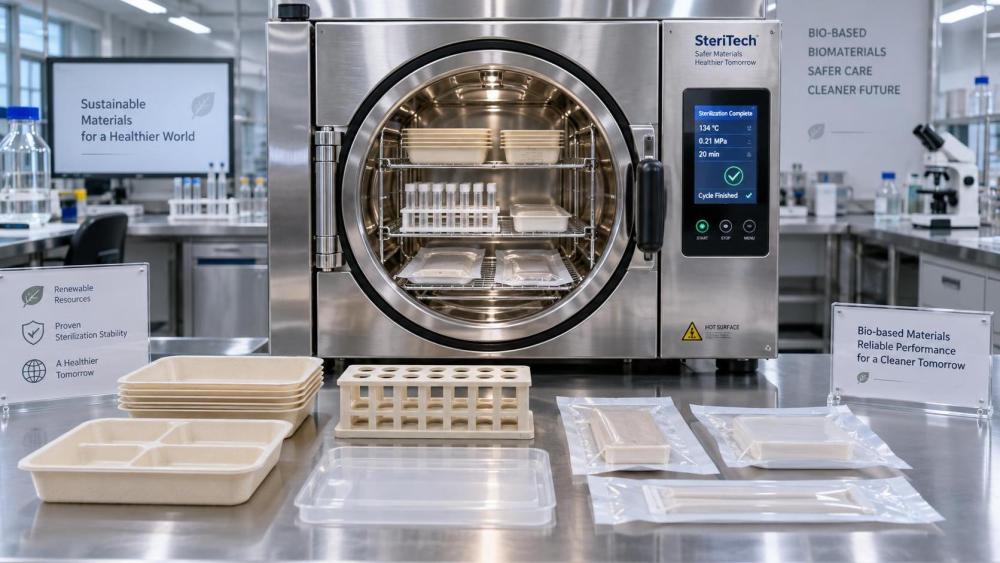
A sterilization cycle can turn an apparently suitable bio-based part into a rejected component: a tray warps after steam exposure, a molded instrument handle becomes brittle after repeated cycles, or a compostable package loses seal integrity before it reaches the filling line. In these situations, the question is not simply whether a material is “biopolymer” or “biodegradable.” The real question is whether its molecular structure, formulation, part design, and processing history can tolerate a specific sterilization method.
Are biopolymer materials suitable for high-temperature sterilization processes? Some are, but many commonly used biopolymers are not suitable for repeated high-temperature steam or dry-heat sterilization without modification. Materials must be evaluated against the actual cycle temperature, dwell time, humidity, pressure, cooling rate, chemical exposure, and required number of cycles. A material that survives one short cycle may still fail through hydrolysis, creep, discoloration, loss of impact strength, or dimensional change after repeated sterilization.
Start with the sterilization method, not the sustainability claim
“High-temperature sterilization” describes several very different environments. Steam autoclaving exposes a material to elevated temperature, pressurized water vapor, condensation, and often repeated heating and cooling. Dry heat avoids moisture but usually requires higher temperatures and longer dwell periods. Retort processing combines heat and pressure in a wet environment, while some industrial systems use heated chemicals, radiation, or vaporized sterilants instead.
That distinction matters because biopolymers tend to have different weaknesses. A polyester may retain its shape under dry heat but hydrolyze when exposed to hot steam. A starch-containing formulation may soften or absorb moisture well before the base resin reaches its theoretical thermal limit. A fiber-filled compound may resist deformation more effectively than the unfilled grade but develop surface cracking if the matrix loses toughness during cycling.
Before selecting a material, define the real service event in practical terms:
- Maximum sterilization temperature and tolerance around that setpoint.
- Time at peak temperature, including heat-up and cool-down phases.
- Steam, dry air, hot water, chemical vapor, or another exposure medium.
- Single-use sterilization before shipment or repeated sterilization during service.
- Part geometry, wall thickness, inserts, joints, seals, labels, and bonded areas.
- Required properties after treatment, such as load-bearing ability, clarity, barrier performance, flexibility, or dimensional accuracy.
A procurement specification that says only “autoclavable” leaves too much room for misunderstanding. The operating window should be written into the material and component requirements, because suitability is always conditional.
Why heat resistance alone does not answer the question
Datasheets often list melting temperature, glass-transition temperature, heat-deflection temperature, or continuous-use temperature. These values are useful starting points, but none independently proves sterilization resistance.
A polymer may have a melting point comfortably above the sterilization temperature and still deform because it becomes rubbery near or above its glass-transition range. In an autoclave, absorbed moisture can also plasticize the material, lowering stiffness while the component is under thermal stress. Thin sections may recover after cooling, while thicker sections cool unevenly and retain warpage. Clips, hinges, press-fit features, and threaded areas are especially vulnerable because they carry residual molding stress.
Moisture-driven degradation creates another gap between datasheet values and real performance. Hydrolysis can break polymer chains, reducing molecular weight and changing viscosity, toughness, elongation, and crack resistance. This is particularly relevant for hydrolysis-sensitive aliphatic polyesters. The component may look acceptable immediately after sterilization but become fragile during assembly, transport, or later use.
For packaging and films, the first visible defect may be curling, haze, delamination, or a weakened heat seal. In medical or laboratory parts, the more serious concern can be loss of fit, leakage at an interface, or an altered mechanical response after several cycles. These are component-level failures, so polymer selection must extend beyond a simple thermal number.
How common biopolymer families behave under high heat
Biopolymer is a broad category. It can refer to materials made from renewable feedstocks, biodegradable polymers, biologically produced polymers, or blends that combine these characteristics. Their sterilization performance differs widely.
PLA and many PLA-based compounds
Polylactic acid is widely used because it can be bio-based, processable, and suitable for many disposable products. Standard PLA, however, is generally a poor choice for conventional high-temperature steam sterilization. Its heat resistance is limited unless the grade is engineered through crystallization control, stereocomplex design, nucleating agents, mineral reinforcement, or other modifications.
Heat-treated or high-crystallinity PLA formulations can show improved resistance to deformation, but their performance still depends on moisture exposure, actual cycle conditions, and part stress. Increased crystallinity may improve thermal stability while reducing transparency or changing impact behavior. A clear disposable item and a rigid opaque component may therefore require very different material approaches even when both begin with PLA chemistry.
PHA materials
Polyhydroxyalkanoates include multiple polymer types with different behavior. Some grades are relatively soft or thermally sensitive, while others can offer better heat resistance when formulated appropriately. Processing stability must be considered carefully because certain PHA materials have a narrow window between useful melt processing and thermal degradation.
For high-temperature sterilization, PHA should not be assumed suitable merely because it is bio-based or biodegradable. The grade, stabilizer package, crystallinity, and sterilization method require review. It may be more appropriate for lower-temperature processes, controlled short exposures, or applications where a sterilization alternative is possible.
Cellulose-based materials and regenerated cellulose
Cellulose-derived materials can perform well in selected packaging, membrane, coating, and fiber applications, but their response to heat and moisture depends heavily on plasticizers, coatings, lamination structure, and fiber orientation. Moisture uptake may affect dimensions and mechanical behavior. A cellulose-based substrate may survive thermal exposure while an adhesive layer, coating, or barrier layer fails first.
For multilayer systems, every layer must be assessed. Sterilization compatibility belongs to the complete construction, not just the headline material.
Bio-based but non-biodegradable engineering polymers
Some polymers are derived partly or fully from renewable feedstocks while retaining the chemistry of established engineering resins. Bio-based polyamides, certain bio-based polyesters, and other durable engineering materials may offer substantially better thermal performance than compostable polymers. Yet they still need method-specific evaluation. Polyamides, for example, can be strong and heat-resistant but may absorb moisture, affecting dimensions and mechanical performance during steam exposure.
Where repeated autoclaving is required, a higher-performance engineering polymer may be more realistic than a biodegradable resin. This does not negate sustainability goals; it redirects them toward renewable feedstock content, lower-impact production, durability, reuse, or end-of-life design that matches the application.
Match the material to the cycle it must survive
The table is not a material approval guide. It is a way to identify failure mechanisms before they become production issues. Steam is often the most demanding route for biodegradable or moisture-sensitive polymers because temperature and water act together. Dry heat may remove the hydrolysis concern but can exceed the thermal capability of many bio-based resins. Where the product function permits it, a lower-temperature sterilization method may expand the range of usable biopolymer options.
A practical evaluation route before committing to a grade
Start with the finished component rather than testing pellets alone. Resin-level data is useful for screening, but the final item includes orientation from molding or extrusion, residual stress, colorants, fillers, weld lines, coatings, adhesives, and assembled features. Each can affect sterilization performance.
- Define acceptance criteria before testing. Decide which properties matter after sterilization: dimensions, burst resistance, tensile strength, impact resistance, seal performance, visual appearance, odor, transparency, or functional fit. “No obvious damage” is not an adequate criterion for critical applications.
- Use the intended cycle. Replicate the actual temperature, dwell time, moisture level, drying phase, and cooling profile as closely as possible. A simplified heat exposure can miss steam-driven hydrolysis or deformation caused by pressure.
- Test the expected number of cycles. Single-use items may only need to withstand one validated process. Reusable components should be evaluated after the maximum anticipated number of cycles, with interim observations because deterioration may be gradual.
- Inspect high-stress features. Measure snap fits, thin walls, openings, sealing surfaces, threaded sections, and areas around inserts. These regions commonly show distortion before the broader part fails.
- Compare before-and-after behavior. Look for changes in mass, color, gloss, haze, stiffness, cracking, deformation, leakage, or assembly force. Where the application demands it, mechanical and chemical characterization should be specified rather than relying only on visual inspection.
- Review manufacturing variability. Drying conditions, melt temperature, residence time, cooling rate, and regrind use can alter molecular weight and crystallinity. A favorable result from one molded sample does not guarantee stable production performance.
Formulation can help, but it can also introduce new trade-offs
Material modification is often considered when a standard grade cannot survive the target cycle. Crystallization promoters, chain extenders, stabilizers, mineral fillers, natural fibers, glass fibers, and blend partners can improve heat resistance or reduce shrinkage. However, these changes may influence flow behavior, surface quality, impact strength, compostability, recyclability, food-contact suitability, or color consistency.
Reinforcement can improve stiffness at elevated temperature, but it does not automatically prevent chemical degradation of the polymer matrix. A filled part may retain its basic shape while becoming more brittle. Similarly, a stabilizer package can improve processing and thermal aging but must be compatible with the intended sterilization route and end-use requirements.
Do not assume that a material described as “heat resistant” will perform identically across processing methods. Injection molding, thermoforming, film extrusion, and additive manufacturing create different morphology and stress patterns. An extruded sheet may respond differently from an injection-molded cap made from the same nominal compound.
When a biopolymer is a reasonable choice
Biopolymer materials can be appropriate where the sterilization process is moderate, exposure is brief, the product is single use, and the selected grade has been verified in the final construction. They can also be viable when the design allows thicker or more stable sections, when tight tolerances are not critical, or when a lower-temperature sterilization approach is available.
They become a more difficult choice when the product must undergo repeated steam autoclave cycles, maintain precision dimensions, retain high impact strength, remain optically clear, or preserve a demanding barrier and seal structure. In those conditions, material teams should compare engineered bio-based alternatives, revised sterilization methods, and product redesign options rather than forcing a standard biodegradable resin into an unsuitable duty cycle.
The useful decision is not “biopolymer versus conventional polymer.” It is whether a defined material grade, processed into a defined component, retains the required properties after the exact sterilization exposure it will face. That is the level at which suitability can be established responsibly.
Have questions about this sector analysis, or seeking best practices specific to your niche? Drop us a line below and let the senior consultants at APIM assist you.
We respect your privacy. Your information is strictly confidential.
Related News
- 00
0000-00
Do polyolefin hot melt adhesives bond well to polyethylene? - 00
0000-00
Korean Study Finds PLA Barely Degrades in Landfill After 320 Days - 00
0000-00
How to assess batch consistency from a thermal potting compounds supplier - 00
0000-00
How much weight can carbon fiber reinforced plastics save in cars? - 00
0000-00
Switching from PS to ABS Sheet Extrusion: Equipment Checks