




Are Biodegradable Polymers Safe to Compost Only in Industrial Facilities?
As sustainability claims reshape material selection, manufacturers and packaging teams need to ask a more precise question than “Is this material biodegradable?” The practical question is: is it safe to compost biodegradable polymers in industrial facilities only, or can the same product break down responsibly in a backyard compost bin, soil, or the natural environment?
The short answer is that many biodegradable polymer products are designed for industrial composting and should not be assumed to compost effectively anywhere else. This is especially relevant for packaging made from PLA, PBAT blends, starch-based compounds, and multilayer bio-based structures. Their end-of-life performance depends on chemistry, thickness, additives, inks, adhesives, collection systems, and the actual operating conditions of the composting site.
“Industrial compostable” is not a warning label in itself. It means the material has been evaluated for a controlled waste-treatment route. But it also means a brand or converter should not imply that the item will disappear harmlessly in a garden, a roadside ditch, or a mixed recycling stream. Those are very different environments.
Industrial composting is a controlled process, not simply a larger compost pile
Industrial composting facilities manage temperature, oxygen, moisture, microbial activity, turning frequency, and residence time. Those conditions accelerate the breakdown of organic waste and certain certified compostable materials. A facility may also grind or shred incoming material, which increases surface area and makes degradation more predictable.
That matters because many polymer structures do not begin to hydrolyze or fragment at a meaningful rate until they encounter sustained heat and moisture. PLA is the familiar example. It is bio-based in many formulations, but “bio-based” does not automatically mean “home compostable.” In ordinary outdoor compost, temperatures may fluctuate widely and remain too low for long periods. A PLA cup or thick thermoformed tray may therefore remain visibly intact far longer than consumers expect.
PBAT is often blended with PLA or starch to improve flexibility and toughness in compostable films and bags. It can help make a material more workable for blown-film extrusion, sealing, and converting, but its presence does not remove the need to assess the finished article. A thin produce bag, a coated paper pack, and a rigid injection-molded item do not behave the same way simply because they share a biodegradable resin family.
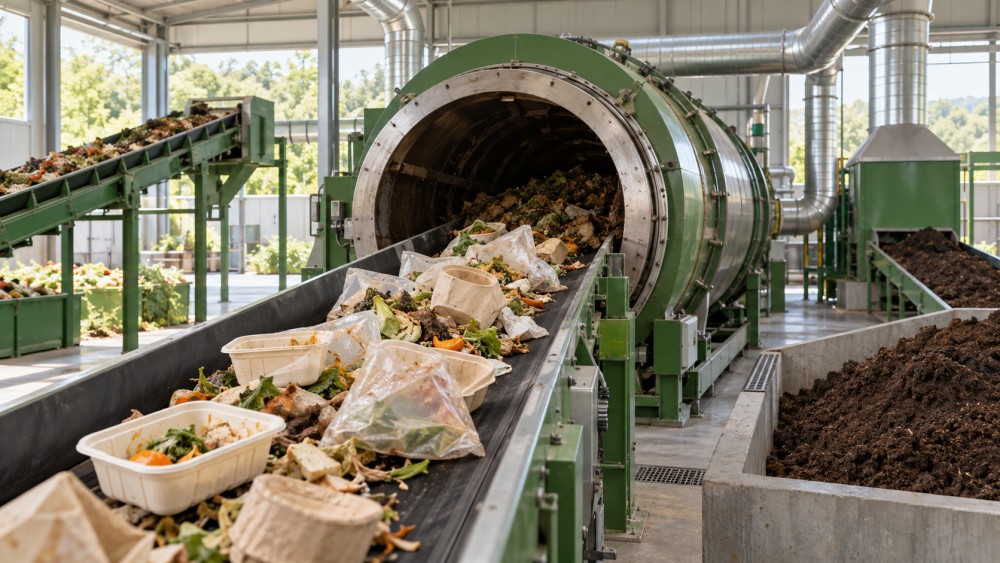
For this reason, the phrase “industrial compostable” should be read as a system claim: the product is intended to enter a specific managed process. It is not a general statement that the material is safe to discard in any natural setting.
Is industrial-only composting safe? Usually yes—if the material and the facility are matched
Composting a suitable biodegradable polymer in an industrial facility is generally an appropriate end-of-life option when three conditions are met. First, the product needs to be designed and certified for industrial composting under the relevant market requirements. Second, the local facility must actually accept compostable packaging or food-service items. Third, the item must reach that facility through a collection route that avoids contamination and sorting losses.
The overlooked point is the middle one. Certification and acceptance are not identical. A compostability certification may show that a material has met a defined test framework, often referenced through standards such as EN 13432 in Europe or ASTM D6400 in the United States. Yet a composting operator may still reject compostable plastics because its process cycle is short, its screening equipment removes film-like materials, or it has experienced contamination from conventional plastic lookalikes.
In practice, operators are concerned with what arrives at the gate, not just what appears on a datasheet. If compostable and conventional bags are visually indistinguishable, sorting crews may remove both. If a cup includes a non-compostable lid, pressure-sensitive label, barrier coating, or adhesive, the whole assembly can become problematic. Material selection decisions made in the resin stage can therefore be undermined later by printing, lamination, closure design, or retail handling.
Why home composting is a different claim
Home composting is less consistent by nature. One household may maintain an active, well-balanced bin with regular turning and abundant green waste. Another may have a cool pile that is dry in summer, wet in winter, and rarely disturbed. The temperature profile, microbial population, and decomposition time can vary sharply even within the same neighborhood.
That variation is why a material intended for industrial composting should not be marketed as suitable for backyard composting unless the finished product has been assessed for that separate condition. The distinction is particularly important for thicker items: cutlery, coffee capsules, molded fiber products with polymer coatings, trays, and durable-looking food-service ware. A thin film may eventually fragment in a home compost setting, while a thicker article from the same formulation may persist.
There is also a practical safety issue. Consumers may interpret “biodegradable” as permission to litter. That is not an acceptable end-of-life route. Degradation in soil, freshwater, or marine environments follows different pathways and timescales from composting. A compostability claim should never be used to suggest that uncontrolled disposal has no environmental consequence.
The word “biodegradable” does not answer the disposal question
In procurement discussions, biodegradable is often treated as a single performance category. It is not. It describes a broad concept: microorganisms can convert a material under certain conditions. The missing details are always the important ones: which microorganisms, under what temperature, with how much moisture and oxygen, over what period, and what remains afterward?
A material can also be biodegradable without being compostable under a recognized composting framework. Conversely, a certified compostable article may be a poor fit for a market where organic-waste collection is limited and the default disposal route is landfill or incineration. The material property and the local waste system need to be considered together.
Product design can decide whether compostability survives conversion
For converters and product developers, the resin grade is only the starting point. Compostable packaging often includes pigments, slip agents, mineral fillers, inks, coatings, primers, labels, tie layers, and adhesives. Each addition can affect processing stability, sealing behavior, shelf performance, and end-of-life assessment.
A flexible package is a useful example. The brand may select a compostable film, but then request higher oxygen barrier, stronger puncture resistance, high-speed form-fill-seal performance, and sharper print quality. Those requirements can lead to multilayer structures or functional coatings. That does not automatically make the package unsuitable, but it does mean the claim must apply to the final converted structure—not merely to the base polymer.
The same discipline applies to industrial adhesives. A compostable substrate bonded with an unsuitable label adhesive, laminate adhesive, or heat-seal layer may no longer support the intended disposal route. This is one reason experienced materials teams review the bill of materials early, before a packaging concept is approved for pilot production.
Processing also matters. Extrusion temperature, residence time, drying conditions, melt filtration, and regrind policy can influence molecular weight and final performance in biodegradable compounds. If the material is degraded during compounding or film extrusion, the product may lose strength before it reaches the user. If it is processed too conservatively, the converter may face unstable output or poor dispersion. End-of-life messaging cannot compensate for weak process control.
Questions a buyer should ask before specifying a compostable polymer
The most responsible choice is not always the polymer with the strongest sustainability language. It is the one that fits the product’s use phase and the waste route that is genuinely available. Before approving a compostable material, procurement and R&D teams should clarify several points:
- What is the intended disposal route in the markets where the product will actually be sold?
- Does the relevant local composting infrastructure accept this category of item, not just food waste?
- Does the claim apply to the completed article, including inks, adhesives, coatings, and accessories?
- Can the product be clearly identified so that consumers and waste handlers do not confuse it with conventional plastic?
- Would a recyclable mono-material design be more practical for this application and region?
These questions are especially important for food-contaminated packaging. Compostable formats can make sense where food-soiled items are collected with organics and where separating food residue from packaging is unrealistic. In a clean, high-volume packaging application with a reliable recycling stream, a recyclable structure may be the more sensible option. There is no universal winner between compostability and recyclability.
A practical way to communicate the claim
Clear disposal language is part of product engineering. “Compostable where accepted” is more honest than a broad biodegradable claim when access to facilities varies. On-pack instructions should avoid implying that home composting is suitable unless that claim has been specifically validated. Brands should also avoid visual cues that resemble conventional recyclable packaging if this creates sorting confusion.
For global supply chains, regional variation deserves attention. A package developed for a market with mature organics collection may be exported into a market where no facility accepts it. The same SKU may then be disposed of through a completely different route. Material specifications, labeling, and launch plans need to account for this rather than treating end-of-life as a marketing footnote.
For material buyers, converters, and product teams following developments in PLA, PBAT, recycled polymers, specialty films, and compounding technology, the useful approach is to connect material performance with disposal reality. A biodegradable polymer can be safe and appropriate for industrial composting, but only when the finished product, local acceptance rules, and collection system point to the same destination. If that route does not exist, the sustainability claim may be technically correct yet operationally incomplete.
Have questions about this sector analysis, or seeking best practices specific to your niche? Drop us a line below and let the senior consultants at APIM assist you.
We respect your privacy. Your information is strictly confidential.
Related News
- 00
0000-00
Do polyolefin hot melt adhesives bond well to polyethylene? - 00
0000-00
Korean Study Finds PLA Barely Degrades in Landfill After 320 Days - 00
0000-00
How to assess batch consistency from a thermal potting compounds supplier - 00
0000-00
How much weight can carbon fiber reinforced plastics save in cars? - 00
0000-00
Switching from PS to ABS Sheet Extrusion: Equipment Checks