




Recycled injection moulding compound can reduce material cost and support sustainability targets, but quality risks rise when feedstock, formulation, handling, and processing controls are weak.
For quality and safety teams, the central question is not whether recycled content is acceptable, but whether its variation remains within validated performance limits.
This article explains when recycled material becomes a part-quality risk, which failures to expect, and how manufacturers can establish practical acceptance controls.
Recycled Content Is Not Automatically a Quality Problem
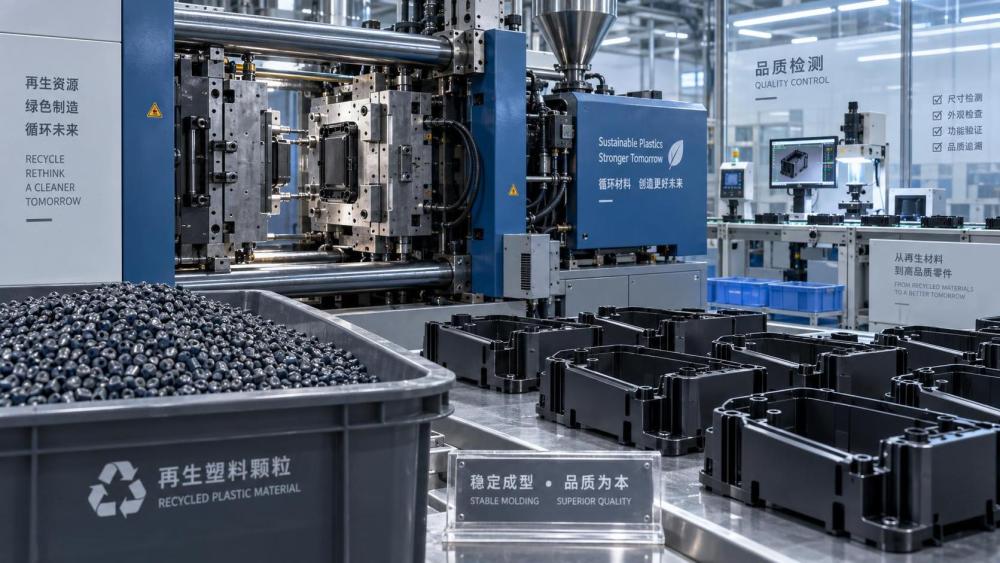
Recycled content does not automatically create defective moulded parts. Well-characterized recycled injection moulding compound can perform reliably when its source, processing history, and formulation are controlled.
The risk begins when recycled material is treated as interchangeable with virgin resin without reviewing its melt behavior, contamination profile, moisture condition, or mechanical property retention.
Quality impact depends on the polymer family, recycled-content percentage, application severity, part geometry, processing window, and the degree of supplier process control.
A recycled PP housing may tolerate broader variability than a glass-fibre reinforced PA connector, a flame-retardant electrical enclosure, or a safety-relevant automotive component.
Therefore, quality teams should assess recycled compound against the functional requirements of the finished part, rather than applying one general approval rule across products.
The most reliable approach is to define measurable material and part criteria before production approval, then monitor whether recycled batches continue to meet them consistently.
When Material Variation Starts Affecting Moulded Part Quality
Part quality becomes vulnerable when batch-to-batch variation exceeds the validated process window. Small material differences can become visible defects or functional failures during injection moulding.
Melt flow rate variation is often an early warning signal. It can change filling behavior, injection pressure, weld-line strength, packing response, and the appearance of surfaces.
If melt viscosity drops after repeated thermal histories, the compound may fill thin sections more easily but provide lower impact resistance or reduced long-term durability.
If viscosity increases unexpectedly, operators may compensate with higher temperatures or pressures, increasing cycle variation, flash risk, internal stress, and potential polymer degradation.
Recycled injection moulding compound may also show wider shrinkage variation than virgin grades. This becomes important for parts with tight dimensions, snap fits, inserts, sealing features, or assemblies.
Warpage risk increases when the recycled stream changes filler level, fibre length, moisture condition, pigment loading, or crystalline structure from one delivery to another.
For quality personnel, repeated machine adjustments are an important signal. A material that requires changing settings every batch may not be stable enough for critical production.
Contamination Can Create Defects That Routine Settings Cannot Fix
Contamination is one of the most serious risks in recycled polymers because it may create cosmetic, mechanical, safety, and processing problems simultaneously.
Foreign polymers can be incompatible with the main resin. During melting, they may form weak domains, gels, streaks, delamination, black specks, or brittle fracture points.
For example, small amounts of PVC in recycled PET can degrade under processing heat, while incompatible polyolefins can reduce clarity and mechanical consistency.
Metal, paper, wood, dust, labels, adhesives, and residual packaging contents can also enter recycled streams when sorting, washing, or filtration are inadequate.
These contaminants may block gates, damage screws, create burn marks, weaken thin walls, or cause visible defects that lead to customer complaints and excessive scrap.
Contamination is particularly concerning for electrical, food-contact, medical, child-use, and flame-retardant applications, where traceability and regulatory status matter alongside appearance.
A quality plan should define acceptable contamination limits, inspection methods, screen-pack requirements, and escalation actions when abnormal particles or surface defects are detected.
Moisture and Thermal Degradation Often Cause Hidden Failures
Moisture control is essential for hygroscopic polymers such as PA, PET, PBT, PC, TPU, and certain recycled blends containing these materials.
Excess moisture can cause hydrolysis during melting. The resulting molecular-weight reduction may not always be obvious visually, yet it can weaken the finished part.
Typical warning signs include silver streaks, splay, bubbles, poor gloss, brittle fracture, lower impact strength, inconsistent viscosity, and unusually high volatile emissions.
Recycled feedstock may absorb more moisture because of storage conditions, washing processes, exposed regrind, damaged packaging, or a larger surface area than virgin pellets.
Drying settings should be based on polymer requirements and verified with moisture measurement, rather than relying only on dryer temperature displays or standard operating habits.
Thermal degradation is another concern because recycled polymer has already experienced at least one heat history. Repeated processing can shorten molecular chains and consume stabilizers.
High barrel temperatures, excessive residence time, poor purging, and repeated regrinding can intensify degradation, especially when recycled content is already close to its performance limit.
Where degradation risk is meaningful, teams should monitor melt flow, color shift, odor, mechanical properties, and material-specific indicators such as intrinsic viscosity for PET.
Mechanical Performance Can Change Before Visual Quality Does
A part can look acceptable while its functional performance has declined. This is why visual inspection alone is not sufficient for recycled compound approval.
Tensile strength, elongation, impact resistance, fatigue life, creep resistance, and stress-crack resistance can change when molecular weight or formulation consistency changes.
Impact performance is often especially sensitive. A recycled compound may retain tensile strength while becoming less ductile and more likely to crack under sudden loading.
Fibre-reinforced compounds require additional attention because recycling can shorten glass or carbon fibres, reducing reinforcement efficiency and changing directional shrinkage behavior.
Shorter fibres may also affect screw wear, surface appearance, weld-line strength, and the ability of a moulded part to meet stiffness requirements.
For safety-relevant parts, validate recycled-content levels through part-specific testing rather than relying only on a compound datasheet generated under different conditions.
Examples include drop testing, torque testing, pressure cycling, clip retention, vibration exposure, thermal aging, chemical resistance, and assembly load validation.
Appearance Problems Matter When Parts Are Customer-Facing
Surface quality becomes more difficult to control when recycled streams include mixed colors, degraded pigments, inconsistent fillers, or residual contamination from earlier applications.
Common defects include color variation, black specks, flow marks, gloss inconsistency, streaking, haze, sink visibility, plate-out, and uneven texture replication.
These defects may be tolerable for hidden industrial components but unacceptable for consumer products, automotive interiors, appliances, electronics housings, and decorative packaging components.
Dark colors can hide certain visual defects, but they do not resolve underlying contamination or degradation issues. Appearance masking should never replace material qualification.
When color consistency is critical, establish approved masterbatch systems, reference plaques, color-difference limits, lighting conditions, and a clear disposition process for suspect batches.
Surface defects should also be reviewed alongside process data. A sudden increase in specks or streaks may indicate an upstream material-control problem rather than operator error.
Flame Retardancy, Chemical Compliance, and Safety Need Separate Review
Safety managers should apply greater caution when recycled injection moulding compound is used in regulated or performance-critical applications.
Flame-retardant compounds may lose consistency if recycled material contains incompatible grades, altered additive levels, or contamination that affects the intended fire-performance mechanism.
Reprocessing can also influence additive distribution and thermal stability. A previous UL rating cannot automatically be assumed to cover a new recycled-content formulation.
For electrical components, reduced tracking resistance, insulation performance, glow-wire behavior, or dimensional stability can create risks that ordinary visual inspection will not reveal.
Chemical compliance requires documented evidence. Recycled streams may contain legacy substances, restricted pigments, plasticizers, metals, or additives that are absent from virgin material.
Relevant controls may include supplier declarations, restricted-substance testing, traceability records, incoming certificates, and periodic third-party verification based on product risk.
Food-contact, medical, and potable-water applications require particularly careful review because regulatory acceptance depends on jurisdiction, material source, contamination control, and intended use.
How Quality Teams Should Qualify a Recycled Compound
Qualification should start by defining what the part must do in service. Material approval without a clear part-performance specification creates avoidable uncertainty.
Document the critical-to-quality characteristics, including dimensions, load requirements, impact behavior, appearance, flammability, chemical exposure, temperature range, and required certifications.
Next, request detailed supplier information covering polymer origin, recycled-content percentage, post-industrial or post-consumer source, compounding process, additives, and batch traceability.
Material specifications should include practical control ranges for melt flow rate, moisture, density, ash content, color, contamination, filler level, and relevant mechanical properties.
Run controlled moulding trials using the intended production tool, machine, cycle time, color, and expected process limits. Laboratory specimens alone may not expose all risks.
Compare virgin and recycled formulations under normal and challenging conditions, including lower and higher barrel temperatures, short interruptions, drying variation, and realistic regrind usage.
Approval should include first-article measurements, functional testing, appearance review, process capability analysis, and a documented limit for permitted recycled-content percentage.
Where the part is critical, use a formal change-control process. Any change in supplier, feedstock source, formulation, recycling route, or percentage should trigger review.
Incoming Inspection Should Focus on Meaningful Signals
Incoming inspection should be risk-based. Testing every possible parameter is inefficient, but ignoring the variables that drive failure creates false confidence.
For many compounds, useful routine checks include pellet appearance, moisture content, melt flow rate, color, bulk density, contamination screening, and certificate-of-analysis verification.
For reinforced grades, ash content or fibre-related measurements can help confirm formulation consistency. For critical applications, retain samples from every approved batch.
Set alert limits before specification limits are exceeded. This gives quality and production teams time to investigate trends before defective parts are produced.
Supplier certificates should support, not replace, verification. A certificate may not capture damage caused during transport, storage, incorrect drying, or accidental material mixing on site.
Warehouse controls matter as much as laboratory controls. Use clear identification, sealed packaging, first-in-first-out handling, segregated storage, and verified drying procedures.
Process Controls Can Reduce Risk but Cannot Rescue Poor Material
Stable injection moulding settings can reduce the effect of normal material variation, but process adjustments cannot reliably correct severe contamination or degraded polymer.
Establish validated ranges for barrel temperature, back pressure, screw speed, cushion, injection speed, holding pressure, mold temperature, cooling time, and residence time.
Monitor machine data for trends instead of relying only on final inspection. Changes in peak pressure, fill time, transfer position, recovery time, or cushion can reveal instability.
Use material-change procedures that prevent mixing with unapproved grades. Purging, hopper cleaning, dryer cleaning, and label verification are basic but highly effective controls.
Regrind should be treated separately from externally sourced recycled resin. Its source, number of heat histories, contamination exposure, and permitted percentage must be controlled.
When operators need repeated intervention to maintain dimensions or appearance, stop treating the issue as a machine problem until material variability has been investigated.
When Recycled Material Is Suitable and When It Is Not
Recycled compound is often suitable for non-visible, non-safety-critical parts with broad dimensional tolerances, moderate loads, stable service temperatures, and well-controlled material sources.
It can also be appropriate for demanding applications when the compound is purpose-designed, consistently produced, thoroughly tested, and supported by strong supplier documentation.
Higher caution is justified for thin-wall parts, clear components, high-gloss surfaces, precision assemblies, structural clips, pressure-containing components, and harsh chemical environments.
It may be unsuitable without extensive validation for life-safety functions, highly regulated applications, or components where a hidden property loss could cause serious injury or failure.
The decision should be based on risk, evidence, and control capability. Sustainability targets are important, but they should not override validated performance requirements.
Conclusion: Control the Compound, Not Just the Recycled Percentage
Recycled injection moulding compound affects part quality when its variability exceeds what the material specification, moulding process, or part design can tolerate.
The most common drivers are contamination, moisture, thermal degradation, inconsistent viscosity, altered additives, filler variation, and insufficient traceability across the recycling supply chain.
Quality and safety teams should focus on application-specific qualification, meaningful incoming checks, controlled drying, process monitoring, functional testing, and disciplined change management.
With these controls, recycled content can support circular-material goals without compromising reliable moulded-part performance. Without them, apparent cost savings can become scrap, recalls, and compliance risk.