




What Causes Black Spots in Plastic Pellets and How Can They Be Fixed?
Black spots in plastic pellets are rarely just a cosmetic issue. They can indicate degraded polymer, foreign contamination, carbonized material releasing from the extruder, or a filtration problem. In recycled compounds and filled formulations, they may also reveal inconsistent feedstock or poor dispersion. The right fix depends on where the defect begins, so changing the temperature profile or adding more screen packs without diagnosis can waste material and create a recurring problem.
When investigating what causes black spots in plastic pelletizing and how to fix it, start by separating two questions: are the spots already present in the incoming material, or are they being created inside the melt-processing line? That distinction usually determines the next action.
What do black spots in pellets usually mean?
A black spot is generally a small particle that absorbs or blocks light more strongly than the surrounding polymer. It may be charred resin, degraded additive, metal-scale contamination, paper or wood fiber from recycled feedstock, a crosslinked gel, or residue from an earlier production run.
The visual result may look similar, but the production risk is different. A dark particle in a black masterbatch may be commercially acceptable while still causing filter pressure instability. The same particle in natural PP, clear PET, white polyamide, film-grade resin, or an electrical component compound may lead to immediate rejection. For products requiring a clean surface, thin-wall molding, film extrusion, optical performance, or reliable insulation, even occasional black specks can become a serious downstream defect.
The first useful observation is the defect pattern:
Thermal degradation and carbonized deposits
Overheating is one of the most common explanations, but the set temperature alone is not enough to prove it. Polymer degradation is driven by the material’s total thermal history: temperature, residence time, shear, oxygen exposure, moisture, and the length of time material remains trapped in low-flow areas.
When resin remains in a dead zone around a screw, adaptor, die, melt pump, screen changer, or valve, it can stay in the machine much longer than the main melt stream. That trapped material may darken, carbonize, and later detach as black particles. This explains a familiar pattern: pellets look acceptable for a period, then specks suddenly appear even though operators have not changed the recipe.
High screw speed can also be misleading. It may reduce average residence time, but excessive shear can create local heat and accelerate degradation. Conversely, a low output rate with high barrel temperatures can leave material in the extruder too long. A stable pelletizing process needs the temperature profile, screw speed, throughput, and pressure condition to work together.
How to correct a degradation-related defect
- Compare actual melt temperature with the resin supplier’s recommended processing range rather than relying only on barrel-zone settings.
- Check whether output has fallen while temperatures and screw speed remain unchanged. Reduced throughput often increases residence time.
- Inspect adaptors, die holes, screen changers, melt pumps, and vent zones for deposits or stagnant material.
- Use a compatible purge procedure during grade, color, or polymer changes, then remove and clean components when persistent residue is suspected.
- Review the screw design for the formulation. A screw that is suitable for a simple virgin resin may not provide the same thermal control or dispersion for a filled, flame-retardant, or recycled compound.
Do not respond to every black-speck problem by reducing all barrel temperatures. If the melt becomes too viscous, pressure can rise, dispersion can worsen, and stagnant zones may become more severe. Temperature changes should be tied to evidence from melt temperature, pressure trend, output stability, and material condition.
Contaminated raw materials and poor handling practices
Black spots can originate before the polymer reaches the extruder. This is particularly common with post-industrial and post-consumer recycled materials, regrind, loose powders, fillers, and compounds handled through shared conveying systems. A small amount of dark polymer, burnt regrind, dust, wood, paper, metal fines, packaging fragments, or residue from a previous batch can remain visible after pelletizing.
Incoming material inspection matters because the pelletizing line cannot fully repair poor feedstock. Melt filtration can capture some contaminants, but it cannot restore a degraded polymer particle to its original properties. If the source material contains heavily burnt pieces or incompatible plastics, those defects may remain as black specks, gels, unmelted particles, odor, unstable melt flow, or weak spots in the finished product.
Moisture is another indirect contributor. Hygroscopic materials such as PET, polyamide, PBT, TPU, and some recycled streams can degrade during processing when drying is inadequate. The defect may not always appear as a neat black dot; it can present as discoloration, brittle pellets, splay in molded parts, viscosity loss, or deposits that later become black particles.
Raw-material checks that prevent repeat defects
- Inspect representative material samples before production, including regrind and minor additives, not only the main resin.
- Keep natural and colored materials physically separated in storage, transfer lines, hoppers, and containers.
- Clean shared conveying equipment between materials, especially after black, carbon-filled, flame-retardant, or highly pigmented compounds.
- Control drying conditions for moisture-sensitive resins and avoid returning questionable startup scrap directly into a clean production stream.
- For recycled feedstock, establish realistic acceptance criteria for contamination, odor, color variation, and pellet consistency before it enters a high-appearance application.
Recycled content does not automatically cause black specks. Well-sorted, well-washed, properly filtered recycled polymer can process consistently. The higher risk comes from variable input streams, inadequate separation, uncontrolled regrind ratios, and repeated thermal exposure.
Filtration problems: when the screen pack is not the real answer
A screen pack, breaker plate, or continuous screen changer is often the final barrier before the die. If black contaminants pass through, filtration may be too coarse, damaged, bypassed, incorrectly assembled, or overwhelmed by the contamination load. A worn seal or poorly seated screen can create a path around the intended filtration media.
However, installing finer screens is not always the best correction. A tighter filtration setup can increase pressure, heat generation, and residence time. In a sensitive formulation, that may create more degradation upstream. The appropriate filtration level depends on resin viscosity, filler content, output target, allowable pressure, die requirements, and the cleanliness demanded by the final application.
Track pressure behavior rather than treating the screen as a static component. A gradual pressure rise is expected as a filter collects material. Sudden pressure shifts, unstable output, or repeated black specks after screen changes can point to an installation issue, contaminant surges, or deposits elsewhere in the melt path.
Equipment areas that are easy to overlook
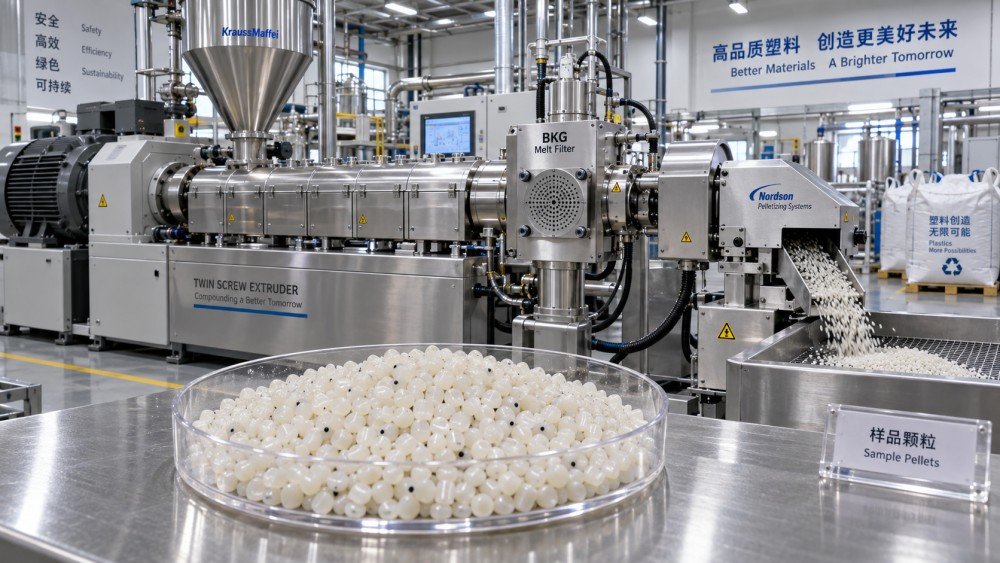
Persistent black spots often survive routine cleaning because the problem sits outside the most visible parts of the pelletizing line. Inspect the entire material path: loader, hopper, feed throat, side feeder, screw elements, vent area, melt pump, screen changer, adaptor, die, cooling water, cutter, and collection system.
For strand pelletizing, damaged strands can collect debris from dirty water baths, guides, or cutters. This does not normally create carbonized particles inside the pellet, but it can contaminate surfaces and make the defect appear to be a resin problem. Underwater pelletizing has different checks: die-face cleanliness, water-loop filtration, cutting chamber condition, and the removal of degraded material around the die face all matter.
In twin-screw compounding, poorly dispersed pigments, carbon black, flame retardants, mineral fillers, or recycled fractions can also resemble contamination. The issue may be a mixing problem rather than a cleanliness problem. If dark particles are consistently similar in size and correlate with a particular additive feed, examine feeder accuracy, additive form, feeding point, and the distribution of kneading and conveying elements.
A practical troubleshooting sequence
A disciplined sequence prevents teams from changing five variables at once and losing the evidence needed to find the cause.
- Contain the affected material. Separate suspect pellets by production time, line, formulation, and raw-material lot. This makes patterns visible and prevents questionable material from being mixed into accepted inventory.
- Inspect the spots. Note whether they are embedded, surface-level, hard, soft, streak-like, or associated with gels. Compare early, middle, and late production samples.
- Review the process record. Look at temperature, melt pressure, motor load, output, feeder settings, vacuum condition, screen changes, shutdowns, and grade transitions around the time defects appeared.
- Check material changes first. A new resin lot, regrind source, filler, pigment, or additive batch is often easier to isolate than an intermittent mechanical issue.
- Clean and inspect high-risk zones. Focus on screens, die, adaptor, screw tips, dead zones, and components used during previous runs.
- Restart with controlled conditions. Use verified material, stable feed rates, documented temperatures, and frequent pellet sampling. Change one condition at a time if the defect remains.
- Confirm downstream impact. Examine molded parts, sheet, film, fiber, or extrudate, because a pellet that appears only slightly affected may create a larger visible defect after remelting.
When black spots require a wider quality review
For noncritical dark compounds, occasional specks may be an appearance issue that can be managed through an agreed specification. That decision is not suitable for every application. Medical, food-contact, electrical insulation, clear packaging, optical films, automotive visible surfaces, and precision components often need stricter control because appearance can signal broader contamination or degradation risk.
Do not assume that a black spot is harmless simply because it is small. If the defect is carbonized polymer, it may be accompanied by reduced molecular integrity in the surrounding melt. If it is foreign material, the concern may be incompatibility, poor bonding, weak points, surface defects, or inconsistent processing in the converter’s equipment.
Material and process decisions are most reliable when the resin specification, additive package, screw configuration, filtration strategy, and downstream requirements are considered together. For compounders and converters comparing these variables, APIM’s coverage of polymer processing, modified compounds, recycled polymers, extrusion systems, and material performance can help frame the technical questions that need to be resolved before changing a grade or equipment setup.
FAQ
Can black spots be removed by adding more masterbatch?
No. Darker color may hide some visual defects, but it does not remove degraded particles or contamination. It can also make quality control harder because the underlying problem remains in the melt stream.
Why do black spots appear after changing from one polymer grade to another?
Different polymers and additives can leave residues that do not fully clear during a normal transition. A material with a lower thermal stability may degrade if trapped after the line is set for a hotter-running grade. Purging and targeted cleaning are more important when changing polymer families, colors, or highly filled formulations.
Are black spots always caused by high temperature?
No. High thermal exposure is a common cause, but contaminated feedstock, insufficient drying, dirty handling systems, filter bypass, worn equipment, and poor additive dispersion can produce similar-looking pellets.
Should a finer screen pack always be used for recycled plastic?
Not automatically. Filtration must balance contaminant removal against pressure, throughput, melt temperature, and the sensitivity of the resin. A finer screen may help only after the feedstock quality and melt-path cleanliness have been addressed.
What is the best first check when black spots suddenly appear?
Compare current samples with the production timeline, then check recent material changes, pressure trend, output rate, and any interruption or grade transition. Those four items usually narrow the investigation faster than adjusting temperatures immediately.
Have questions about this sector analysis, or seeking best practices specific to your niche? Drop us a line below and let the senior consultants at APIM assist you.
We respect your privacy. Your information is strictly confidential.
Related News
- 00
0000-00
How does washing affect contamination in post-consumer recycled PP resins? - 00
0000-00
How does feedstock affect depolymerization equipment selection? - 00
0000-00
US Sets 213.44% Preliminary Antidumping Deposit on Chinese PTMEG - 00
0000-00
When should epoxy be used as a thermal interface material for semiconductors? - 00
0000-00
US Midterm Results Unlikely to Quickly Shift Recycled Plastics Market or Legislation
Tag
- film extrusion
- optical films
- recycled polymers
- polyamide
- TPU
- PET
- PBT
- polymer processing
- masterbatch
- extrusion systems
- plastic pelletizing
- melt pumps
- screen changers
- melt filtration
- screw design
- mineral fillers
- underwater pelletizing
- strand pelletizing
- post-consumer recycled materials
- black masterbatch
- what causes black spots in plastic pelletizing and how to fix it