




Water-Ring vs. Underwater Pelletizing: What Is the Difference?
Water-Ring vs. Underwater Pelletizing: What Is the Difference?
Understanding what is the difference between water-ring and underwater plastic pelletizing systems matters because pelletizing choices directly affect product quality, operating stability, maintenance workload, and total production cost.
Both systems cut polymer melt directly at the die face and use water to cool newly formed pellets. However, they manage cooling, pellet transport, drying, and process control differently.
For compounders, recyclers, resin producers, and extrusion equipment buyers, the correct choice depends less on technology labels than on polymer behavior, target throughput, pellet specifications, and operating priorities.
A water-ring pelletizer is often valued for simplicity, compact layout, and efficient processing of many standard thermoplastics. Underwater pelletizing is usually selected for demanding materials, higher capacities, and tighter process control.
This guide explains the practical differences between both systems, identifies where each option performs best, and provides a decision framework for industrial material processing projects.
Quick Answer: Which Pelletizing System Is Better?
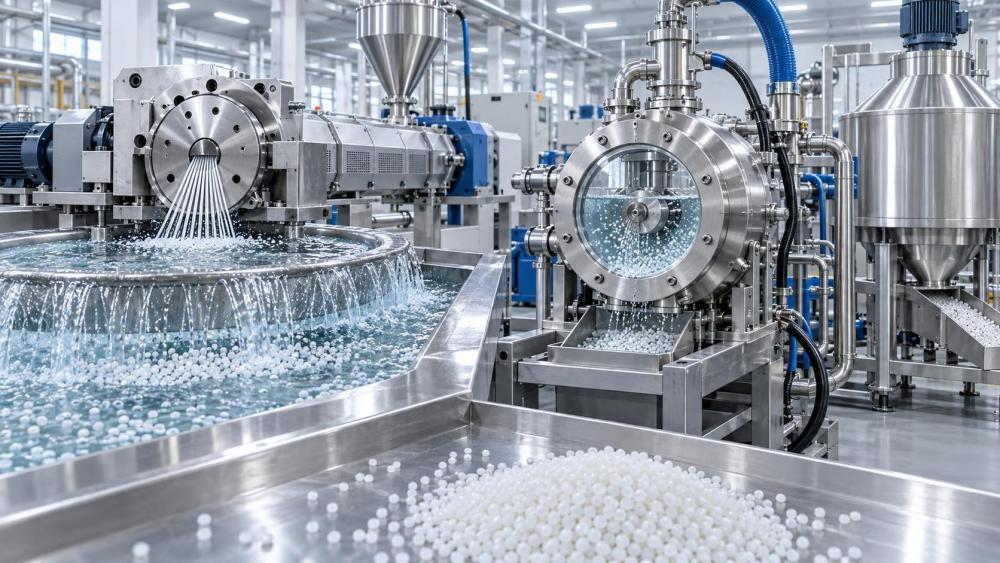
Neither system is universally better. Water-ring pelletizing is usually a practical choice for many commodity resins, masterbatches, filled compounds, and recycling applications with moderate production requirements.
Underwater pelletizing generally offers more controlled cooling and more consistent pellet formation when processing high-output lines, sensitive engineering polymers, sticky materials, or formulations with narrow processing windows.
The most important difference is where cooling occurs. Water-ring systems cut pellets at an exposed die face, while underwater systems cut pellets inside a pressurized water chamber.
That distinction influences die temperature control, pellet cooling speed, pellet shape, startup behavior, water handling, equipment complexity, and the likelihood of issues such as agglomeration or pellet deformation.
Buyers should therefore compare the complete operating model instead of only comparing initial machine price. A lower-cost pelletizer can become expensive when scrap, downtime, or inconsistent output increases.
How Water-Ring Pelletizing Works
In a water-ring pelletizing system, molten polymer exits through multiple die holes positioned around the perimeter of a die plate. Rotating knives cut the melt strands immediately.
Water flows around the die face in a ring-shaped chamber, cooling and carrying the cut pellets away from the cutting area. The pellets then travel to separation and drying equipment.
The die face is typically exposed to the surrounding environment rather than enclosed in a pressurized water chamber. This gives operators relatively direct access during inspection and maintenance.
Water-ring systems commonly include an extruder, melt pump when required, screen changer, pelletizer, water circulation loop, centrifugal dryer, and pellet collection or conveying equipment.
They are widely used for polyolefins, some filled compounds, color masterbatch, calcium-carbonate-filled materials, recycled PP, recycled PE, and other formulations with stable melt behavior.
Because the system is comparatively straightforward, it can be easier for production teams to understand, operate, and troubleshoot. Its compact configuration also benefits facilities with limited floor space.
However, the exposed cutting environment can make water-ring systems more sensitive to changing melt viscosity, die buildup, inconsistent feedstock, and materials that remain tacky during early cooling.
How Underwater Pelletizing Works
Underwater pelletizing also cuts molten polymer at the die face, but the die plate, cutting knives, and pellet discharge area operate inside a sealed, water-filled cutting chamber.
Pressurized process water contacts the pellets immediately after cutting. The water rapidly removes heat and transports pellets through piping toward a dryer, classifier, or collection system.
The enclosed chamber allows more precise control of water temperature, pressure, flow rate, and die-face conditions. These controls can improve stability for difficult or high-value polymer formulations.
Underwater pelletizing lines are often paired with sophisticated automation, including automatic startup sequences, die-face heating controls, pressure monitoring, water treatment, and integrated process diagnostics.
This technology is frequently used for virgin resin production, engineering plastics, hot-melt materials, thermoplastic elastomers, high-output compounding, and applications requiring consistent pellet geometry.
It can also be valuable when a polymer must be cooled immediately to prevent sticking, oxidation, deformation, or uncontrolled crystallization. These concerns are common in demanding specialty material processing.
The tradeoff is greater capital cost and a more complex maintenance environment. Operators must manage a sealed water system, pressure-sensitive components, filtration, seals, valves, and process instrumentation.
Water-Ring vs. Underwater Pelletizing: Core Technical Differences
The main comparison begins with cooling intensity. Underwater systems deliver immediate, enclosed cooling, while water-ring systems provide cooling around an exposed die face after the pellet is cut.
Underwater cooling is usually more uniform because the water environment is tightly controlled. This can reduce pellet sticking and support better consistency when melt temperatures fluctuate slightly.
Water-ring cooling is often sufficient for materials that solidify quickly and maintain stable viscosity. It may become less forgiving when polymers are soft, low-viscosity, or highly heat-sensitive.
Pellet shape is another important distinction. Underwater systems often produce more uniform, rounded pellets because cutting and cooling occur in a controlled chamber with stable water flow.
Water-ring systems can also produce good pellet quality, but shape consistency may depend more heavily on knife condition, die cleanliness, melt pressure stability, cooling-water balance, and formulation behavior.
Throughput requirements also influence selection. Underwater pelletizers are commonly engineered for high production capacities and continuous production environments where stable output has significant economic value.
Water-ring lines can handle substantial throughput, but their practical operating range depends on polymer type, die design, water management, and the plant’s tolerance for adjustment during production changes.
Maintenance access differs as well. Water-ring equipment can provide faster physical access to the die and knives, while underwater systems may require more structured shutdown and service procedures.
Yet maintenance frequency should not be judged by access alone. A stable underwater process can reduce unplanned intervention for materials that repeatedly cause buildup, stringing, or pellet agglomeration.
Material Suitability: Which Polymers Fit Each Technology?
Water-ring pelletizing is commonly appropriate for polypropylene, polyethylene, polyethylene compounds, mineral-filled polyolefins, many masterbatches, and recycled materials with predictable processing characteristics.
It is especially attractive where operators need a reliable, economical system for multiple general-purpose formulations without the cost and control requirements of a fully enclosed underwater process.
Filled compounds require careful evaluation. Glass fiber, talc, calcium carbonate, flame retardants, and other additives can change melt viscosity, die wear, and cooling behavior substantially.
For some filled materials, water-ring pelletizing performs effectively when die design and knife settings are optimized. For highly loaded or abrasive compounds, durability and consistency must be verified.
Underwater pelletizing is often preferred for engineering plastics such as PA, PBT, PET, PC, TPU, TPE, and selected high-temperature or performance-oriented compounds.
It is also frequently used for materials that remain soft or sticky after cutting, including certain elastomeric products, hot-melt formulations, adhesives, and polymers requiring rapid thermal stabilization.
Polymer grade alone should never determine the decision. Moisture sensitivity, additives, melt temperature, residence time, volatility, viscosity curve, production rate, and downstream handling requirements are equally important.
For recycled polymers, contamination and property variability add another layer of risk. A pelletizing trial using representative feedstock is often more valuable than selection based on generic material categories.
Pellet Quality, Drying, and Downstream Processing
Pellet quality affects more than appearance. Size distribution, shape, surface condition, residual moisture, fines content, and bulk density influence conveying, blending, drying, packaging, and final product consistency.
Uniform pellets generally flow more predictably through hoppers, gravimetric feeders, and pneumatic conveying systems. They can also improve dosing accuracy in compounding, injection molding, and extrusion operations.
Underwater pelletizing can support narrow pellet-size distribution when pressure, water flow, knife speed, and melt throughput remain properly balanced. This is useful for automated downstream production.
Water-ring systems can meet demanding quality requirements as well, particularly for stable formulations. However, process changes may show more quickly through tails, irregular pellets, fines, or partially fused material.
Drying performance deserves close attention in both systems. Water must be effectively separated from pellets before storage because excessive moisture can affect hygroscopic polymers and create handling problems.
For polymers such as nylon, PET, PBT, and certain thermoplastic polyurethanes, moisture control is already critical. Pelletizer selection should support the broader material drying and storage strategy.
Procurement teams should request pellet samples, particle-size data, moisture specifications, bulk-density measurements, and evidence of stable operation at intended commercial throughput before approving equipment.
Capital Cost, Operating Cost, and Maintenance Tradeoffs
Water-ring pelletizing usually has a lower initial investment than a comparable underwater system. Its simpler mechanical layout can reduce the financial barrier for smaller lines or cost-sensitive expansions.
That advantage is meaningful when production volumes are moderate, materials are stable, and product specifications do not require the highest level of pellet uniformity or enclosed process control.
Underwater pelletizing requires a larger investment in the cutting chamber, water handling, pressure controls, automation, piping, instrumentation, and supporting separation or drying equipment.
Its economic case improves when output is high, scrap is costly, production runs are long, or material value justifies tighter quality control. Downtime reduction can outweigh higher acquisition cost.
Operating expenses should include electricity, process-water treatment, filtration, knife replacement, die maintenance, spare parts, labor, cleaning time, dryer performance, and expected production losses.
Water quality is a frequently underestimated cost factor. Contaminated process water can affect cooling efficiency, wear components, clog passages, increase cleaning frequency, and compromise consistent pellet handling.
For both technologies, the best financial comparison uses total cost of ownership over several years. Buyers should model expected throughput, uptime, yield, maintenance hours, and off-spec material costs.
How to Choose the Right System for Your Production Line
Start with the polymer and formulation. Identify melt temperature, viscosity, additives, filler loading, moisture sensitivity, thermal stability, stickiness, and the expected variation in incoming raw materials.
Next, define commercial requirements. Specify annual output, hourly throughput, acceptable pellet-size range, required uptime, changeover frequency, labor availability, quality targets, and downstream equipment constraints.
Then assess process risk. Materials that form tails, stick to the die, degrade at elevated temperature, or fluctuate in viscosity may benefit from the more controlled environment of underwater pelletizing.
Water-ring technology is often appropriate when the formulation is well understood, the line requires accessible maintenance, and the business objective favors a balanced combination of cost and dependable output.
Underwater technology is often justified when production must run continuously at high capacity, pellet consistency is commercially important, or the material has a narrow and demanding processing window.
Equipment suppliers should be asked for documented trials using the actual resin, filler package, additives, and target throughput. Generic demonstrations using a different polymer can hide important risks.
Review the entire line, not only the pelletizer. Extruder torque, screw design, melt filtration, pump stability, cooling-water capacity, dryer selection, conveying, and automation all affect final results.
Finally, involve production, maintenance, quality, procurement, and product-development teams early. A technically suitable machine can still fail commercially when service support, spare parts, or operator capability are insufficient.
Common Selection Mistakes to Avoid
A common mistake is selecting solely by purchase price. Lower initial cost may be attractive, but frequent stoppages, pellet defects, and high scrap rates can quickly eliminate the expected savings.
Another mistake is assuming that every polymer within the same family behaves identically. Different molecular weights, recycled content levels, pigments, fillers, and additives can alter pelletizing behavior significantly.
Some buyers underestimate startup and changeover needs. Plants producing many colors, grades, or small batches should evaluate cleaning access, material transition time, and operating procedures carefully.
Ignoring water management is also risky. Water temperature, contamination, filtration, circulation rate, and drying efficiency are process variables, not secondary utilities that can be addressed later.
Finally, do not rely only on nominal capacity. Request evidence of stable output at the required formulation, pellet specification, and operating duration, including realistic startup and shutdown conditions.
Conclusion: Make the Choice Based on Process Risk and Business Value
Water-ring and underwater pelletizing systems both serve important roles in polymer manufacturing. Their shared purpose is converting molten polymer into usable pellets, but their operating environments are fundamentally different.
Water-ring pelletizing is generally a cost-effective, compact, and accessible solution for stable materials and many conventional compounding or recycling applications. It can deliver strong performance with proper process control.
Underwater pelletizing provides faster, more controlled cooling and is often the stronger option for high-throughput production, challenging polymers, sensitive formulations, and strict pellet-consistency requirements.
When evaluating what is the difference between water-ring and underwater plastic pelletizing systems, focus on material behavior, expected throughput, quality targets, maintenance capability, and total ownership cost.
A structured trial with real production material remains the most reliable final step. It turns a general technology comparison into an evidence-based investment decision for the specific production line.
Have questions about this sector analysis, or seeking best practices specific to your niche? Drop us a line below and let the senior consultants at APIM assist you.
We respect your privacy. Your information is strictly confidential.
Related News
- 00
0000-00
Do polyolefin hot melt adhesives bond well to polyethylene? - 00
0000-00
Korean Study Finds PLA Barely Degrades in Landfill After 320 Days - 00
0000-00
How to assess batch consistency from a thermal potting compounds supplier - 00
0000-00
How much weight can carbon fiber reinforced plastics save in cars? - 00
0000-00
Switching from PS to ABS Sheet Extrusion: Equipment Checks
Tag
- engineering plastics
- pelletizing systems
- recycled polymers
- TPU
- PET
- PBT
- masterbatch
- extrusion equipment
- plastic pelletizing
- melt filtration
- screw design
- underwater pelletizing
- underwater pelletizing systems
- engineering polymers
- gravimetric feeders
- color masterbatch
- what is the difference between water-ring and underwater plastic pelletizing systems