




Vietnam Tightens REACH Proof for PCR Resin Imports
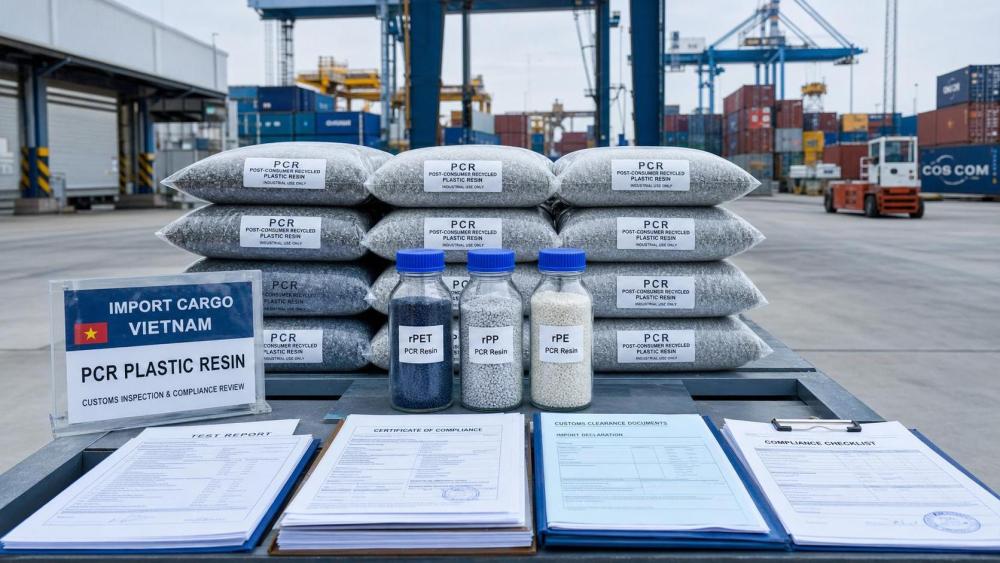
From July 16, 2026, Vietnam will require import shipments of recycled plastic pellets produced through PCR Plastic Washing & Pelleting, including rPET, rPP and rPE, to carry REACH SVHC screening reports from Vietnam-recognized laboratories together with a declaration of conformity. For exporters, importers, procurement teams and supply chain operators handling PCR resin trade, this is not just a paperwork update. It raises the documentary threshold at the point of customs clearance and links missing compliance evidence directly to cargo detention and return procedures at key ports.
What the new import requirement clearly changes
According to the provided information, Vietnam's Ministry of Industry and Trade and the General Department of Customs issued a joint notice stating that, starting on 2026-07-16, all imported recycled plastic pellets generated from the PCR Plastic Washing & Pelleting process must be accompanied by a REACH SVHC screening report issued by a laboratory recognized by Vietnam, along with a declaration of conformity.
The requirement covers rPET, rPP and rPE within that product scope. The same information states that non-compliant cargo will be detained on site at Ho Chi Minh Port and Hai Phong Port, and return procedures will then be initiated. The notice therefore connects document completeness and compliance status directly to port release conditions.
The provided summary also makes clear that this change materially increases document delivery requirements and certification-related costs for Chinese exporters of PCR pellets.
Where the pressure will show up across the trade chain
Export shipments now face a stricter pre-clearance document burden
From an industry perspective, exporters shipping PCR pellets into Vietnam are likely to feel the impact first because the new rule is tied to import entry documentation. The practical effect is concentrated in shipment preparation, compliance file assembly and release risk. What deserves closer attention is that the required report must come from a Vietnam-recognized laboratory, which turns laboratory qualification into part of the transaction risk rather than a secondary technical detail.
Import and procurement teams will need tighter supplier document control
Importers and buyers sourcing rPET, rPP or rPE into Vietnam may be affected through supplier onboarding, purchase order conditions and cargo acceptance checks. Analysis shows that the issue is no longer limited to product availability or price. Whether suppliers can provide the required REACH SVHC screening report and declaration of conformity in the expected format may now influence purchasing decisions, shipment timing and customs readiness.
Logistics and customs-facing service providers may see higher execution sensitivity
For supply chain service providers involved in booking, customs coordination and delivery scheduling, the rule introduces a sharper link between document readiness and port operations. Because the provided information specifically mentions detention and return procedures at Ho Chi Minh Port and Hai Phong Port, service teams handling those routes may need to watch submission timing, document consistency and handover completeness more closely.
Testing and certification-related work becomes more operationally relevant
Observably, the requirement also gives more weight to testing and conformity documentation within the PCR pellet trade flow. The impact is not only technical. It reaches quotation preparation, export file completion and shipment release planning, especially for businesses that previously treated compliance reports as supporting materials rather than mandatory clearance documents.
What companies should watch in current execution
Check whether existing reports match the new acceptance condition
Companies trading affected PCR pellets should review whether their current REACH-related documents align with the newly stated requirement, especially the need for an SVHC screening report issued by a Vietnam-recognized laboratory and an accompanying declaration of conformity. Analysis shows that having a test report alone may not be enough if the issuing body or supporting declaration does not match the required form.
Reassess shipment timing against documentary lead time
The provided information points to immediate customs consequences for non-compliant cargo, so businesses should pay attention to the time needed to secure qualifying reports and prepare complete files before shipment or before cargo reaches port. This is particularly relevant where delivery schedules are tight and documents are often finalized late in the export cycle.
Review contract and procurement language around compliance responsibility
For buyers, sellers and intermediaries, a practical point of attention is how compliance responsibility is assigned in purchase documents and delivery arrangements. It is more appropriate to understand this as a rule change that can move documentary risk back into commercial terms, especially where responsibility for testing, declarations and rework of non-compliant shipments is not clearly addressed.
Continue monitoring how the rule is applied in practice
The supplied information confirms the requirement and the detention consequence, but it does not provide fuller implementation detail. Companies should therefore keep watching for further clarification in official wording, acceptance practice, document review standards and any updates affecting execution at the named ports.
Why this reads as an enforcement signal, not only a policy notice
Analysis shows that this development is better understood as an implemented trade-compliance signal rather than a general policy direction. The reason is the direct connection between required REACH proof and port detention for cargo that does not meet the standard. At the same time, it should not yet be overstated as a fully transparent execution framework, because the input does not provide more detailed operating criteria beyond the report, declaration and detention consequence.
From an industry perspective, the key issue is that compliance evidence is moving closer to being a release prerequisite for affected PCR pellets. That changes how exporters and buyers need to think about testing, document sequencing and shipment readiness.
How this update is best understood for now
At this stage, the most reasonable reading is that Vietnam's July 16 measure marks a concrete tightening of import compliance requirements for certain PCR recycled plastic pellets, with immediate relevance to customs handling and delivery risk. It is more appropriate to understand this as a landed rule change with practical enforcement implications, while still recognizing that the market will need to observe how documentation standards and execution consistency develop in practice.
For companies active in this trade flow, the immediate significance lies less in broad market interpretation and more in whether their compliance files, testing arrangements and shipment preparation can meet the new documentary threshold without disrupting delivery.
Basis of this article and what still needs verification
This article is generated on the basis of the user-provided news title, event date and event summary. For developments of this kind, commonly relevant source categories may include official notices, releases from regulatory authorities, customs or trade administration information, industry association updates, standard-setting documents and reporting by authoritative media.
No specific official source link was provided in the input, so the exact official publication path still needs to be verified on an ongoing basis. Observably, further attention should remain on later policy detail, certification interpretation, execution standards, procurement document changes, industry feedback and how affected companies implement the requirement in actual shipments.
Have questions about this sector analysis, or seeking best practices specific to your niche? Drop us a line below and let the senior consultants at APIM assist you.
We respect your privacy. Your information is strictly confidential.
Related News
- 00
0000-00
Do polyolefin hot melt adhesives bond well to polyethylene? - 00
0000-00
Korean Study Finds PLA Barely Degrades in Landfill After 320 Days - 00
0000-00
How to assess batch consistency from a thermal potting compounds supplier - 00
0000-00
How much weight can carbon fiber reinforced plastics save in cars? - 00
0000-00
Switching from PS to ABS Sheet Extrusion: Equipment Checks